Many custom options...


And formats...



Heaven in Chinese / Japanese...
Buy a Heaven calligraphy wall scroll here!
Personalize your custom “Heaven” project by clicking the button next to your favorite “Heaven” title below...
1. Heaven
3. Grace from Heaven / Grace from God
4. Voice of Heaven / Voices from Heaven
7. Destiny Determined by Heaven
9. Oneness of Heaven and Humanity
10. Angel / Messenger of Heaven
12. Heaven Sent
13. Heaven Blesses the Diligent
15. Heaven and Earth
16. Grace from Heaven / Grace from God
17. Warrior of the Heavenly Realm
19. Blue Sky
Heaven
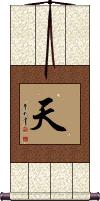
天 means “heaven” or “sky” in Chinese, Japanese Kanji, and old Korean Hanja.
The context determines if you are talking about heaven or the sky above (often they are the same concept).
When combined with other characters, words like “today” and “tomorrow” are created. While sometimes the character for “sun” is used to mean “day,” often “sky” represents “day” in Asian languages.
Example: 今天 (this sky) = “today,” 明天 (next sky) = “tomorrow” in modern Chinese and Japanese.
In Chinese culture, regardless of which religion, it's almost always assumed that God (and any other deities) live up above the sky. The concept of God living in the sky is likely the reason heaven is associated with this character.
The equation goes something like this: God's domain is the sky, thus, the sky is heaven.
Note: As a single character, this is a little ambiguous, so you might want to choose our Kingdom of Heaven selection instead.
Kingdom of Heaven
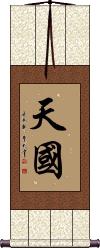
天國 is the very Christian way to refer to the “Kingdom of Heaven” in Chinese, old Korean, and Japanese. 天國 is also the translation for “paradise.”
The first character means “Heaven.” The second character means “kingdom” but, in modern times, has been extended to mean “country” (but no one will translate this particular character combination as “Heaven Country”). 天國 is the ancient version of this word, as in modern times (after WWII), the second character was simplified in mainland China and Japan.
Kingdom of Heaven
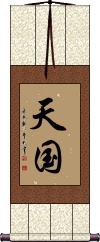
天国 is the same meaning and pronunciation as our other entry for “Kingdom of Heaven,” but the second character was simplified in Japan and mainland China to this version.
Choose the appearance that you like best (they will be somewhat universally understood - as most people are aware of this simplification in places where they still use all traditional characters - such as Taiwan and Hong Kong). You can consider the other version to be the “ancient version.”
Grace from Heaven / Grace from God
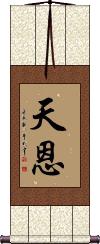
天恩 is the deepest way to say “Heaven's Grace” or “God's Grace” in Chinese.
The first character means Heaven or sky (referring, in this case, to the domain of God).
The second character means grace, blessings, benevolence, favor/favour, acts of kindness, merits, or beneficial influence.
This title can also be defined as:
Blessings of Heaven, Favor of the Emperor, Divination's luckiest day, or blessings of nature. Note: When you see “Emperor” above, remember that the Emperor, like the Pope, is theoretically chosen by God or seen as an emissary or conduit of God in ancient Asian culture. It would only be read that way in a certain context, such as “The Emperor, in his mercy, bestowed upon him Heaven's Grace, and the prisoner was set free.”
Note: Technically, this is a Japanese word too (pronounced "ten-on") but it’s rarely used in Japan anymore. Therefore, this title is best if your audience is Chinese.
Voice of Heaven / Voices from Heaven
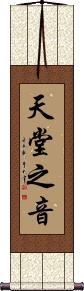
天堂之音 is a title that can be translated as either “voice of heaven” or “voices from heaven.”
The first two characters mean heaven.
The third character is a possessive article (kind of like making heaven into heaven's).
The last character means voice but can also mean sound.
Note: This can be pronounced in Korean, but it's not a commonly used term.
Blessed by Heaven
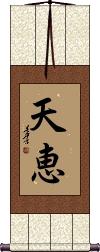
天恵 means “Heaven's Blessing,” “Blessings from Heaven,” or “Blessed by Heaven” in Japanese Kanji.
Depending on the context in which this is used, it can also mean “gift of nature,” or even “natural resources” (as in Heaven or God bestowed things like oil, iron, gold, and other natural resources upon mankind).
Heaven Rewards Hard Work
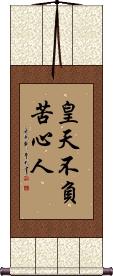
皇天不负苦心人 is an inspirational Chinese proverb that can be translated in a few ways:
Heaven will not disappoint the person who tries.
If you try hard, you're bound to succeed eventually.
Heaven rewards diligent work.
Sincere/heartful effort reaps the grace of Heaven.
Destiny Determined by Heaven
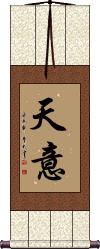
天意 is a way to express destiny in a slightly religious way.
天意 means “Heaven's Wish” or “Heaven's Desire,” with the idea of fate and destiny being derived as well. It suggests that your destiny comes from God / Heaven and that your path has already been chosen by a higher power.
My Japanese dictionary defines this word as “divine will” or “providence,” but it also holds the meaning of “the will of the emperor.” Therefore, I don't suggest this phrase if your audience is Japanese - it feels strange in Japanese anyway.
Heaven Blessing
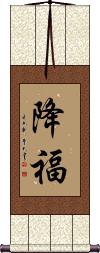
降福 is a Chinese word that means blessings from heaven.
Oneness of Heaven and Humanity
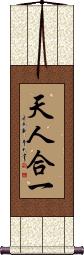
天人合一 is a title that represents the oneness of heaven and humanity. It conveys the idea that man is an integral part of nature.
You can also read this as “heaven and man in unity,” or “nature and man in unity.” The “man” is really “people” or “humans” and is not gender-specific in Chinese.
Angel / Messenger of Heaven
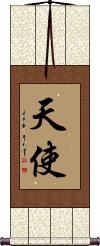
天使 is the meaning of Angel in Chinese, Japanese Kanji, and old Korean Hanja.
The first character means heaven. The second means messenger. Together it makes sense that we are talking about angels as Heaven's Messengers.
If you are an “Angel Junkie,” this may be the wall scroll for you.
I also think it's a great choice if your name happens to be Angel.
See Also: Angel
Warrior of Heaven
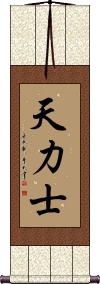
天力士 means “Heavenly Warrior,” or “Hero of Heaven,” in Chinese, old Korean, and Japanese.
Often used in a Buddhist context.
Heaven Sent
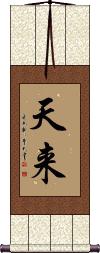
天来 is a Chinese and Japanese title that means: heavenly; divine; inspired; heaven sent.
This can also be the Japanese surname Tenrai or Japanese female given names Takara or Sora.
Heaven Blesses the Diligent
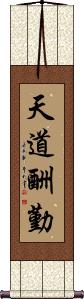
天道酬勤 can be interpreted in a few different ways:
God blesses those who work hard.
It is the way of Heaven to smile on the diligent.
God will reward those that are worthy.
Heaven blesses those who are diligent.
Whichever translation you like, a scroll like this on your wall may serve as a reminder to work hard because your diligence will pay off both in this life and the next.
Note: This can be pronounced in Korean, but it's not a commonly used term.
One Family Under Heaven
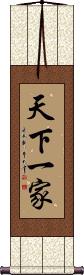
天下一家 is a proverb that can also be translated as “The whole world is one family.”
It is used to mean that all humans are related by decree of Heaven.
The first two characters can be translated as “the world,” “the whole country,” “descended from heaven,” “earth under heaven,” “the public,” or “the ruling power.”
The second two characters can mean “one family,” “a household,” “one's folks,” “a house” or “a home.” Usually, this is read as “a family.”
Note: This proverb can be understood in Japanese, though not commonly used.
Heaven and Earth
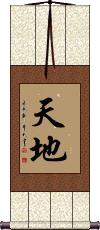
天地 is “Heaven and Earth” in Chinese, Japanese Kanji, and old Korean Hanja.
This title is used in many different contexts. It can be a general term but is also used by Buddhists and in other religions.
This can also be used to refer to all of nature, the universe, the top and bottom, the realm of life, or the sphere of existence.
Grace from Heaven / Grace from God
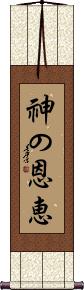
神の恩恵 means God's Grace in Japanese.
The first two characters act to create a word that means “divine,” “God's,” or “The Spirit's.”
The last two Kanji mean grace, favor/favour, blessing, or benefit.
Warrior of the Heavenly Realm
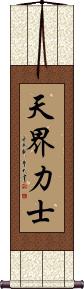
天界力士 means “warrior of the heavenly realm” in Chinese, old Korean Hanja, and Japanese Kanji.
This is also known as Narayana in Buddhism.
Archangel / Arch Angel
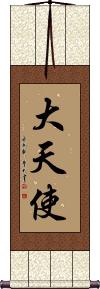
大天使 is the title Archangel in Chinese characters, Japanese Kanji, and old Korean Hanja.
The first character means big or great (in this case, it means “arch”).
The second means heaven (or sky).
The last means messenger.
The second and third characters together make the title for angel, which is literally “Heaven's Messenger.”
This title would be understood as “The Chief of all Angels,” or “The Great Angel.” Some might even say it's the boss of Angels.
See Also: Angel
Blue Sky
The Blue Dome of Heaven
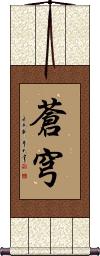
蒼穹 is a poetic way to express “sky” in Chinese and Japanese Kanji.
It's like saying, “The blue dome of heaven,” or a way to say “blue sky” within a poem.
Fatal error: Cannot redeclare foreignPrice() (previously declared in /home/gwest/web/chinesescrollpainting.com/public_html/includes/currencyconverter.php:22) in /home/gwest/web/orientaloutpost.com/public_html/includes/currencyconverter.php on line 22