Many custom options...


And formats...



Humble in Chinese / Japanese...
Buy a Humble calligraphy wall scroll here!
Personalize your custom “Humble” project by clicking the button next to your favorite “Humble” title below...
1. Humble
2. Humble / Modesty / Humility
8. Daughter
9. Mistress / Concubine / Servant
10. Kyojitsu: Falsehood and Truth
11. Dogen
12. Even a fool may sometimes come up with a good idea
13. A Wise Man Changes His Mind
15. Modesty
Humble
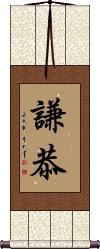
Humble / Modesty / Humility
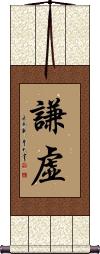
謙虚 is the most common way to say humble or modest in Japanese without a derogatory meaning (some other words suggest weakness, but this version holds a better humble meaning).
In Japanese, the first Kanji means self-effacing, humble oneself, and modesty. The second means void or emptiness.
See Also: Moderation
Humility / Being Humble
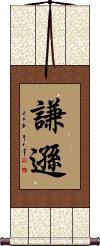
謙遜 can also be translated as being modest, humble, or unpretentious.
Being humble is considering others to be as important as yourself. You are thoughtful of their needs and willing to be of service. You don't expect others or yourself to be perfect. You learn from your mistakes. When you do great things, humility reminds you to be thankful instead of boastful.
This Humility title is also used as one of the 8 key concepts of Tang Soo Do. Often romanized as “Kyum Son.”
Also sometimes used in Japanese to express humility with an essence of modesty.
Humble / Modest
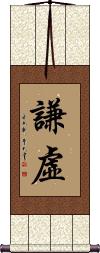
謙虛 can also be translated as humbleness or humility.
In Chinese and Korean, the first character means “modest.” The second means “empty.” Together these characters reinforce the ideas of modesty and being empty of ego.
 In Japan, they tend to use a slightly-simplified version of the second Kanji for this word. It also happens to be an alternate/simplified version used in China too. If you want to order the modern Japanese/simplified version, just click in the Kanji image shown to the right, instead of the button above.
See Also: Moderation
Moderation / Temperance
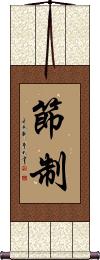
節制 means moderation or temperance in Chinese, Japanese Kanji, and old Korean Hanja.
Moderation is creating a healthy balance in your life between work and play, rest and exercise. You don't overdo or get swept away by the things you like. You use your self-discipline to take charge of your life and your time.
節制 can also be translated as sobriety or self-restraint.
This is often used as part of the Seven Heavenly Virtues to represent sobriety and/or temperance.
Calm and Open Mind
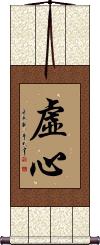
虛心 is a Buddhist term that speaks of being open-minded and/or having a calm and humble mind or heart.
God Forgive Me
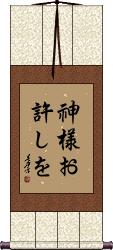
神様お許しを is how to write “God Forgive Me” in Japanese.
There is an essence of humble begging or “please” implied in this phrase.
Note: Because this selection contains some special Japanese Hiragana characters, it should be written by a Japanese calligrapher.
Daughter
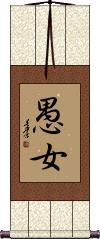
愚女 is a humble title for “daughter” in Japanese.
If you literally define each character, you get “silly girl” or “foolish woman.”
Mistress / Concubine / Servant
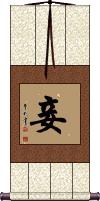
妾 is the most simple way to say concubine or mistress in Chinese, Japanese Kanji, and old Korean Hanja.
Sometimes this can mean servant. Occasionally, a woman may use this title in place of “I” or “me” to say “your humble servant” in a self-deprecating way.
Kyojitsu: Falsehood and Truth
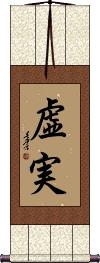
虚実 is a Japanese word that means “falsehood [and] truth” or “fiction [and] fact.”
This concept is used in warfare, gameplay, and martial arts strategies. 虚実 can be a strategy of real and/or deceptive moves. This gets to some Sun Tzu Art of War stuff where in warfare a strategic move is either a real and serious move or it is a deceptive blow.
Let's explore each character in more depth:
虚 was originally written 虛 (there is a very subtle difference in the strokes at the bottom of the character) and means unpreparedness, falsehood, emptiness, void, abstract theory, empty or unoccupied, diffident or timid, false, humble or modest, virtual, or in vain.
In the Buddhist context, 虛 represents the Pali/Sanskrit word “śūnya,” meaning empty, vacant, unreal, unsubstantial, untrue, space, humble, or in vain.
In ancient Eastern/Chinese astronomy, 虛 represents the “Emptiness” constellation (one of the 28 mansions in the sky).
実 was originally 實 in Chinese (they currently write it as 实 in Simplified Chinese) with the meaning, truth, reality, sincerity, honesty, fidelity, and substance.
The Buddhist context is similar, adding real, true, honest, really, solid, definitely, sincere, solid, fixed, full, to fill, fruit, kernel, verily, in fact, the supreme fact, or ultimate reality to the definition.
Dogen
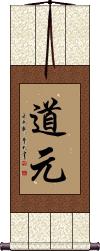
Usually, when people are looking for 道元 or “Dogen,” they are referring to the Japanese Zen monk by this name.
He lived from 1200-1253. This Dogen name or title literally means “The Way Origin” or “Beginning of the Path.” It is understood to mean “beginning of right doctrine or faith” in the context of his name and work to establish the Sōtō school of Zen in Japan.
To accomplish that task, this humble monk traveled from Japan and across China to find the more original or pure forms of Buddhism.
Even a fool may sometimes come up with a good idea
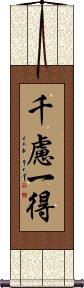
千慮一得 means “1000 tries, one success,” or “[a] thousand tries [leads to] one success.”
This proverb is a humble way to express your success, ideas, or accomplishments. As if you are a fool who just got lucky in inventing or creating something.
Translations for this proverb include:
Even without any notable ability on my part, I may still get it right sometimes by good luck.
Even a fool may sometimes come up with a good idea.
Compare this to the English idiom, “Even a broken clock is right twice a day.”
A Wise Man Changes His Mind (but a fool never will)
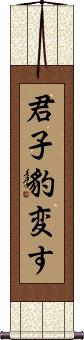
君子豹変す is a Japanese proverb that suggests that a wise man is willing to change his mind, but a fool will stubbornly never change his.
The first word is 君子 (kunshi), a man of virtue, a person of high rank, a wise man.
The second word is 豹変 (hyouhen), sudden change, complete change.
The last part, す (su), modifies the verb to a more humble form.
The “fool” part is merely implied or understood. So if wise and noble people are willing to change their minds, it automatically says that foolish people are unwilling to change.
Korean CKD Virtues
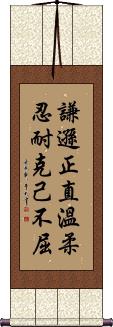
谦逊正直温柔忍耐克己不屈 are the virtues used by Choi Kwang Do Martial Arts.
| English | Hanja | Hangul | Pronunciation |
| 1. Humility (Humble / Modesty) | 謙遜 | 겸손 | gyeom son |
| 2. Honesty (Integrity) | 正直 | 정직 | jeong jig |
| 3. Gentleness | 溫柔 | 온유 | on yu |
| 4. Perseverance (To Endure) | 忍耐 | 인내 | in nae |
| 5. Self-Control (Self-Restraint) | 克己 | 극기 | geug gi |
| 6. Unbreakable Spirit (Unyielding / Unbending) | 不屈 | 불굴 | bur gur |
The characters shown here are in the ancient Korean Hanja form of writing. If you wish for a Korean Hangul form of these tenets, we can arrange that with our Master Calligrapher Xing An-Ping (click on the Hangul next to the South Korean flag above to order this in Hangul).
Modesty
Depending on the context, 謙遜 can be translated as modesty, humbleness, or humility.
The first character means modesty, while the second means yielding. Together, it could be stated as “yielding modesty.”
See Also: Chastity | Prudence | Moderation
Fatal error: Cannot redeclare foreignPrice() (previously declared in /home/gwest/web/chinesescrollpainting.com/public_html/includes/currencyconverter.php:22) in /home/gwest/web/orientaloutpost.com/public_html/includes/currencyconverter.php on line 22