Many custom options...


And formats...



Hung Gar in Chinese / Japanese...
Buy a Hung Gar calligraphy wall scroll here!
Personalize your custom “Hung Gar” project by clicking the button next to your favorite “Hung Gar” title below...
1. Hung Gar
2. Hung Kuen
3. Hung Ga Kuen
4. Red Color
5. Five Families / Tsoi Li Hoi Fut Hung
10. Baby
11. Happy Birthday
12. Khánh
13. Sword of Death
Hung Gar
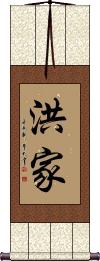
洪家 is the martial arts title Hung Ga or Hung Gar.
The first character means flood, big, immense, or great but it can also be the surname, Hong or Hung.
The last character means family or home.
This can also be read as “The Hung Family” or “The Hung Household.” This title is mostly associated with a style of Kung Fu.
Hung Kuen
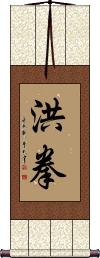
洪拳 is the martial arts title Hung Kuen.
The first character means flood, big, immense, or great but it can also be the surname, Hong or Hung.
The last character means fist.
Hung Ga Kuen
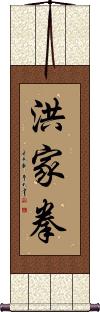
洪家拳 is the martial arts title Hung Ga Kuen.
The first character means flood, big, immense, or great but it can also be the surname, Hong or Hung.
The second character means family or home.
The last character is a fist.
Red Color
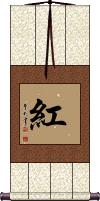
紅 is a single character that means red in Chinese, Japanese Kanji, and old Korean Hanja.
The perceived meaning of this character can be ambiguous. Most will see it as the color red but it can also mean Communist (just like it can in English). In Japanese, it can be a female given name “Rena,” or refer to red silk lining. In Chinese, red is a good luck color, and can refer to a bonus or revolutionary.
Five Families / Tsoi Li Hoi Fut Hung
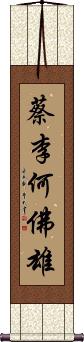
蔡李何佛雄 is the five families associated with San Soo Kung Fu.
The characters are always the same, but there are several ways these are romanized from Cantonese, Mandarin, and other dialects. Some common ones include Tsoi Li Hoi Fut Hung and Choi Li Ho Fut Hung.
If you are using a different romanization, that does not mean it's wrong. It might just be that your school is using a different dialect or romanization scheme.
Wing Chun Fist Maxims (Part 1)
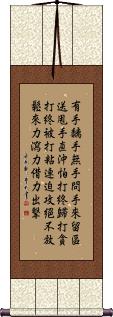
A customer asked me to split these Wing Chun maxims into two parts, so he could order a couplet. I thought this was a good idea, so it's been added here.
1 有手黐手,無手問手
2 來留區送, 甩手直沖
3 怕打終歸打, 貪打終被打
4 粘連迫攻, 絕不放鬆
5 來力瀉力, 借力出擊
A couplet is a set of two wall scrolls that start and finish one phrase or idea. Often, couplets are hung with the first wall scroll on the right side, and the second on the left side of a doorway or entrance. The order in Chinese is right-to-left, so that's why the first wall scroll goes on the right as you face the door.
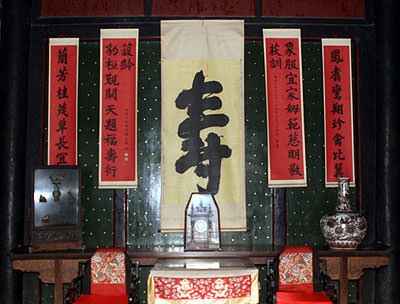
Of course, couplets can also be hung together on a wall. Often they can be hung to flank an altar, or table with incense, or even flanking a larger central wall scroll. See an example here from the home of Confucius
Be sure to order both parts 1 and 2 together. One without the other is like Eve without Adam.
Om Mani Padme Hum
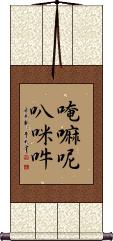
唵嘛呢叭咪吽 is the Avalokiteshvara mantra in Mandarin Chinese.
This chant is usually romanized as “Om Mani Padme Hum” from Sanskrit.
From Tibetan, it's “Om Mani Peme Hung.”
House of Good Fortune
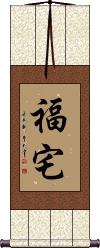
福宅 is perhaps the Chinese equivalent of “This blessed house” or perhaps “home sweet home.”
This phrase literally means “Good fortune house” or “Good luck household.” It makes any Chinese person who sees it feel that good things happen in the home in which this calligraphy is hung.
Happy Birthday
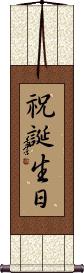
祝誕生日 is the shortest way to write “Happy Birthday” in Japanese.
The first Kanji means “wish” or “express good wishes,” and the last three characters mean “birthday.”
Because a birthday only lasts one day per year, we strongly suggest that you find an appropriate and personal calligraphy gift that can be hung in the recipient's home year-round.
Baby
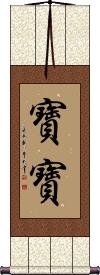
寶寶 is how Chinese people express “baby.”
The word is composed of the same character twice, and therefore literally means “double precious” or “double treasure.”
This would be a nice wall scroll to put either inside or by the door of your baby's room (not on the door, as wall scrolls swing around wildly when hung on doors that open and close a lot).
Happy Birthday
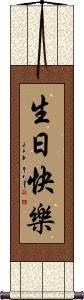
生日快樂 is how to write “Happy Birthday” in Chinese.
The first two characters mean “birthday,” and the second two characters mean “happiness,” or rather a wish for happiness.
Because a birthday only lasts one day per year, we strongly suggest that you find an appropriate and personal calligraphy gift that can be hung in the recipient's home year-round.
Khánh
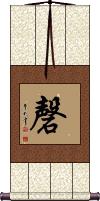
磬 means “chime stones,” but I'm including it here for those looking for the original Chinese character for the Vietnamese name Khánh.
Other definitions include ancient percussion instrument made of stone or jade pieces hung in a row and struck as a xylophone, sounding stone, ancient Chinese chime shaped like a chevron.
There is also a possibility that your original character is 慶 which means to celebrate or felicity. Contact me if you need that character.
Sword of Death
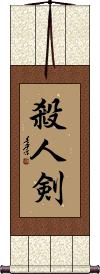
殺人剣 is a Japanese title for “Death Sword,” “Life Taking Sword,” or “satsujinken.”
This is the opposite of katsujinken or the “life-saving sword.” This title is not as commonly used in Japanese but pairs well when hung with katsujinken.
The first two Kanji are a word that translates as homicide, murder or kill (a person). 殺人剣 is specifically to kill a person (as the second character means person or human) as opposed to an animal, etc.
The last Kanji is the Japanese variant of the originally-Chinese character for a sword.
See Also: Katsujinken
Fatal error: Cannot redeclare foreignPrice() (previously declared in /home/gwest/web/chinesescrollpainting.com/public_html/includes/currencyconverter.php:22) in /home/gwest/web/orientaloutpost.com/public_html/includes/currencyconverter.php on line 22