Many custom options...


And formats...



Imagination in Chinese / Japanese...
Buy an Imagination calligraphy wall scroll here!
Personalize your custom “Imagination” project by clicking the button next to your favorite “Imagination” title below...
Imagination
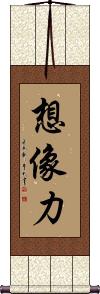
想像力 is probably the best way to express “imagination” in Chinese, Japanese Kanji, and old Korean Hanja.
It literally means “your strength to imagine.” The last character means strength or ability, while the first two mean imagine or conceptualize. My Japanese dictionary defines this as “The power of imagination.” While my Korean dictionary says, “imaginative power.”
Imagine / Imagination
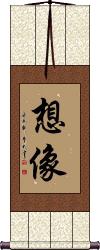
想像 is the shortest word for imagine, visualize, or imagination.
It can also mean “to guess,” (which is why I favor the 3-character version of imagination (just a third character is added to the end, which clarifies it).
Meditation
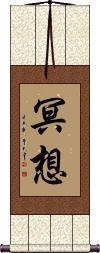
This encompasses the idea of meditation.
It's also a term used to describe a deep form of daydreaming, exploring one's imagination, the act of contemplating, or the idea of contemplation. 冥想 is often associated with Buddhism; however, the word “Zen” in Japanese (or “Chan” in Chinese) is probably more commonly used (or better known in the west).
See Also: Zen
Creativity
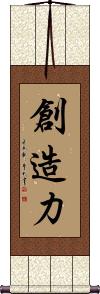
創造力 is a word that means “strength of creativity” or sort of “creativity (is your) strength.”
This can also be translated as “ingenuity.”
Creativity is the power of imagination. It is discovering your own special talents. Daring to see things in new ways and find different ways to solve problems. With your creativity, you can bring something new into the world.
The first character means “to create,” and the second means “to make or build.” Together they mean “creative.” The third character means “strength.”
Illusion
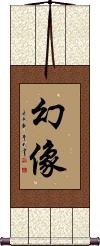
幻像 is a universal word for Illusion in Chinese, Japanese Kanji, and old Korean Hanja.
The first character means phantasm, vision, dream, illusion, apparition, or fantasy.
The second character means statue, picture, image, figure, portrait, shape, form, appearance, to be like, to resemble, to take after, to seem, or in rare/ancient context: an elephant.
 Note that the first character can be written without the left-side radical in Chinese. This form is shown to the right. Both forms are acceptable in Chinese but the character shown to the right is more likely to be read as "elephant."
See Also: Reality
Create / Creation
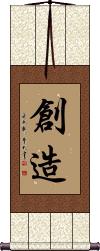
創造 means to create, to bring about, to produce, or simply creative or creation.
The first character here means to create, Genesis, or origin.
The second means to make or build.
Creative / Creativity
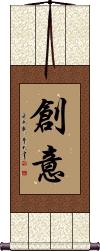
創意 is creative or creativity in Chinese characters, old Korean Hanja, and Japanese Kanji.
It can also refer to an original idea or originality.
Unbridled Creativity
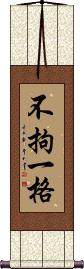
不拘一格 is a Chinese proverb that speaks of exploring different styles and not being stuck in conventional thinking.
It can also be translated as “not sticking to one pattern” or “not limited to one type (or style).” The most simple translation is “being creative” or “unbridled creativity.” Some may also say this means “not being stuck in a rut,” in the context of a designer or artist.
If you translate this, the first two characters mean “not stick to” or “not confine oneself to.”
The second two characters mean “one mode,” “one pattern,” “one form,” “one style,” or “one rule.”
Dream / Dreams
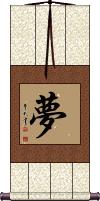
夢 is the very simple word for dreams in Chinese and Japanese.
It can also mean having a vision or simply an illusion.
Idea / Thought
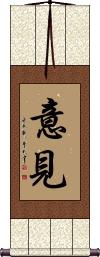
意見 means idea, thought, opinion, or view in Japanese.
This word also has a similar meaning in Chinese, just often used in China.
Idea / Thought
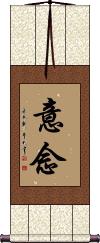
意念/意唸 means idea or thought in Chinese.
Thought / Thinking / Idea
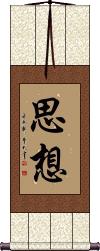
思想 means thought, thinking, or idea in Chinese, Japanese Kanji, and old Korean Hanja. Sometimes it can mean ideology, depending on context.
This can refer to someone's personality - like saying, “he is a thinker.”
Dream / Vision
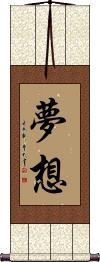
夢想 is the two-character version of dream or dreaming, which can mean “to dream of [something],” vision, imagine, or reverie.
Be careful, as, in some contexts, it can mean dreaming of something in vain.
Fatal error: Cannot redeclare foreignPrice() (previously declared in /home/gwest/web/chinesescrollpainting.com/public_html/includes/currencyconverter.php:22) in /home/gwest/web/orientaloutpost.com/public_html/includes/currencyconverter.php on line 22