Many custom options...


And formats...



Inner Peace in Chinese / Japanese...
Buy an Inner Peace calligraphy wall scroll here!
Personalize your custom “Inner Peace” project by clicking the button next to your favorite “Inner Peace” title below...
1. Inner Peace
2. Inner Peace / Silence / Serenity
3. Achieve Inner Peace; Find Deep Understanding
8. Worldwide Wish for Peace and Prosperity
9. Inner Bliss and Peace from Meditation
10. Reach Peace and Calm Through Meditation
11. Spiritual Peace / Enlightened Peace
12. Peace / Harmony
14. Peacefulness / Tranquility / Perfectly Quiet
16. Worldwide Peace
17. Peace of Mind
18. World Peace
19. Great Peace
20. Live in Peace and Contentment
21. World Peace
22. House Of Peace
23. Patience Yields Peace of Mind
24. Eternal Peace
25. Eternal Peace and Happiness
28. Faith Love Peace
29. Patience Brings Peace of Mind
31. Balance / Peace
33. One Who Does Not Do Bad Things, Worries Not of Knocks at His Door
35. Peaceful Heart / Peace of Mind / Calm Mind
36. Tranquil / Tranquility / Serenity
37. Peaceful Warrior
38. Safe and Sound
39. Non-Violence
40. Safety and Well-Being of the Family
43. Patience / Perseverance / To Endure / Tolerant
44. Paix de l'esprit
46. Peaceful / Tranquil / Calm / Free From Worry
47. Peaceful Warrior
48. Wado-Kai
49. Wado-Ryu
50. Om Shanti
51. Kokoro no Heiwa
52. Safe and Sound
55. Good Night
56. A Life of Serenity Yields Understanding
57. Good Health
58. Samurai
59. Zion
64. Life in Harmony / Balanced Life
65. It is better to be a warrior in a garden than a gardener in a war
66. Feng Shui
67. Beautiful Life / Life in Perfect Harmony
68. No Trouble / Freedom from Problems
70. Keep Calm in Face of Adversity
71. No Worries
72. Tiger Rumor
Inner Peace
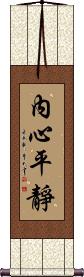
內心平靜 is a Chinese and Japanese phrase that is a direct translation of the western idea of inner peace.
The first two characters contain the idea of “heart,” “innermost being,” or “deep in the/your inner mind.”
The last two characters mean “tranquil” and “serene.”
I have seen this phrase used as “inner peace” for art prints and even on the side of coffee cups. But I think the translation is too literal. It feels like a direct translation from English rather than a nicely composed Chinese or Japanese phrase. See my other entries for “inner peace.”
See Also: Serenity | Simplicity | Peace
Inner Peace / Silence / Serenity
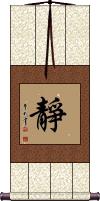
靜 is the simplest way to convey the meaning of inner peace and serenity.
靜 is often translated as “serenity.” It can also be used to express the ideas of still, calm, serene, quiet, silent, stillness, not moving, or tranquility.
In the old days, Chinese, Japanese, or Korean people might hang a wall scroll with this character in their reading room to bring about a sense of peace in the room.
 While they once used the same character form in Japan, they now use a slightly-simplified version in modern Japan (after WWII). This version is shown to the right, and can be selected for your wall scroll by clicking on that Kanji instead of the button above.
See Also: Peace
Achieve Inner Peace; Find Deep Understanding
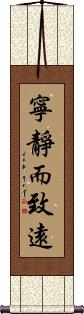
寧靜而致遠 is five characters from a longer ten-character proverb composed by Zhuge Liang about 1800 years ago.
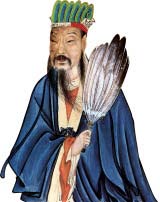
诸葛亮 Zhuge Liang
The proverb means “Your inner peace/tranquility/serenity will help you see or reach far (into the world).”
The last word means “far” but the deeper meaning is that you will surpass what you can currently see or understand. Perhaps even opening up vast knowledge and understanding of complex ideas.
Peace and Love
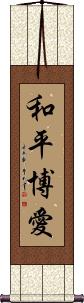
和平博愛 is the Chinese and Japanese way to express “Peace and Love.”
These are two separate words, so the calligrapher will put a slight space between the first two characters, which mean peace, and the last two, which represent universal love. This space is not shown on the sample character images for this phrase.
A special note: Word lists may seem okay in English but feel strange in Chinese and Japanese. We don't offer too many of them but this one is often-requested and feels okay in Chinese and Japanese, though a bit uncommon in Korean.
Peace of Mind
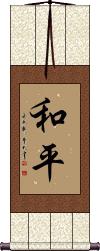
和平 is the Chinese order for these two characters, which means peace but can also be translated as amicability, specifically, or mildness. 和平 is often translated as a simple way to say “peace of mind.” This combination is used in Korean Hanja to mean “peace and harmony.”
Alone, the first character means peace and harmony.
The second character means balance when read by itself.
Note: 和平 are often seen in the opposite order in Japanese with the same meaning (You'll sometimes find them in this order in Japan, so either way is OK).
Peace / Peaceful
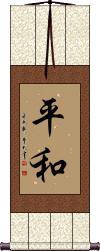
平和 is the Japanese and Korean order of these characters used most often to express the idea of peace, tranquility, and harmony.
It's just the reverse order of the Chinese. In this order in Chinese, it means takes the “mild” definition rather than “peace.” In Korean, the combination keeps the same meaning in either order.
The second character also means balance, so there is an element of harmony and balance along with peace.
Peace and Tranquility
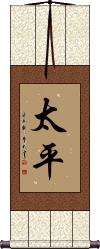
太平 means “peace and tranquility” or “peace and security” in Chinese, Japanese Kanji, and old Korean Hanja.
The literal translation would be “very balanced” or “very peaceful.”
The first character means very, much, too much, or extremely.
The second character means balanced, peaceful, calm, equal, even, level, or smooth.
Peace and Tranquility
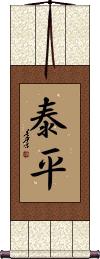
泰平 means peace and/or tranquility in Japanese and Korean (also understood but not as common in Chinese).
Worldwide Wish for Peace and Prosperity
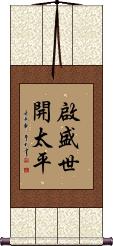
啟盛世開太平 means “To bring flourishing peace and security to the world (our current era).”
It's a wish that a new door leading to peace and prosperity could be opened to mankind.
Character and word breakdown:
啟 to open; to start; to initiate; to enlighten or awaken.
盛世 a flourishing period; period of prosperity; a golden age.
開 to open; to start; to turn on.
太平 peace and security; peace and tranquility; peace; tranquility.
I don't like to do breakdowns like this, as the words altogether create their unique meaning (encompassed in the main title above).
Inner Bliss and Peace from Meditation
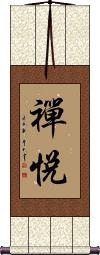
禪悅 is a title that refers to the inner bliss and peace you can achieve from meditation.
This term transcends a few religions, including Taoism and Buddhism. It can also be translated as “joy of the mystic trance” or simply “meditative bliss.”
Amazing that such a complex idea can be expressed in just two Chinese characters. Note that the first character is Chan/Zen (Chinese/Japanese), which means “meditation” in both languages.
Reach Peace and Calm Through Meditation
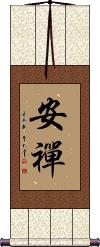
安禪 creates a title that means to reach peace and calm through meditation.
安禪 is an excellent wall scroll for your relaxation or meditation room.
This is also a Buddhist-related term that encompasses the idea of entering into dhyana meditation.
This is also used in Japanese, but in modern times, the second character has changed, so it's 安禅 now. If you want the modern Japanese version, just choose a Japanese calligrapher, and let me know when you place your order.
Spiritual Peace / Enlightened Peace
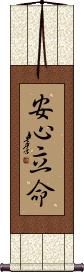
These Japanese Kanji, 安心立命, can be translated as “religious enlightenment” or “spiritual peace gained through faith.”
Other dictionaries define as “spiritual peace and enlightenment” or “keeping an unperturbed mind through faith.”
My Buddhist dictionary defines it as “spiritual peace and realization of enlightenment.”
In the Zen school, this is about settling one's body and life; attaining complete peace, and establishing one's course of life in accord with the ultimate reality.
Peace / Harmony
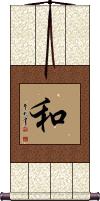
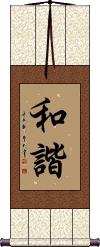
和 is the simplest form of peace and harmony.
和 can also be translated as the peaceful ideas of gentle, mild, kind, and calm. With a more harmonious context, it can be translated as union, together with, on good terms with, or on friendly terms.
Most people would just translate this character as peace and/or harmony. 和 is a very popular character in Asian cultures - you can even call it the “peace symbol” of Asia. In fact, this peace and harmony character was seen repeatedly during the opening ceremony of the 2008 Olympic Games in Beijing (a major theme of the games).
In old Chinese poems and literature, you might see this used as a kind of "and." As in two things summed together. As much as you could say, "the sun and moon," you could say "the sun in harmony with the moon."
See Also: Inner Peace | Patience | Simplicity
Warrior for Peace
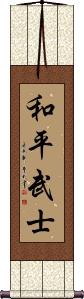
和平武士 means “Warrior for Peace” (a warrior who fights for peace) in Chinese.
Note this is not the same thing as a “peaceful warrior.”
See Also: Peace
Peacefulness / Tranquility / Perfectly Quiet
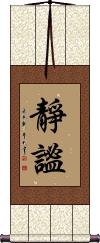
The Whole World at Peace
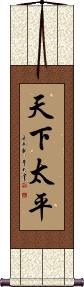
This proverb can be translated as the whole world at peace, peace and prosperity, peaceful and tranquil, peace reigns over the land, times of peace, peace and tranquillity, peaceful world, or from the Greek, times of halcyon.
Sometimes (rarely) written as 天下泰平 (variant 3rd character).
Worldwide Peace
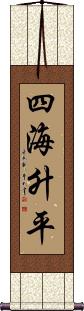
四海升平 literally means “all four oceans at peace,” which is a way to express “world peace.”
Peace of Mind
(five-character version)
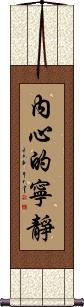
內心的寧靜 is the long way to express the idea of “peace of mind” in Chinese.
The first two characters mean heart or “innermost being.”
The middle character is a connecting modifier.
The last two characters mean peace, tranquility, or serenity.
Some may also translate this as “inner peace,” but I like our other inner-peace options for that idea.
This kind of makes sense in Korean but will have an archaic read - even by those who can understand Korean Hanja.
World Peace
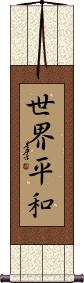
世界平和 is the Japanese title for “world peace” or “peace of the world.”
Great Peace
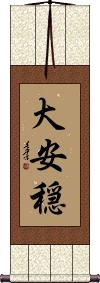
大安穏 means great peace, great repose, nirvanic peace, or great tranquility.
Live in Peace and Contentment
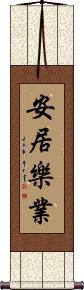
安居樂業 is the Chinese, Japanese Kanji, and old Korean Hanja proverb for “living in peace and working happily,” or “to live in peace and be content with one's occupation.”
World Peace
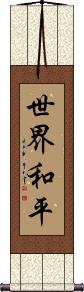
世界和平 is the Chinese title for “world peace.”
House Of Peace

和平之家 is the title “House Of Peace” in Chinese.
Patience Yields Peace of Mind
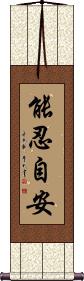
This ancient Chinese proverb can be translated as “Patience brings peace of mind,” “One who has patience finds peace,” and a few other ways.
Eternal Peace
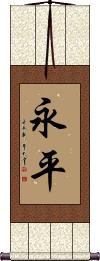
永平 is a way to write “eternal peace” in Chinese and Japanese.
This may also refer to Yongping county in Dali Bai autonomous prefecture. 永平 is also a Japanese surname that romanizes as Nagahira.
Eternal Peace and Happiness

永恆和平與幸福 means “Eternal Peace And Happiness” in Chinese.
Peace, Love, Happiness
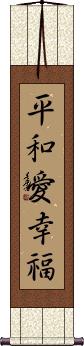
平和, 愛, 幸福 means “peace, love, happiness” in Japanese.
This is a word list, which is not the most natural kind of composition in Japanese (usually there is a subject, object, and verb - or a single word).
Peace, Love, Happiness
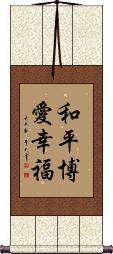
和平博愛幸福 is a word-list that means “peace, love, happiness,” in Chinese.
Word lists like this are not commonly-seen in China. Phrases with subject, verb, and object, or just single words are more natural for calligraphy artwork.
Stable - Mind at Peace
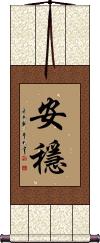
安穩 can mean a steady, stable, sedate, and calm mind.
Other translations include “body and mind at rest,” or “peace and comfort.”
Faith Love Peace
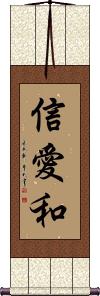
信愛和 is a word list that reads, “Faith Love Peace.”
This is not a natural phrase in Chinese or Japanese, as it lacks a subject, verb, or object. But if this is what you want, here it is.
Patience Brings Peace of Mind
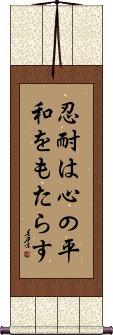
忍耐は心の平和をもたらす means “patience brings peace of mind,” in Japanese.
Note: Because this selection contains some special Japanese Hiragana characters, it should be written by a Japanese calligrapher.
Peace and Good Health
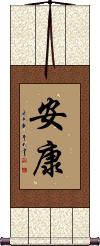
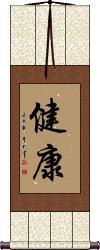
安康 means just what it says. It's a word that expresses both the idea of being at peace and healthy at the same time.
Note: 安康 is a bonafide word in Chinese and Korean, and the characters will at least make sense in Japanese.
Balance / Peace
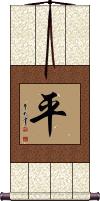
平 is a single character that means balance in Chinese but it's not too direct or too specific about what kind of balance.
Chinese people often like calligraphy art that is a little vague or mysterious. In this way, you can decide what it means to you, and you'll be right.
平 is also part of a word that means peace in Chinese, Japanese, and old Korean.
Some alternate translations of this single character include: balanced, peaceful, calm, equal, even, level, smooth, or flat.
Note that in Japanese, this just means “level” or “flat” by itself (not the best choice for balance if your audience is Japanese).
Sleep / Rest / Repose
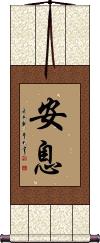
安息 means to rest, to go to sleep, to rest peacefully, or in repose, in Chinese characters, Japanese Kanji, and old Korean Hanja.
One Who Does Not Do Bad Things, Worries Not of Knocks at His Door
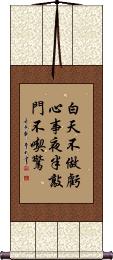
白天不做亏心事夜半敲门不吃惊 literally translates as: [If one does] not do bad things in the daytime, one need not be alarmed at knocks on the door in the middle of the night.
The meaning is something like, “A quiet conscience sleeps in thunder.” Basically, the message is, “don't commit crimes and you won't be jumpy every time the doorbell rings (so don't do anything wrong and your life will have fewer worries and you can sleep at night).”
Antiwar / Anti-War
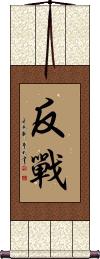
反戰 means antiwar, as in what a pacifist believes in.
China does plenty of saber-rattling but thankfully doesn't go to war very often, and Japan has embraced a pacifist ideology. Therefore, it's rare to need this word. However, this is the kind of word that war protesters would write on their signs.
 There is a modern Japanese version of the second character which has become the standard in Japan after WWII. If you want your calligraphy written in the modern Japanese form, please click on the Kanji shown to the right instead of the button above. Note: Most Japanese and all Chinese people will recognize the form shown in the upper left.
Peaceful Heart / Peace of Mind / Calm Mind
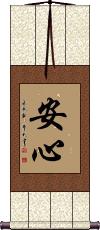
安心 can be defined as relief, peace of mind, feeling at ease, to be relieved, to set one's mind at rest, and easiness.
安心 is a nice word that encompasses great meanings within just two characters. Some of the other meanings include pacifying, settling the mind, and peace of mind. It's also the idea of feeling a sense of security, safety, and confidence in your state of well-being.
This can be used by everyone, but some consider it to be a Buddhist concept (You'll find it in your Zen dictionary).
Note: Can be romanized as Anshin or Anjin in Japanese.
Tranquil / Tranquility / Serenity
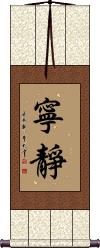
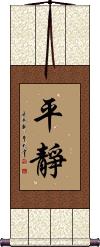
寧靜 expresses the idea of tranquility and serenity in Chinese.
See Also: Peace | Inner Peace | Harmony | Calm
Peaceful Warrior
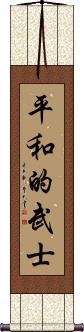
平和的武士 means “Peaceful Warrior” in Chinese. This does in fact sound like an oxymoron in Chinese - but many of you have asked for this special title.
Note this is not the same thing as “warrior for peace.”
See Also: Peace
Safe and Sound
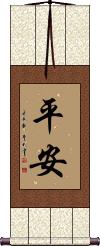
This word means “safe and sound” in Chinese, Japanese, and Korean.
Can also be translated as well-being, peace, tranquility, quietness, and calmness.
Note: There is also a longer four-character version in our calligraphy database.
See Also: Tranquility | Peace
Non-Violence
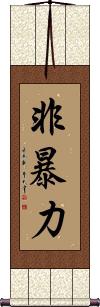
非暴力 is fairly self-explanatory.
The first character means “not,” “non-,” or “un-”
The middle and last character together mean “violence,” “use of force,” or simply “violent.”
Together, these three characters would normally be translated as “nonviolence.” A great gift for your favorite peace-lover.
See Also: Peace
Safety and Well-Being of the Family
Kanai Anzen
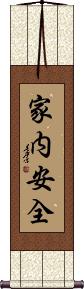
家內安全 is the Japanese way of saying “Family First.”
It's a Japanese proverb about the safety and well-being of your family and/or peace and prosperity in the household.
Some Japanese will hang an amulet in their home with these Kanji. The purpose is to keep your family safe from harm.
According to Shinto followers, hanging this in your home is seen as an invocation to God to always keep family members free from harm.
We were looking for a way to say “family first” in Japanese when this proverb came up in the conversation and research. While it doesn't say “family first,” it shows that the safety and well-being of your family is your first or most important priority. So, this proverb is the most natural way to express the idea that you put your family first.
See Also: Peace and Prosperity
Harmony / Balance
Serenity / Tranquility
Serenity / Tranquility
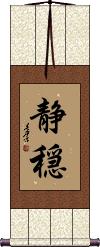
靜穏 is a Japanese-specific way to express “serenity” or “tranquility.”
Notes: The second Kanji is not a Chinese character - it was morphed or developed in Japan after Chinese characters were absorbed into the Japanese language during the 5th century.
The first character is slightly-simplified from the original Chinese form but still recognizable.
See Also: Peace
Patience / Perseverance / To Endure / Tolerant
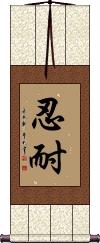
忍耐 is patience, the quiet hope, and trust that things will turn out right.
You wait without complaining. You are tolerant and accepting of difficulties and mistakes. You picture the end in the beginning and persevere to meet your goals.
忍耐 can also mean “to endure,” “restrain oneself,” or “forbearance,” and in some contexts, it can mean “perseverance” or “endurance.”
忍耐 is also used as a tenet of Taekwondo, Tang Soo Do, and other Korean martial arts where it's titled “Endurance” and romanized as “In Neh.”
 Note that when writing this as Kanji, Japanese will tend to write the first character in the form shown to the right. If you select our Japanese master calligrapher, please expect this Kanji form (yes,
it’s
just one stroke that is slightly different in location, crossing another stroke in the Japanese Kanji form).
Note that when writing this as Kanji, Japanese will tend to write the first character in the form shown to the right. If you select our Japanese master calligrapher, please expect this Kanji form (yes,
it’s
just one stroke that is slightly different in location, crossing another stroke in the Japanese Kanji form).
See Also: Peace | Harmony | Perseverance
Paix de l'esprit
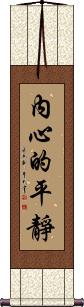
內心的平靜 means inner peace or peace of mind.
This is the Chinese equivalent of the French phrase Paix de l'esprit.
Dharma Gate of Bliss
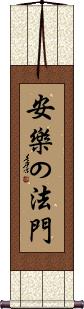
安樂の法門 represents that the Dharma Gate or the Door to Enlightenment leads to peace and happiness.
The Dharma Gate is the method of attaining or actualizing peace and happiness in Zen and other Buddhist traditions.
Peaceful / Tranquil / Calm / Free From Worry
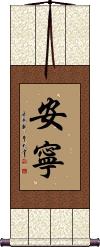
This is a nice word that means peaceful, tranquil, calm, composed, “free from worry,” “public peace,” tranquility, good health, well-being, or welfare in Chinese and Korean.
Note: The definition in Japanese is not so broad but still means peaceful or “public peace.”
Peaceful Warrior
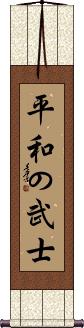
平和の武士 can be read as “Peaceful Warrior” or “Warrior for Peace” in Japanese. This sounds like an oxymoron in Japanese, so it's a weird title. Expect Japanese people to be perplexed when they see it.
Character breakdown:
平和 (heiwa) peace; harmony.
の (no) possessive particle.
武士 (bushi) warrior; samurai; soldier.
Wado-Kai
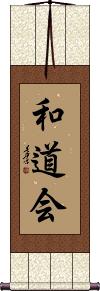
Wado-Kai is used as a title for styles of Karate and Aikido.
Breaking down the characters into the proper Japanese Romaji, you have “wa dou kai” or “wa dō kai.” The meaning is roughly-translated as “Harmony Way Club” or “Peace Method Association.” The first Kanji should probably be read as harmony, rather than peace in this case.
See Also: Wado-Ryu
Wado-Ryu
Style of Karate or Jujitsu
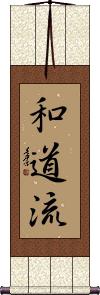
和道流 or Wado-Ryu is a style of Karate or Jujutsu (Jujitsu).
Note: Many will argue whether this is a style of Karate or Jujutsu.
While some find Wado-Ryu similar to Shotokan Karate, enough differences exist in perspective and technique that it stands by itself.
Breaking down the characters into the proper Japanese Romaji, you have “wa dou ryuu” or “wa dō ryū.” The meaning is roughly-translated as “Harmony Way Style” or “Peace Method Style.” The first Kanji should probably be read as harmony rather than peace in this case.
See Also: Wado-Kai
Om Shanti
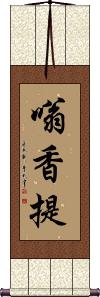
嗡香提 is the Chinese version of ॐशान्तिः or “Om Shanti,” the famous mantra or invocation of peace.
Kokoro no Heiwa
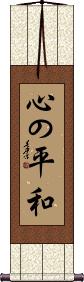
心の平和 means “heart of peace” or “peaceful heart” in Japanese.
Safe and Sound
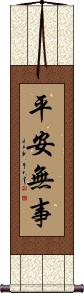
This proverb means “safe and sound without toil or trouble.”
It kind of means that all is well with a feeling of complete safety. The ideas contained in these characters include well-being, peace, tranquility, quietness, calmness, and non-problematic.
Let It Be / Be Relieved
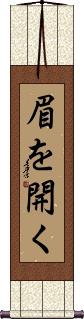
眉を開く is a Japanese proverb and expression that means “to feel relieved,” “to forget about one's troubles,” or “to settle into peace of mind.”
The literal words suggest relaxing your eyebrows or face. Allow worry or concern to go away, and just be content with “letting it be.”
Note: Because this selection contains some special Japanese Hiragana characters, it should be written by a Japanese calligrapher.
Realistic / Practical
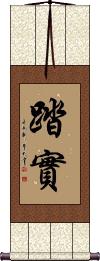
踏實 means realistic or practical.
If you need a reminder to remain grounded in your life, this is a great way to do that. 踏實 also can have the meanings of “at ease,” “down to earth,” “to have peace of mind,” “free from anxiety,” steady, or steadfast.
Good Night
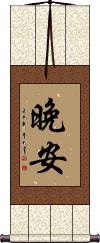
晚安 is how to write “good night” in Chinese.
This literally is a wish for an “evening of peace” or “night of calm.”
晚安 is not a normal title for a calligraphy wall scroll. It might be appropriate for a hotel front desk if anything.
A Life of Serenity Yields Understanding
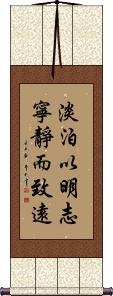
淡泊以明志寧靜而致遠 is a kind of complex ten-character proverb composed by Zhuge Liang about 1800 years ago.
This is a Chinese proverb that means “Leading a simple life will yield a clear mind, and having inner peace will help you see far (into the world).”
What I have translated as “simple life” means NOT being materialistic and NOT competing in the rat race.
The last word means “far” but the deeper meaning is that you will surpass what you can currently see or understand. Perhaps even the idea of opening up vast knowledge and understanding of complex ideas.
The whole phrase has a theme that suggests if you are NOT an aggressive cut-throat person who fights his way to the top no matter how many people he crushes on the way, and instead seek inner peace, you will have a happier existence and be more likely to understand the meaning of life.
See Also: Serenity
Good Health
Samurai
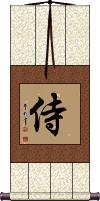
In Japanese, 侍 represents the warriors that attempted to hold peace when there was no Emperor in Japan.
Be cautious though, as it is an old way to express “servant” or “waiter” in Chinese and Korean. Of course, if you are a samurai, you are a servant to your Shogun-ate, Lord, or the people (which is the root meaning).
See Also: Warrior
Zion
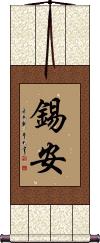
錫安 is the Chinese title for Zion.
While 錫安 is supposed to sound like the western word Zion, it also has meaning.
錫 means to bestow or grant (but can mean tin in chemistry).
安 means peace, calm, safety, and tranquility.
Content and Motionless
The condition of perfect meditation
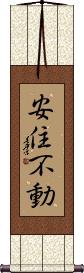
安住不動 means at peace and immovable.
The first two Kanji mean being content with one's present position or well-composed.
The last two Kanji mean immobile, firmness, fixed, and/or motionless.
In the Zen school, this is being well-composed and immovable - the ideal state of Zen meditation.
Joyfulness / Happiness
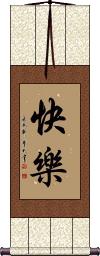
快樂 or joyfulness is an inner sense of peace and happiness.
You appreciate the gifts each day brings. Without joyfulness, when the fun stops, our happiness stops. Joy can carry us through hard times even when we are feeling very sad.
快樂 can also mean pleasure, enjoyment, delight, cheerfulness, or merry. In some ways, this is the essence that makes someone perceived as a charming person.
See Also: Happiness
Calm / Tranquility
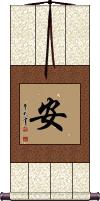
安 is used in a lot of compound words in the CJK world.
Alone, this character has a broad span of possible meanings. These meanings include relaxed, quiet, rested, contented, calm, still, to pacify, peaceful, at peace, soothing, or soothed.
安 and even the pronunciation was borrowed from Chinese and absorbed into both Japanese Kanji and Korean Hanja. In all these languages, this character is pronounced like “an.”
Galatians 5:22-23

Here is Galatians 5:22 and a bit of 23 in Chinese.
The text with punctuation:
圣灵所结的果子,就是仁爱,喜乐,和平,忍耐,恩慈,良善,信实,温柔,节制。
Hand-painted calligraphy does not retain punctuation.
This translation is from the Chinese Union Bible.
You may know it from the KJV as:
5:22 But the fruit of the Spirit is love, joy, peace, longsuffering, gentleness, goodness, faith,
5:23 Meekness, temperance...
Life in Harmony / Balanced Life
Harmonious Life
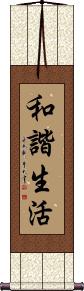
This 和諧生活 title suggests that you have, or want to get your life in balance.
The first two characters regard the idea of balance, harmony, and peace.
The second two characters mean “life.” More specifically this refers to your livelihood, career, and the daily activities that comprise your life or living. Some would translate those two characters as “one's daily existence.”
Note: We have a couple of titles for this idea. This version is more of a noun, thus "The Balanced Life" verses a verb form like "Balancing [Your] Life."
It is better to be a warrior in a garden than a gardener in a war
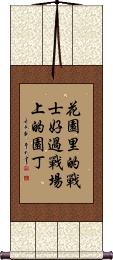
花園里的戰士好過戰場上的園丁 is the Chinese for the phrase, “It is better to be a warrior in a garden than a gardener in a war.”
This proverb is purported to come from the following exchange:
A student approaches his samurai master and says,
“Teacher, you instruct me how to fight, yet you preach to me about peace. How do I reconcile the two?”
The samurai responds,
“Because it is better to be a warrior in a garden than a gardener in a war.”
Feng Shui
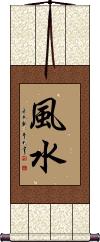
風水 is the famous technique and approach to arranging your home externally around natural features and internally to create balance and peace.
These two characters literally mean “wind water.” Obviously, the title is far more simple than the concept behind this subject.
It may enlighten you slightly to know that the character for “wind” can also mean style, custom, or manner in some contexts. This may apply somewhat to this title.
In a technical sense, this title is translated as Chinese geomancy.
Beautiful Life / Life in Perfect Harmony
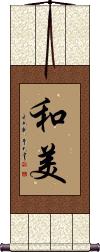
和美 is a word that means “harmonious” or, “in perfect harmony.”
The deeper meaning or more natural translation would be something like, “beautiful life.”
The first character means peace and harmony.
The second character means beautiful. But in this case, when combined with the first character, beautiful refers to being satisfied with what you have in your life. This can be having good relations, good feelings, comfort, and having enough (with no feeling of wanting).
Note: In Japanese, this is often used as the name "Wami." This title is probably more appropriate if your audience is Chinese.
No Trouble / Freedom from Problems
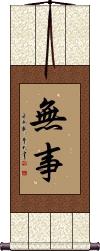
無事 is a Zen Buddhist term meaning no problem and no trouble.
無事 is the Zen state of perfect freedom from troubles and leaving secular affairs behind.
Sometimes this is used to describe the state of satori and complete tranquility of mind.
Written as 無事に with an extra Hiragana at the end, this becomes an adverb to describe something in the condition of safety, peace, quietness, and without troubles.
無事 (Buji) can also be a given name in Japan.
This has more meaning in the Japanese Zen Buddhist community than in China or Korea, where it can mean “be free” or “nothing to do or worry about.”
Harmony / Balance
Cho Wa
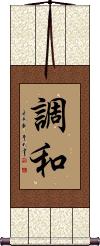
調和 is one of the several ways to express harmony in Chinese and Japanese.
Note: The first character means harmony but also suggests a musical meaning. It can also describe warriors marching in perfect cadence (in step) or to regulate something.
The second character carries the meaning of harmony and peace by itself.
Together, these characters create a word that can be defined as harmonious, to mediate, to reconcile, to compromise; mediation, temper, to mix, blend, blended, season, seasoning (getting the flavors of the food in balance), to placate, or be in harmonious proportion.
The meaning varies depending on the context. However, when hanging as a wall scroll, this will refer to the person (you) being balanced and in harmony while rational and under control simultaneously.
Keep Calm in Face of Adversity
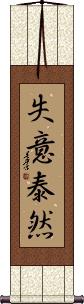
失意泰然 is a very old Japanese proverb that suggests “keeping calm and collected at times of disappointment,” or “maintaining a serene state of mind when faced with adversity.”
It's hard to relate individual character meanings to the overall meaning unless you also understand Japanese grammar. The word order is very different than English. That being said, here's the character meaning breakdown:
失 To miss, lose or fail.
意 Feelings, thoughts, meaning.
泰 Safe, peaceful.
然 Like that, in that way, however, although.
Using these definitions in English, we might say, “Although you may fail or lose, have a feeling of peace and calm.”
No Worries
My Australian friends always say, “No worries, mate.” It's caught on with me, though I drop the “mate” part since it confuses my fellow Americans.
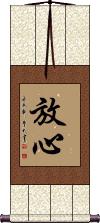
If you would like to express the idea of “no worries,” 放心 is the best and most natural way to say it in Chinese.
The characters you see to the left can be translated as “put your mind at rest” or “to be at ease.” You could literally translate “no worries,” but it doesn't “flow” like this simple Chinese version.
For your info, the first character means to release, to free, to let go, to relax, or to rest. The second character means your heart or your mind.
Note that in Japanese and Korean, this holds the similar meaning of “peace of mind” but can also mean absentmindedness or carelessness, depending on context.
Tiger Rumor
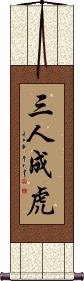
These four characters together relay the meaning that can be expressed in English as “When three people say there's a tiger running in the street, you believe it.”
Of course, there is an ancient story behind this idiom...
三人成虎 is actually a proverb that resulted from a conversation that occurred around 300 B.C.
The conversation was between the king of the Wei kingdom and one of the king's ministers named Pang Cong.
It was near the end of one of many wars, this time with the Zhao kingdom. Pang Cong was to be sent by the king to the Zhao kingdom with the king's son, who was to be held hostage. It was common at the time for a king to make his son a hostage to secure stable peace between warring kingdoms.
Before minister Pang Cong departed, he asked his king, “If one person told you a tiger was running in the street, would you believe it?.”
“No,” the king said.
The minister continued, “What if two people told you?”
The king replied, “Well, I would have my doubts but I might believe it.”
The minister continued, “So, what if three people told you that a tiger is running in the streets?”
The king replied, “Yes, I would believe it. It must be true if three people say it.”
The minister then reminded the king, “Your son and I are now traveling far away to live in the distant Zhao kingdom - much farther from your palace than the street. Rumors may fly about me in my absence, so I hope your majesty will weight such rumors appropriately.”
The king replied, “I have every trust in you, do not worry”
While the minister was gone, the king's enemies gossiped about minister Pang Cong on many occasions. At first, the king thought nothing of these comments and rumors. But slowly, as the rumors mounted, the king began to suspect ill of his minister.
Sometime later, when peace was well-established, the minister and prince were freed and returned to the kingdom of Wei. The king received his son BUT DID NOT EVEN SUMMON MINISTER PANG CONG TO THE PALACE!
Hopefully, this story will help you see how dangerous words can be when used to promote rumors or create ill will. And perhaps will inspire you not to believe everything you hear.
There is also a secondary suggestion in this idiom that gossip is as ferocious as a tiger. Some Chinese people who don't know the ancient story above may believe that this scroll means that rumors are as vicious as three tigers.
Note: This proverb appears in my Korean dictionary but is not well-known in Korea.
Good Health / Healthy / Vigor
Also suggests being at peace
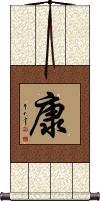
康 is a single character that means good health or vigor in Chinese, Japanese Kanji, and old Korean Hanja.
康 can also mean peaceful, at ease, or abundant in some contexts.
Please note that this is rarely seen alone in Japanese Kanji. In Japanese, it is used both for health-related compound words and to denote the kouhou through koushou eras of Japan.
In Korean, this can also be the family name “Kang” (caution: not the only family name romanized as Kang in Korean).
Fatal error: Cannot redeclare foreignPrice() (previously declared in /home/gwest/web/chinesescrollpainting.com/public_html/includes/currencyconverter.php:22) in /home/gwest/web/orientaloutpost.com/public_html/includes/currencyconverter.php on line 22