Many custom options...


And formats...



Inner Strength Inner Well-Being and Health in Chinese / Japanese...
Buy an Inner Strength Inner Well-Being and Health calligraphy wall scroll here!
Personalize your custom “Inner Strength Inner Well-Being and Health” project by clicking the button next to your favorite “Inner Strength Inner Well-Being and Health” title below...
Vitality
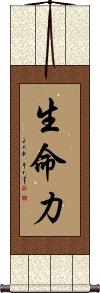
生命力 can mean “vitality” or “libido.”
The first two characters mean “life” or “life force.” The last character is a common word that means “strength.” So together, you get the meaning of “life strength” which is the essence of vitality.
Some will also translate this word as “good health.”
See Also: Life Force | Health
Strong / Healthy
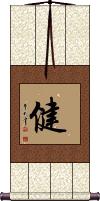
This “strong” character is the more “healthy” version of strong. 健 is the “strong” that is appropriate for an athlete.
Beyond “healthy,” it can also mean strength, persistence, vigorous, or invigorated/invigoration.
Inner Strength / Inner Well-Being and Health
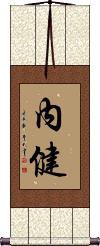
內健 is an old Chinese word meaning inner strength or inner health.
It's the idea of health and well-being starting or residing inside yourself. Also defined as fortitude within the context of good health.
Strong / Healthy
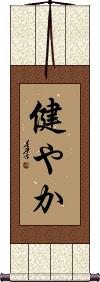
健やか is a verbose way to say strong and healthy in Japanese. 健やか is the “strong” that is appropriate for an athlete.
Beyond “healthy,” it can also mean strength, persistence, vigorous, or invigoration.
Japanese also use the first Kanji to mean the same thing. This version adds two hiragana which serve to emphasize or amplify the word and clarify the meaning.
Note: Because this selection contains some special Japanese Hiragana characters, it should be written by a Japanese calligrapher.
Healthy Living
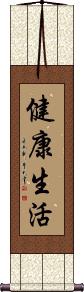
If you are into healthy living, 健康生活 might be an excellent selection for a wall scroll to hang in your home.
The first two characters speak of health, vitality, vigor, and being of sound body. The second two characters mean living or life (daily existence).
Power / Strength
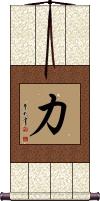
力 is the simplest form of “power” or “strength.”
In Japanese, it is pronounced “chikara” when used alone, and “ryoku” when used in a sentence (there are also a few other possible pronunciations of this Kanji in Japanese).
In some contexts, this can mean ability, force, physical strength, capability, and influence.
Strong / Powerful
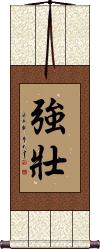
強壯 is an adjective that means powerful or strong.
It can also be translated as able-bodied, robust, or sturdy.
This version of strength also suggests muscularity.
 Note that the second character was simplified in Japan after WWII (also simplified in mainland China but not for calligraphy). If you want the modern Japanese/simplified version, please click on the Kanji shown to the right.
Physical Strength
Fatal error: Cannot redeclare foreignPrice() (previously declared in /home/gwest/web/chinesescrollpainting.com/public_html/includes/currencyconverter.php:22) in /home/gwest/web/orientaloutpost.com/public_html/includes/currencyconverter.php on line 22