Many custom options...


And formats...



Integrity in Chinese / Japanese...
Buy an Integrity calligraphy wall scroll here!
Personalize your custom “Integrity” project by clicking the button next to your favorite “Integrity” title below...
1. Integrity
7. Fidelity / Personal Integrity / Honor
8. Integrity: Sincere Honest and Faithful
9. Dignity / Honor / Sanctity / Integrity
10. Sense of Shame / Sense of Honor / Integrity / Modesty
11. Loyalty
14. Honesty
Integrity
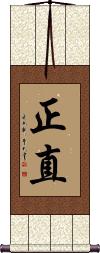
Integrity is living by your highest values. It is being honest and sincere. Integrity helps you to listen to your conscience, do the right thing, and tell the truth. You act with integrity when your words and actions match. Integrity gives you self-respect and a peaceful heart. Please note that the second Kanji sometimes has an alternate form in Japanese. Let us know if you want the alternate form shown to the right.
Note: This entry is cross-listed as “honesty” because it also fits that definition.
Beyond Integrity, this word also means "upright" and "honest" in Chinese. Means "integrity," "honesty" or "frankness" in Japanese.
Honor and Integrity
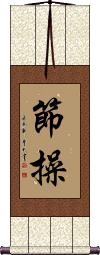
節操 means honorable, integrity of principle, constancy, honor, and in a certain context, chastity.
Please note that there are a few ways to relay the idea of integrity in Asian languages and more than one way to define honor in English. 節操 is far from the only way to express “honor and integrity.”
Personal Integrity
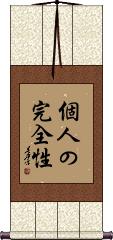
個人の完全性 is “personal integrity” in Japanese.
Unwavering Integrity
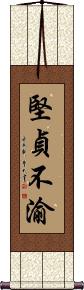
堅貞不渝 is a Chinese proverb that means unyielding integrity or unwavering resolution.
Integrity / Honesty
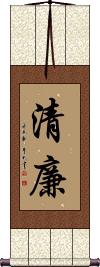
清廉 means honest, uncorrupted, honesty, integrity, purity, and unselfishness.
In Japanese, this can also be the given name Kiyoyuki.
Personal Integrity
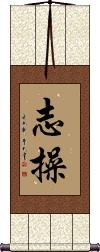
志操 is personal integrity - basically, holding yourself to a higher standard of honesty and reliability. These two characters also contain the ideas of constancy, principles, and faithfulness.
Note: In Japanese, this just means “principle.”
Fidelity / Personal Integrity / Honor
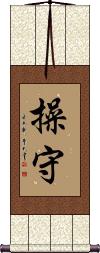
操守 is the Chinese and Japanese Kanji for personal integrity, constancy, fidelity, and honor/honour.
The original meaning of the first character is chastity, fidelity, honor, and/or faith.
The second character means to defend, guard, keep watch, and be observant.
So, this is about being observant of and guarding your integrity and honor.
Integrity: Sincere Honest and Faithful
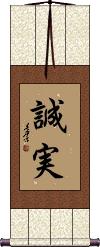
誠実 is the Japanese version of integrity which can also be defined as a combination of “sincere, honest, and faithful.”
Some may also define this as “loyal” or “loyalty.” In some contexts, it can mean “genuine.” Yes, all of this meaning in just one Japanese word!
Dignity / Honor / Sanctity / Integrity
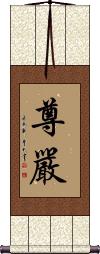
尊嚴 is a form of honor that means showing great respect for yourself, other people, and the rules you live by.
When you are honorable, you keep your word. You do the right thing regardless of what others are doing.
尊嚴 is the kind of personal honor or dignity that is of great value. If you lose this, you have lost yourself and perhaps the reputation of your family as well.
While this is not directly the same thing as “face” or “saving face” in Asian culture, it is associated with the same concept in China.
 In Japan, they currently use a more simplified second character for this word. The ancient Japanese form is the same as China but after WWII some Kanji were changed. If you want the modern Japanese version, just click on the Kanji image shown to the right, instead of the button above.
Sense of Shame / Sense of Honor / Integrity / Modesty (Korean)
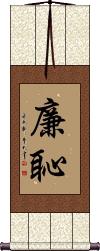
廉恥 simultaneously means “sense of honor” and “sense of shame” in Korean.
This term is often used as a tenet of Taekwondo, where the English terms “integrity” and “modesty” are applied.
廉恥 is also a Chinese word, though it is usually read with the “sense of shame” meaning, and is a poor choice for a wall scroll if your audience is Chinese.
Loyalty
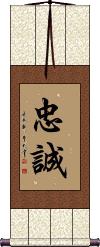
忠誠 is the written form of loyalty that is universal in Chinese, Japanese Kanji, and old Korean Hanja.
Loyalty is staying true to someone. It is standing up for something you believe in without wavering. It is being faithful to your family, country, school, friends, or ideals when the going gets tough and when things are good. With loyalty, you build relationships that last forever.
Notes:
1. There is also a Japanese version that is part of the Bushido Code which may be more desirable depending on whether your intended audience is Japanese or Chinese.
2. This version of loyalty is sometimes translated as devotion, sincerity, fidelity, or allegiance.
Having High Principles
Do not bow down for the sake of five pecks of rice
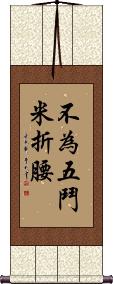
不为五斗米折腰 is a Chinese idiom/proverb that speaks of being above bribes and not losing face or honor for short-term gain.
Some may also translate the perceived meaning as “high-hearted” or “integrity beyond reproach.”
The more literal meaning is “Do not bow down for the sake of five pecks of rice.”
Fidelity Honor Courage
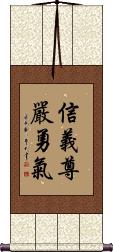
信義尊嚴勇氣 means fidelity, honor, and courage in Chinese.
This is a word list that was requested by a customer. Word lists are not common in Chinese, but we've put this one in the best order/context to make it as natural as possible.
We used the “honor” that leans toward the definition of “dignity” since that seemed the best match for the other two words.
Please note: These are three two-character words. You should choose the single-column format when you get to the options when you order this selection. The two-column option would split one word or be arranged with four characters on one side and two on the other.
Honesty
正直 or honesty is being truthful and sincere. It is important because it builds trust. When people are honest, they can be relied on not to lie, cheat or steal. Being honest means that you accept yourself as you are. When you are open and trustworthy, others can believe in you.
正直 is one of the 8 key concepts of Tang Soo Do.
Note: This entry is cross-listed as "integrity" because it also fits that definition.
Please note that the second Kanji sometimes has an alternate form in Japanese. Let us know if you want the alternate form shown to the right.
Fatal error: Cannot redeclare foreignPrice() (previously declared in /home/gwest/web/chinesescrollpainting.com/public_html/includes/currencyconverter.php:22) in /home/gwest/web/orientaloutpost.com/public_html/includes/currencyconverter.php on line 22