Many custom options...


And formats...



Karma - Cause and Effect in Chinese / Japanese...
Buy a Karma - Cause and Effect calligraphy wall scroll here!
Personalize your custom “Karma - Cause and Effect” project by clicking the button next to your favorite “Karma - Cause and Effect” title below...
Karma - Cause and Effect
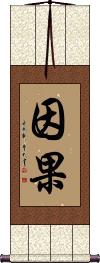
Evil Cause, Evil Result
Meaning: You reap what you sow
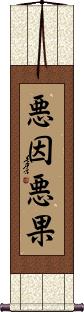
悪因悪果 is a Japanese proverb that means “Evil cause, evil effect” or “Bad causes bring bad results.”
The English equivalent is probably, “Sow evil and reap evil” or more commonly, “You reap what you sow.”
Note: 悪因悪果 is also considered to be a Buddhist phrase encompassing the idea of karmic retribution.
Everything Happens for a Reason
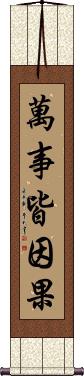
萬事皆因果 means “Everything happens for a reason” in Chinese.
The first two characters mean “all things” or “everything.”
The middle character kind of means “in all cases.”
The last two characters create a complex word that can be defined in many ways, such as “karma,” “cause and effect,” “fate,” and “every cause has its effect, as every effect arises from a cause.”
Keep in mind that Chinese grammar is a bit different than English, so trust me that this makes a natural-sounding proverb in Chinese.
Fate / Opportunity / Chance
The Buddhist idea of Fate
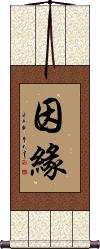
因緣 is the Buddhist concept of a chance meeting or an opportunity that presents itself by fate.
Sometimes this is used to describe a cosmic chain of events or cause and effect.
It also is used to describe predestined relationships between people - and sometimes married couples (although if you want one about marriage, try this: Fate / Destiny of Lovers.
因緣 can also be translated as origin, karma, destiny, affinity, connection, and relation. This all depends on context - seen alone on a wall scroll, this will be read with a “fate/chance” meaning by a Chinese person or a Korean person who can read Hanja.
The more complex definition of this word would be, “Direct causes and indirect conditions, which underlie the actions of all things.”
This concept is known as nidana in the original Sanskrit. Also sometimes presented as hetupratyaya (or “hetu and prataya”), which I believe is Pali.
Note: Japanese will tend to use this version of the second Kanji: 
If you order this from the Japanese master calligrapher, expect that you’ll get this version. However, this word often carries a negative connotation in Japanese (bad things happen), as it is used that way in a certain Japanese idiom. Therefore, this may not be the best choice if Japanese is your target language.
See Also: Buddhism | Opportunity
Fatal error: Cannot redeclare function foreignPrice() (previously declared in /home/gwest/web/chinesescrollpainting.com/public_html/includes/currencyconverter.php:22) in /home/gwest/web/orientaloutpost.com/public_html/includes/currencyconverter.php on line 22