Many custom options...


And formats...



Ken Zen Ichi Nyo in Chinese / Japanese...
Buy a Ken Zen Ichi Nyo calligraphy wall scroll here!
Personalize your custom “Ken Zen Ichi Nyo” project by clicking the button next to your favorite “Ken Zen Ichi Nyo” title below...
Ken Zen Ichi Nyo
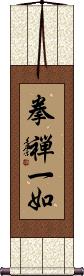
拳禪一如 is a Japanese phrase that is often translated as “train both body and spirit.”
Here's the breakdown of the words in this phrase:
拳 means fist.
禅 is zen, which means meditation.
一如 is a word that means “to be just like,” “oneness,” “true nature,” or “true character.”
So to get to the translation of “train both body and spirit,” you must understand that “fist” is representing “body” and the idea of meditation is representing “mind.”
I have to say, this is not how I would translate this. To me, it's really about training with your mind and remembering that meditation is a huge part of training, not just your fist. As the Shaolin Buddhist monks show us, meditation is just as important as physical training in martial arts.
Once in a Lifetime
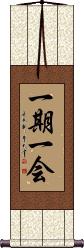
This Japanese title can be translated as “for this time only,” “chance meeting,” “one meeting, one opportunity,” “never again,” or “one chance in a lifetime.”
The characters literally mean “one time one meeting” - of course, the Kanji characters have meaning far beyond a direct translation like this.
Some might use this proverb to talk of an opportunity that presents itself just once in your life. It could also be a one-and-only chance meeting with your true soul mate. An expression of any event that might happen once in a lifetime.
This is primarily a Japanese title, however, there is also a Traditional Chinese (and old Korean) version of this proverb. Just the last character is different. The traditional form was used in Japan before WWII and in Korea prior to 1900. This title is somewhat known in China.
If you want the older traditional form, just click on the character to the right.
Niten Ichi Ryu

&#; is the martial arts title, Niten Ichi-Ryū.
The rough translation is “Two Heavens as One.”
Ichi wa Zen, Zen wa Ichi
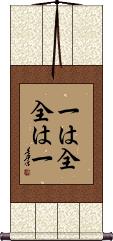
一は全、全は一 means “One is all, all is one” in Japanese.
一は全、全は一 is a somewhat well-known modern proverb in Japanese. However, many will associate it with an episode of Fullmetal Alchemist, a popular Japanese anime series.
Note: Because this selection contains some special Japanese Hiragana characters, it should be written by a Japanese calligrapher.
Ichi-Dan / First Degree
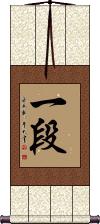
In Japanese martial arts, this usually represents the first-degree black belt rank.
It can also be like a linguistic stair step of “more, much more, still more, all the more.” It can also be a step, rung, level, or rank.
Also sometimes used in the context of Buddhism to mean “first step” or “first stage.” This might presume the first step towards enlightenment etc.
There is one single thread binding my Way together
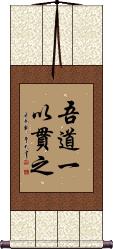
吾道一以貫之 is a phrase from the Analects of Confucius that translates as “My Way has one thread that runs through it.”
Other translations include:
My Way is penetrated by a single thread.
There is one single thread binding my Way together.
My Way is run through with a unifying thread.
My Way is Consistent.
And sometimes poetic license is taken, and it is translated as:
My Way is the only one; I'll treasure it and stick to it with humility until the end.
After this was said, some 2500+ years ago, another disciple of Confucius clarified the meaning by stating, “Our master's Way is to be loyal and have a sense of reciprocity.”
In Japanese, this is purported to be romanized as “Waga michi ichi wo motte kore wo tsuranuku,” though some will argue the true pronunciation.
Note: Sometimes written 吾道以一貫之 instead of 吾道一以貫之 with no difference in meaning.
Energy Sword Body in Concert
Spirit, Sword & Body as One
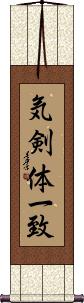
气剑体一致 often gets translated as “Mind Sword Body,” or “Spirit, Sword, and Body as One.” But I think these translations don't tell you enough about what this is really saying.
In this context, 気, which is the modern Japanese version of 氣, means spiritual and unseen energy or “life energy.” In some cases, 気 can be translated as spirit, feeling, or nature. If defined as the mind, it's more about the invisible or intangible parts of one's mind (or soul).
剣 is the Japanese version of 劍 meaning sword.
体 is the modern Japanese version of 體 meaning body.
The Kanji 一 means one, and in this case, suggests “all in one.”
The Kanji 到 means to send, deliver, or convey. But together, 一到 suggests all these things in agreement, union cooperation, or in concert.
Note: Arguments exist as to whether this should be romanized as Kikentaiitchi, Kikentaiicchi, or kikentaiichi. Technically, if you drop the last character, you get 気剣体一 and kikentaiichi (ki ken tai ichi), which is also a valid phrase.
Fatal error: Cannot redeclare foreignPrice() (previously declared in /home/gwest/web/chinesescrollpainting.com/public_html/includes/currencyconverter.php:22) in /home/gwest/web/orientaloutpost.com/public_html/includes/currencyconverter.php on line 22