Many custom options...


And formats...



King in Chinese / Japanese...
Buy a King calligraphy wall scroll here!
Personalize your custom “King” project by clicking the button next to your favorite “King” title below...
King
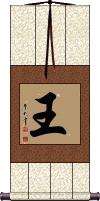
王 is wang which means king. It is not pronounced the way you think in Chinese. It is more like English speakers would want to pronounce wong. It has roughly the same vowel sound as tong, song, or long in English.
Note that this means king only, not the emperor. An emperor is higher than a king, and theoretically is chosen by God, according to ancient Chinese culture. However, the definition is often blurred at various points in Asian history.
王 can also be defined as ruler, sovereign, monarch, or magnate. It is also can refer to a game piece in the chess-like Japanese strategic game of shoji.
Note: This can also be a family name in Chinese, Korean and Vietnamese (in Vietnamese it's Vương).
See Also: Queen
King
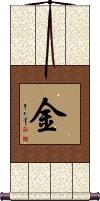
金 is how the name King is transliterated into Mandarin Chinese.
The meaning of this character is metal or gold, and it only vaguely sounds like “king”. But it was used in many articles for famous people like Larry King. If my last name was “King”, I would rather use the character 王 which means king, and romanizes as “wang” or “wong.”
King
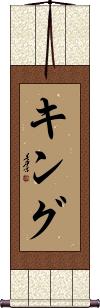
キング is the name King in Japanese Katakana.
Note: Because this title is entirely Japanese Katakana, it should be written by a Japanese calligrapher.
Monkey King
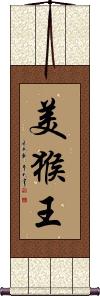
美猴王 is the specific title for “Monkey King.”
A character made famous by the ancient novel Journey to the West.
It literally means “Handsome/Beautiful Monkey King.”
See Also: Monkey Fist | Drunken Monkey
Monkey King
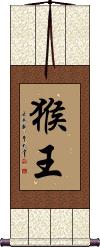
猴王 is the short title for “Monkey King.” This can refer to the character made famous by the ancient novel Journey to the West.
This literally reads “Monkey King.” However, this title is open to interpretation and could be used for someone who is the boss of the primate exhibit at the zoo or certain characters in Chinese opera.
See Also: Monkey Fist | Drunken Monkey
Lion King
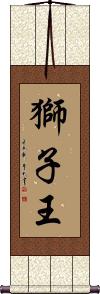
獅子王 is the Chinese title for “The Lion King” (also associated with the Disney movie).
This has the “Lion King” meaning in Japanese however, not associated with the movie you are thinking of. 獅子王 is also a Japanese surname that romanizes as Shishiou.
Adamantine / King Kong
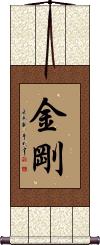
金剛 can translate as adamantine from Chinese, Japanese, and old Korean.
Other meanings and translations can include diamond, thunderbolt, Indra's indestructible weapon, a Buddhist symbol of the indestructible truth, Vajra (a mythical weapon), guardian deity, hardness, indestructibility, power, the least frangible of minerals.
The Chinese pronunciation of “Jīn Gāng” became the loanword used in English as “King Kong.” You can see King Kong as the indestructible ape guardian deity depending on how you read the story.
Fudo Myo-o / Wisdom King
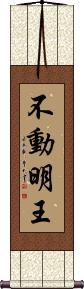
不動明王 is the fierce form of the Buddha Vairocana, and the most important of the Myō-ō or Ming Wang class of deities.
Romanized as Fudō Myō-ō, in Japanese Buddhism or Bùdòng Míngwáng / Pu-Tung Ming-Wang in Chinese Buddhism,
Originally Acala/Achala (अचल “The Immovable”), Acalanātha (अचलनाथ “Immovable Lord”) or Āryācalanātha (आर्याचलनाथ, “Noble Immovable Lord”).
In English, this deity is sometimes called “Wisdom King.”
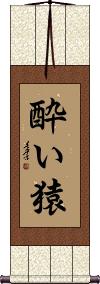
Drunken Monkey
Queen / Empress
Wife of the King
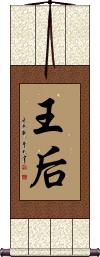
王后 is another way to write queen in Chinese, Japanese Kanji, and old Korean Hanja.
王后 is sometimes used for the title of empress.
The first character means “king,” and the second means “wife,” or a short form to say “wife of the king/emperor.” So this is literally “king's wife” or “emperor's wife.” Some will translate this as “queen consort.”
Wukong / Goku
Monkey King
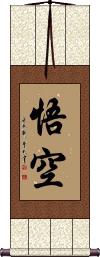
悟空 is the short name or given name of Sun Wukong, the Monkey King, from the ancient Chinese novel Journey to the West.
This title is also known as the given name of the Monkey King in Japanese. This can also be Goku, short for Son Goku, a fictional character of the Dragon Ball Japanese manga series (also based loosely on the Monkey King).
Sun Wukong / Son Goku
Monkey King
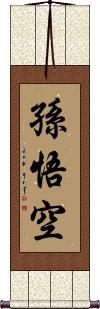
孫悟空 is the name Sun Wukong, also known as the Monkey King. He is the main character with supernatural powers in the ancient Chinese novel Journey to the West.
This title is also known as the real name of the Monkey King in Japanese. This can also be the Son Goku, better known as simply Goku, a fictional character of the Dragon Ball Japanese manga series.
Fatal error: Cannot redeclare foreignPrice() (previously declared in /home/gwest/web/chinesescrollpainting.com/public_html/includes/currencyconverter.php:22) in /home/gwest/web/orientaloutpost.com/public_html/includes/currencyconverter.php on line 22