Many custom options...


And formats...



Law of the Fist Karate Kempo Karate in Chinese / Japanese...
Buy a Law of the Fist Karate Kempo Karate calligraphy wall scroll here!
Personalize your custom “Law of the Fist Karate Kempo Karate” project by clicking the button next to your favorite “Law of the Fist Karate Kempo Karate” title below...
See also: Martial Arts Words and Phrases
Law of the Fist Karate / Kempo Karate
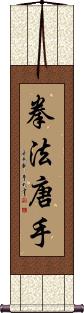
The first two characters mean “fist law” which is Romanized from Japanese as “Kenpo” or “Kempo.”
The last two are a secondary way to express “karate.”
Notes:
The more common way to express “karate” is literally “empty hand” (meaning “without weapons in your hand”). This version would be translated literally as “Tang hand” (as in the Tang Dynasty) or “China hand” (sometimes “Tang” means “China” in Japanese). Even though the character for “Tang” is used instead of “empty,” it's still pronounced “kara-te” in Japanese.
拳法唐手 is not commonly used in China - so please consider it to be a Japanese-only title.
Many Japanese people will say the last two Kanji are the old and antiquated way of saying Karate. This fact does not stop this title from existing, as these four characters are often seen in Kenpo / Kempo Dojos around the western world.
Kempo Karate / Law of the Fist Empty Hand
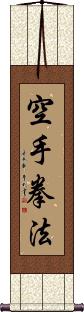
空手拳法 is the Kanji title for Kempo Karate.
The first two characters mean “karate” - technically they express “empty hand.”
The last two express “fist law” which is Romanized from Japanese as “Kenpo” or “Kempo.”
That “empty hand” translation can be understood better when you grasp the idea that karate is a martial art without weapons (other than the weapons organic to your body, such as your foot, hand, fist, etc). When you practice karate, you do so with empty hands (no weapons).
Note: There is also an antiquated way to write karate. It has the same pronunciation but a different first character which means “Tang” as in the Tang Dynasty. Some dojos use that form - let us know if you need that alternate form, and we'll add it.
Shorinji Kempo / Kenpo
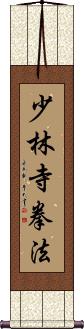
少林寺拳法 is a specific type of martial art in Japan that claims origins in the Kung Fu practiced in the original Shaolin Monastery of China.
The first three characters mean “Shaolin Monastery,” and you might notice the Japanese is pronounced in a very similar way. The reason is, many words were “borrowed” from the original Chinese when Japan did not have a written language and simply absorbed Chinese characters into their language around the 5th century. When a Japanese word did not exist, the Chinese pronunciation was often absorbed as well as the written form.
The last two characters mean “fist law” or “method of the fist.” It has long been argued as to whether the Japanese for these characters should be Romanized as “kempo” or “kenpo.” The official method should be “kenpou” but it's common to drop the “u” that comes after the “o.”
I imagine if you are looking for this title, you already know what it means, so the above is simply extra information that a student of Shorinji Kempo might want to know.
Kenpo / Kempo / Quan Fa / Chuan Fa
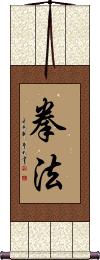
拳法 is a form of martial arts that can be translated in several ways.
Some will call it “fist principles,” “the way of the fist,” or even “law of the fist.” The first character literally means fist. The second can mean law, method, way, principle, or Buddhist teaching.
Kempo is really a potluck of martial arts. Often a combination of Chinese martial arts such as Shaolin Kung Fu with Japanese martial arts such as Karate, Jujutsu (Jujitsu), Aikido, and others. You may see the term “Kempo Karate,” which basically means Karate with other disciplines added. In this way, Kempo becomes an adjective rather than a title or school of martial arts.
These facts will long be argued by various masters and students of Kempo. Even the argument as to whether it should be spelled “kenpo” or “Kempo” ensues at dojos around the world (the correct Romaji should actually be “kenpou” if you precisely follow the rules).
The benefit of Kempo is that the techniques are easier to learn and master than pure Kung Fu (wu shu). Students are often taught basic Karate moves, kicks, and punches before augmenting the basic skills with complex Kung Fu techniques. This allows students of Kempo to achieve a level where they can defend themselves or fight in a relatively short amount of time (a few years rather than a decade or more).
Because the definition of this word is so fluid, I should make some notes here:
1. Purists in Okinawa will claim that “Okinawa Kenpo” or “Ryukyu Hon Kenpo” is the original and true version of this martial art from the old kingdom. It is actually little or no connection between Okinawa Kenpo and the way the word is used elsewhere.
2. In Chinese, where these characters are pronounced “quan fa” (sometimes Romanized as “chuan fa” because the Chinese-pinyin “q” actually sounds like an English “ch” sound), these characters do not hold the connotation of being a mixed martial art. It is simply defined as “the law of the fist.”
3. My Japanese dictionary oddly defines Kenpo as the “Chinese art of self-defense.” I personally don't feel this is the most common way that people perceive the word but just something you should know.
Fatal error: Cannot redeclare foreignPrice() (previously declared in /home/gwest/web/chinesescrollpainting.com/public_html/includes/currencyconverter.php:22) in /home/gwest/web/orientaloutpost.com/public_html/includes/currencyconverter.php on line 22