Many custom options...


And formats...



Lee Plum in Chinese / Japanese...
Buy a Lee Plum calligraphy wall scroll here!
Personalize your custom “Lee Plum” project by clicking the button next to your favorite “Lee Plum” title below...
1. Lee / Plum
2. Green Plum and Bamboo Horse
4. Li
5. Ly
6. May
7. Mae
8. Leanna
10. Ume
11. Bruce Lee
Lee / Plum
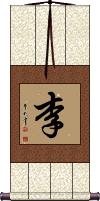
This is the most common Chinese character which sounds like “Lee” or “Li” and is used as a surname / family name in China.
李 actually means “Plum.” So it's really Mr. Plum and Mrs. Plum if you translated the name instead of romanizing.
This is not the only character in Chinese that can be romanized as “Lee” or “Li.” If your family name is “Lee” or “Li” please be sure this is the correct character before you order this scroll (look at your grandparents' Chinese passports or other documents if you are an ABC and are trying to create a heritage wall scroll).
Famous people with this surname include Bruce Lee (Li Xiao-Long), Minister Li Peng, and famous Tang Dynasty poet Li Bai.
In Korea, this is the original character for a surname that romanizes as “Yi.”
Note: This also one version of Lee that is a common Korean surname. However, it’s often romanized as "Yi" and sometimes as "Ri" or "Rhee."
Green Plum and Bamboo Horse
Innocent Children's Games
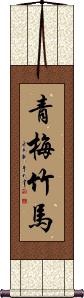
青梅竹馬 means “green plums and hobby-horse.”
Figuratively, it means “innocent children's games,” “childhood sweethearts,” or “a couple who grew up as childhood friends.”
This phrase may sound a little strange as it's a kind of Chinese proverb or idiom. It makes much more sense in Chinese than in English.
Riko / Momoko
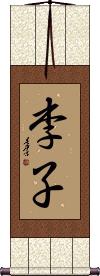
李子 is one of several Japanese female given names that romanize as Riko, Momoko, or Satoko.
This one is associated with a plum. It literally means “plum child.”
This is the surname Li in Chinese (Mandarin).
The meaning of this character is Plum.
This is the Ly in Chinese (Mandarin).
The meaning of this character is Plum.
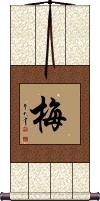
This is a common transliteration to Mandarin Chinese for the name May.
梅 actually means “plum blossom.” This is a common name for girls in China.
梅 is the transliteration to Mandarin Chinese for the name Mae.
It also works in Korean for the same name.
The meaning of this character is plum.
Leanna
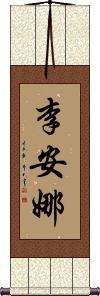
This is another transliteration to Mandarin Chinese for the name Leanna.
The first character is the only difference. Both ways, the first character is pronounced like “lee” but this one happens to be the same “lee” as in “Bruce Lee” - it also means plum.
Obaidori / Oubaitori
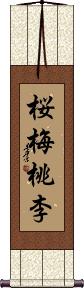
Ōbaidōri or Oubaitori means cherry, apricot, peach, and plum blossoms.
While these four different blossoms look very similar at first glance, they all bloom differently and have their own distinct shapes and smells. Yet despite their differences, each and every blossom is proud and beautiful in its own way.
梅 can romanize as Ume, a Japanese surname.
This is also sometimes used as a female given name in both Chinese and Japanese. However, pronunciation is Mei in Chinese and Ume in Japanese.
The meaning is “Japanese apricot” (Prunus mume). It can also refer to a Chinese plum.
Note: This is not the only name or character that romanizes as Ume in Japanese. Make sure you have the right Kanji before you order.
Bruce Lee
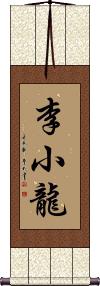
李小龍 is the real full name of Bruce Lee.
 Many people have no idea that Bruce Lee had a “real” Chinese name. In Mandarin and Cantonese, he is known as “Lǐ XiǎoLóng” and “Léi SíuLùng” respectively.
He kept his family name pronunciation (Li = Lee). 李 is a common family name that also means “plum.”
His given name 小龍 (Xiao-Long), literally means “little dragon.” 李小龍 is why you often see the character for dragon associated with Bruce Lee on various posters etc.
For a pronunciation lesson, the “X” in Romanized Mandarin is pronounced like a “sh” sound but with your tongue at the bottom of your mouth. The vowel sound in “Long” is like the English “oh,” not like the “ah” sound in the English word “long.”
If you are a big Bruce Lee fan, you should know this information, and you should have this wall scroll hanging in your room or martial arts studio.
Note: Japanese use these same Chinese characters / Kanji to write Bruce Lee's real name (with different pronunciation - which is a bit like how the name “Bruce Lee” sounds in English).
See Also: Kung Fu | Martial Arts
Fatal error: Cannot redeclare foreignPrice() (previously declared in /home/gwest/web/chinesescrollpainting.com/public_html/includes/currencyconverter.php:22) in /home/gwest/web/orientaloutpost.com/public_html/includes/currencyconverter.php on line 22