Many custom options...


And formats...



Not what you want?
Try other similar-meaning words, fewer words, or just one word.
Light Bright in Chinese / Japanese...
Buy a Light Bright calligraphy wall scroll here!
Personalize your custom “Light Bright” project by clicking the button next to your favorite “Light Bright” title below...
Light / Bright and Promising Future
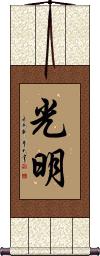
光明 is a nice way to say “light” in Chinese and old Korean Hanja.
This is because the word also suggests a bright future or refers to someone who is very promising (great future potential).
The first character means light or bright.
The second character means bright and clear (in this context).
This word appears in most Japanese dictionaries, but it is not the most common Japanese Kanji word for light (more commonly used for the name Mitsuharu).
In old Korean Hanja, this can also mean brightness or brilliance.
In the context of Buddhism, this means “Light emanating from a Buddha or Bodhisattva, symbolizing their wisdom and compassion.”
Light / Bright / Shine
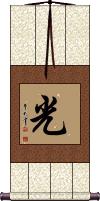
光 is the simplest way to express “light” in Chinese, Japanese Kanji, and old Korean Hanja.
It can also mean ray or bright. Chinese tend to use a two-character word for light/bright, so this character is probably best if your audience is Japanese. Also, when pronounced Rei, this can be a Japanese female given name.
In the Zen Buddhist context, this is the pure light that everyone possesses at their origin.
Bright and Promising Future
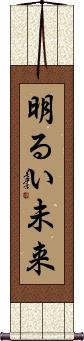
明るい未来 is a Japanese proverb that means “Bright Future.”
It suggests a lot of possibilities and potential awaits in your future. A great gift for a graduate.
The first part of this proverb literally means bright or light. The second part means the future but can also be translated as “the world to come.”
Note: Because this selection contains some special Japanese Hiragana characters, it should be written by a Japanese calligrapher.
Light / Bright
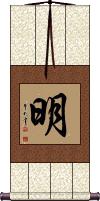
明 means light, bright, clear, clarity, to understand, or wise.
In Chinese, this can refer to the Ming Dynasty (1368-1644) where it can also be the surname Ming.
In Japanese, this can be romanized many different ways when used as surnames or given names. 明 is a partial list of those names: Meishuu, Mei, Min, Myoujin, Myou, Hinata, Haru, Toshi, Tooru, Sayaka, Saya, Satoshi, Asumi, Akera, Akemine, Akesaki, Ake, Akuru, Akiraka, and Akira.
In the Buddhist context, this represents vidyā (knowledge). To expand that, Buddhists understand this to mean bright, clear, enlightenment, wisdom, or to understand. It represents Buddha-wisdom and its revelation; also the manifestation of a Buddha's light or effulgence.
Shiken Haramitsu Daikomyo
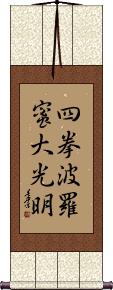
四拳波羅蜜大光明 is “shiken haramitsu daikōmyō,” a famous Japanese Buddhist mantra.
四拳 = shi-ken = four fists (many translate this as “four hearts”).
波羅蜜 = ha-ra-mitsu = A loanword representing pāramitā, or entrance into Nirvana. Awkwardly, it also means jackfruit.
大光明 = dai-kou-myo = big/great light bright (great bright light).
Shiken represents four hearts:
1. The Merciful Heart - Love and caring for all living things.
2. The Sincere Heart - Pursues righteousness, or the right path - sincerely trying to do what is right.
3. The Attuned Heart - Knows that nature and fate have their ways, and thus stay in tune with the universe.
4. The Dedicated Heart - Steadfast on the chosen path to the end.
Reiki - Master Symbol
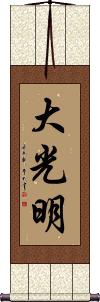
大光明 is the master symbol “Daikomyo” or “Dai Ko Myo,” which is usually associated with the healing practice of Reiki.
This title can be translated as “Great Bright Light.” This symbol, as used in Reiki, alludes to “Enlightened Nature” or the radiance of a purified soul or deity.
Pronunciations in Chinese and Korean are included above but this title has no meaning except when used by a Reiki practitioner. In fact, this title is not that well known by those outside the Reiki community in Japan.
In Chinese, this would be interpreted as “Great Bright Future” (the second two characters alone create a word that means “bright future” in Chinese).
Kodokan
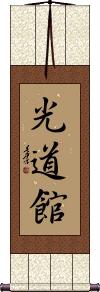
光道館 is Kodokan.
This is the title of an Aikido dojo, studio, or hall.
Be careful in selecting the correct Kodokan, as there are a few different titles that romanize as Kodokan.
Here's how the characters break down in meaning for this one:
1. Light / Bright
2. Way / Path (the Tao/Dao as in Taoism/Daoism)
3. Schoolroom / Building / Establishment / Mansion / Hall (of learning)
Altogether, you get something like “The Path of Light Establishment.”
Fatal error: Cannot redeclare foreignPrice() (previously declared in /home/gwest/web/chinesescrollpainting.com/public_html/includes/currencyconverter.php:22) in /home/gwest/web/orientaloutpost.com/public_html/includes/currencyconverter.php on line 22