Many custom options...


And formats...



Line in Chinese / Japanese...
Buy a Line calligraphy wall scroll here!
Personalize your custom “Line” project by clicking the button next to your favorite “Line” title below...
1. Line
2. Marie-Line
3. ...And this above all to thine own self be true
4. Seichusen
6. Subaru
8. Appreciation and Love for Your Parents
10. Every Creature Has A Domain
Line
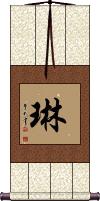
This is a common Mandarin Chinese transliteration for the female French name Line.
Marie-Line
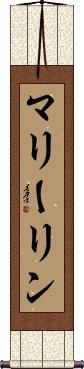
マリーリン is the name Marie-Line or Marieline in Japanese (Katakana).
Note: Because this title is entirely Japanese Katakana, it should be written by a Japanese calligrapher.
Marie-Line
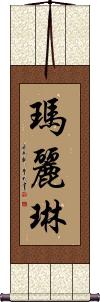
This is a common Mandarin Chinese transliteration for the female French name Marie-Line.
...And this above all to thine own self be true
A line from Shakespeare's Hamlet
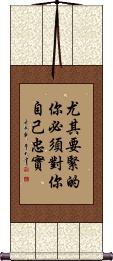
尤其要緊的你必須對你自己忠實 is the classic translation of a line from Shakespeare's Hamlet into Chinese.
Seichusen
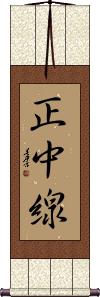
This is Seichusen, the Japanese martial arts concept meaning “right/correct middle/center line/thread.”
To thine own self be true
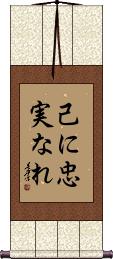
己に忠実なれ is “...to thine own self be true” in Japanese.
This is a small portion of the classic line from Shakespeare's Hamlet.
Note: Because this selection contains some special Japanese Hiragana characters, it should be written by a Japanese calligrapher.
Subaru
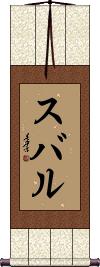
スバル is the Japanese title for the Subaru car company.
About half the line of Subaru cars sold in Japan is very different than the models sold in the USA and UK.
Note: Because this title is entirely Japanese Katakana, it should be written by a Japanese calligrapher.
New Beginning
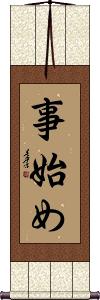
事始め is a Japanese word that means taking up a new line of work or the beginning of new things.
In another context, it can refer to starting the preparations for New Year's festivities or resuming work after the New Year's vacation.
Appreciation and Love for Your Parents
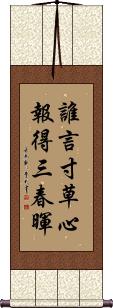
誰言寸草心報得三春暉 is the last line of a famous poem. It is perceived as a tribute or ode to your parents or mother from a child or children that have left home.
The poem was written by Meng Jiao during the Tang Dynasty (about 1200 years ago). The Chinese title is “You Zi Yin” which means “The Traveler's Recite.”
The last line as shown here speaks of the generous and warm spring sunlight which gives the grass far beyond what the little grass can could ever give back (except perhaps by showing its lovely green leaves and flourishing). The metaphor is that the sun is your mother or parents, and you are the grass. Your parents raise you and give you all the love and care you need to prepare you for the world. A debt that you can never repay, nor is repayment expected.
The first part of the poem (not written in the characters to the left) suggests that the thread in a loving mother's hands is the shirt of her traveling offspring. Vigorously sewing while wishing them to come back sooner than they left.
...This part is really hard to translate into English that makes any sense but maybe you get the idea. We are talking about a poem that is so old that many Chinese people would have trouble reading it (as if it was the King James Version of Chinese).
The LORD is my Shepherd
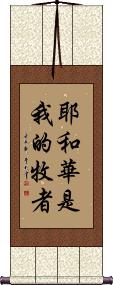
耶和華是我的牧者 is the first line from Psalms 23 straight out of the Chinese Union Bible.
This reads, “The LORD is my shepherd,” or “Jehovah is my shepherd.”
The character breakdown:
耶和華 = Jehovah (most English Bibles translate as LORD or God). This Chinese title is meant to sound a bit like the original Hebrew YHWH or Yahweh.
是 = is.
我的 = my.
牧者 = shepherd.
Every Creature Has A Domain
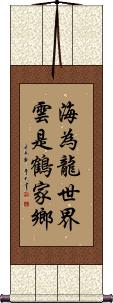
海為龍世界雲是鶴家鄉 is a somewhat poetic way to say that everyone and everything has its place in the world.
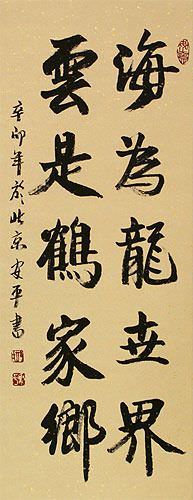 The first line (which is the column on the right) says, “The Ocean is the World of the Dragon.” The next column says, “The Clouds are the Domain of the Cranes.”
The image to the right is what this calligraphy can look like in xing-kaishu style by a Master Calligrapher.
The Great Path has No Gate
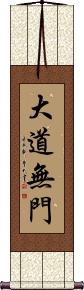
大道無門 is a Buddhist proverb that means “The Great Way has no entrance,” “The Great Way is gateless,” or “The Great Path lacks a gate.”
This can be translated in many other ways.
This concept was authored within a long sacred text by 無門慧開 (known as Wúmén Huìkāi in Chinese or Mumon Ekai in Japanese). He was a Chinese Chan Master (in Japanese, a Zen Master) who lived between 1183 and 1260 AD. His most famous work was a 48-koan collection titled “The Gateless Barrier” or “The Gateless Gate” (無門關 Wú Mén Guān in Chinese, or 無門関 Mu Mon Kan in Japanese). This calligraphy title is a notable line from this collection.
I like this reference to the source of this proverb: The Gateless Gate 無門關
Shogun / Japanese General
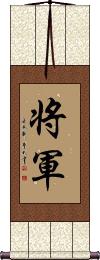
将軍 or Shogun, in the simplest definition, is a General, but you could also use words such as commander, lord, overlord, highest ranking, or commanding officer.
The title “Shogun” has held some slightly ambiguous meanings at times in Japanese history.
In the west, when someone mentions “Shogun,” we may be filled with thoughts of gallant warriors. Some might even think of the TV mini-series with Richard Chamberlain. Often westerners use the words, Samurai and Shogun interchangeably, but that's really not technically correct. In the case of the Samurai, the Shogun was a designated (by the emperor) leader of a gild of Samurai. In this context, the Shogun was a Samurai lord. Or effectively, a commanding officer of a company of Samurai - to put it in modern military terms.
Sometimes a Shogun was a general; other times, he was the leader of a military government in Japan - but not a front-line warrior like a Samurai.
Variants of the same characters are used in China for the rank and title of a General of the People's Liberation Army (and the same term and characters have been used for the last 2200 years since the Qin Dynasty).
Fatal error: Cannot redeclare foreignPrice() (previously declared in /home/gwest/web/chinesescrollpainting.com/public_html/includes/currencyconverter.php:22) in /home/gwest/web/orientaloutpost.com/public_html/includes/currencyconverter.php on line 22