Many custom options...


And formats...



Listen in Chinese / Japanese...
Buy a Listen calligraphy wall scroll here!
Personalize your custom “Listen” project by clicking the button next to your favorite “Listen” title below...
Listen
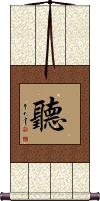
聽 means to listen, hear, and obey (depending on context).
聽 is a stand-alone word in Chinese but is usually seen in compound words in Korean. Therefore, this title is best for a Chinese audience.
 The ancient form of this character is shown in the upper left. However, there is a modern Japanese Kanji version shown to the right. If you want this modern Japanese version, please let us know when you place your order.
Listen to Both Sides and be Enlightened, Listen to One Side and be in the Dark
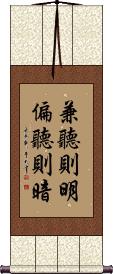
兼聽則明偏聽則暗 is an ancient Chinese proverb about getting all the information from all sides so that you truly understand a situation.
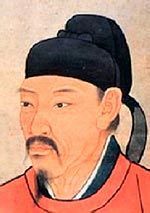
Wei Zheng
A man named Wei Zheng lived between 580-643 AD. He was a noble and wise historian and minister in the court of the early Tang Dynasty. The emperor once asked him, “What should an emperor do to understand the real-world situation, and what makes an emperor out-of-touch with reality?”
Wei Zheng replied, “Listen to both sides and you will be enlightened; listen to only one side and you will be left in the dark.”
Then Wei Zheng went on to cite examples of leaders in history that were victorious after heeding both sides of the story, and other leaders that met their doom because they believed one-sided stories which often came from flattering lips.
Please note that there is an unwritten rule when the same character appears twice in the same phrase, the calligrapher will alter the appearance so that no two characters are exactly alike in the same piece. This calligraphy has two repeating characters that will be written differently than they appear here.
Listen with Open Mind
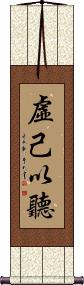
虛己以聽 is a Chinese proverb that means to listen to the ideas of others with an open mind.
Listen to Your Heart / Follow Your Heart
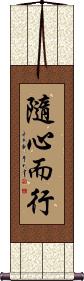
隨心而行 is the closest way to express this idea in Chinese. Literally translated, this phrase means “Allow your heart to dictate your behavior” or “Let your heart guide your conduct” in Chinese. You could also translate this as “follow your heart.” Or, with a bit of imagination, it could mean: “let your spirit be your guide.”
Note that in some cases, “heart” can mean “mind,” “soul” or even “spirit” in Chinese. In ancient China, it was thought that the big pumping organ in your chest was where your thoughts came from, or where your soul resides.
Ancient western thought followed a similar belief. Thus phrases like “I love you with all my heart” and “I give you my whole heart.”
Follow Your Heart
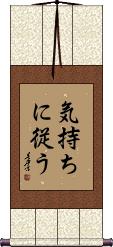
気持ちに従う is a Japanese phrase that means follow your heart.
The first part of this Japanese proverb means feeling, sensation, or mood.
The second part suggests the following, abiding by, or listening to this inner feeling.
In this context, you could say it means your heart, as the whole proverb suggests that you follow the feelings that you have inside.
Note: Because this selection contains some special Japanese Hiragana characters, it should be written by a Japanese calligrapher.
Fatal error: Cannot redeclare foreignPrice() (previously declared in /home/gwest/web/chinesescrollpainting.com/public_html/includes/currencyconverter.php:22) in /home/gwest/web/orientaloutpost.com/public_html/includes/currencyconverter.php on line 22