Many custom options...


And formats...



Live for the Day in Chinese / Japanese...
Buy a Live for the Day calligraphy wall scroll here!
Personalize your custom “Live for the Day” project by clicking the button next to your favorite “Live for the Day” title below...
2. Live For The Day / Seize The Day
4. Live In The Moment / Live In The Now
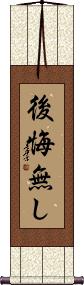
7. No Regrets
8. A Life of Happiness and Prosperity
11. Ikiru / To Live
12. Live Strong
13. Live Laugh Love
14. Live Strong
17. Live in Peace and Contentment
19. Live and Let Die
21. Live Free or Die
23. Live Well
24. Live Together and Help Each Other
25. Live Love Die
26. Life Goes On
27. Life Force
28. Everyday Life
29. Birth / Life
30. Life Goes On
31. Life is Short
32. Alive
35. A Life of Serenity Yields Understanding
36. Optimism / Happy With Your Fate
37. A Life of Happiness and Prosperity
39. Live By The Sword Die By The Sword
40. Galatians 5:25
Live For The Day
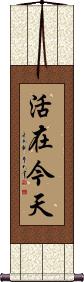
活在今天 is not an eastern concept, so it does not translate into a phrase that seems natural on a wall scroll.
However, if this is your philosophy, the characters shown here do capture your idea of living for today or living in the moment. 活在今天 says “Live in today,” and they are grammatically correct in Chinese.
Note: This kind of makes sense in Korean Hanja but the grammar is Chinese, so it’s not that natural in Korean.
Live For The Day / Seize The Day
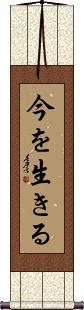
今を生きる is a Japanese phrase that can be translated as “live for the day,” “live for the moment,” “seize the day,” or “make the most of the present.”
You can think of this as the Japanese version of “Carpe Diem.”
Note: Because this selection contains some special Japanese Hiragana characters, it should be written by a Japanese calligrapher.
Live Without Regret
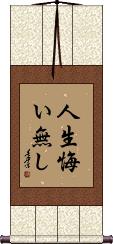
人生悔い無し is how to say “live without regrets” in Japanese.
Note: Because this selection contains some special Japanese Hiragana characters, it should be written by a Japanese calligrapher.
See Also: Live for Today
Live Without Regret
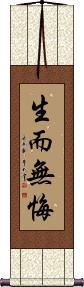
生而無悔 is how to say “live without regrets” in Mandarin Chinese.
Note: There is some debate about whether this makes sense in Japanese. It would be read, "nama ji mu ke," and be understood in Japanese. But, a Japanese person will probably think it’s Chinese (not Japanese).
See Also: Live for Today
Live In The Moment / Live In The Now
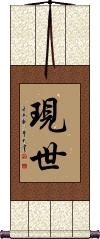
現世 is a very short way to write “live in the moment” or “live in the now” in Japanese.
This short word is open to interpretation. It's used in Japanese Buddhism to mean “the current epoch” or “the current age” (the current age is but a brief moment in the greater scope of existence). In that context, this is pronounced “utsushiyo” or “ustusiyo” in Japanese. Otherwise, it's pronounced “gensei” in Japanese.
Other translation possibilities include:
Earthly world
This world
This life
Present life
Present generation
Present incarnation
This existence
This (momentary) reality
Note: This is also a word in Chinese and old Korean Hanja. While the meaning is more or less the same, this is not recommended for a wall scroll if your audience is Chinese or Korean. This selection is best if your audience is Japanese.
Living / Live Life
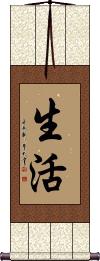
生活 means life, living, to live, or the state of being alive. It can also refer to your daily existence or livelihood. It can also be a suggestion to just “Live life.”
生活 is also the term used in other titles such as “healthy living” or Lance Armstrong's “Livestrong” campaign (Chinese title for Livestrong only).
If you need a reminder that you are alive and to take a breath, this might be the perfect wall scroll for you.
Live Laugh Love
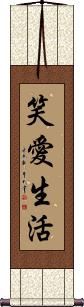
In English, the word order shown in the title is the most natural or popular. In Chinese, the natural order is a little different:
The first character means laugh (sometimes means smile).
The second character means love.
The last two characters mean “live” as in “to be alive” or “pursue life.”
Please note: 笑愛生活 is not a normal phrase in that it does not have a subject, verb, or object. It is a word list. Word lists are not common in Asian languages/grammar (at least not as normal as in English). We only added this entry because so many people requested it.
We put the characters in the order shown above, as it almost makes a single word with the meaning “A life of laughter and love.” It's a made-up word, but it sounds good in Chinese.
We removed the Japanese pronunciation guide from this entry, as the professional Japanese translator deemed it "near nonsense" from a Japanese perspective. Choose this only if your audience is Chinese and you want the fewest-possible characters to express this idea.
In Korean, this would be 소애생활 or "so ae saeng hwar" but I have not confirmed that this makes sense in Korean.
No Regrets
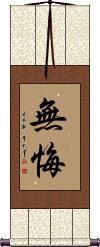
無悔 is how to say “no regrets” in Mandarin Chinese.
This also makes sense in Japanese, though not the most common way to express “no regrets” in Japanese.
See Also: Live for Today
No Regrets
A Life of Happiness and Prosperity
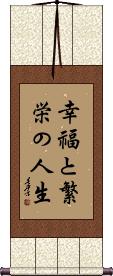
幸福と繁栄の人生 is a Japanese proverb that means “A life of happiness and prosperity” or “A life of happiness and success.”
Note: Because this selection contains some special Japanese Hiragana characters, it should be written by a Japanese calligrapher.
See Also: Prosperity
Carpe Diem / Seize the Day
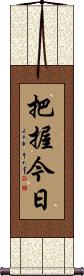
把握今日 is the closest and most natural way to express this proverb in Chinese.
The first two characters mean “to seize” but can also be translated as “take control of.”
The last two characters mean “today.”
Live in Prosperity
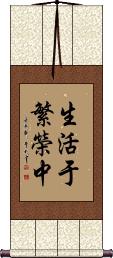
生活于繁榮中 means “live in prosperity.” It's kind of a suggestion to be prosperity the center of your world.
This is the way some people want to live (and you should always live for what you love). However, this phrase does not suggest a peaceful life - rather one that is always busy. It's not for everyone, but it might be for you.
See Also: Prosperity
Ikiru / To Live
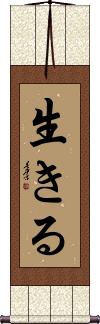
生きる is a Japanese title that means to live, to exist, to make a living, to subsist, to come to life, or to be enlivened.
生きる is also the title of a 1952 Japanese movie that uses the translated English title of “To Live.”
This term, when used in the context of baseball, and some Japanese games such as “go,” can mean “safe.”
Note: Because this selection contains some special Japanese Hiragana characters, it should be written by a Japanese calligrapher.
Live Strong
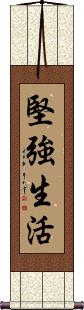
While hard to translate directly, 堅強生活 is the best way to write “Live Strong” in Chinese. If you are a cancer survivor or support Lance Armstrong's ideas, this is a nice selection for a wall scroll.
The first two characters mean strong or staunch. The last two mean living or life (daily existence). While the Chinese version is the reverse order of “Live Strong” it is the only way to write it in a natural form that is grammatically correct.
Note that we are in no way affiliated or connected to Lance or his foundation. This translation is offered because of multiple requests from customers whose philosophies or ideas match those of the Live Strong idea.
Live Laugh Love
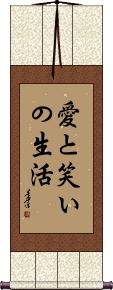
Because a word list of “Live Laugh Love” is not natural in Japanese, this takes the concept and incorporates it into a proper phrase.
愛と笑いの生活 can be translated as “A life of love and laughter” or “Live life with love and laughter.”
Note: Because this selection contains some special Japanese Hiragana characters, it should be written by a Japanese calligrapher.
Live Strong
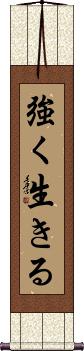
強く生きる is “Live Strong” in Japanese.
If you are a cancer survivor, or simply support Lance Armstrong's ideas, this is a nice selection for a wall scroll.
Note that we are in no way affiliated or connected to Lance, nor his foundation.
Note: Because this selection contains some special Japanese Hiragana characters, it should be written by a Japanese calligrapher.
You Only Live Once
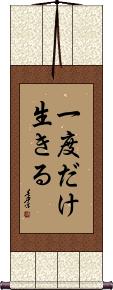
一度だけ生きる is the simplest Japanese phrase that means “[you] only live once” or “only one [life] to live.”
The first four characters create a word that means “only once.”
The last three characters create a word that means “to live” or “to exist.”
Note: Because this selection contains some special Japanese Hiragana characters, it should be written by a Japanese calligrapher.
Traveler / To Live Abroad
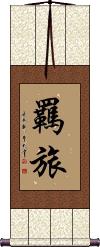
羈旅 is a Chinese and Japanese title for traveler/traveller, to live abroad, to be traveling, or just travel.
Live in Peace and Contentment
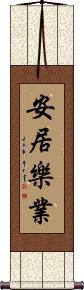
安居樂業 is the Chinese, Japanese Kanji, and old Korean Hanja proverb for “living in peace and working happily,” or “to live in peace and be content with one's occupation.”
Live Long and Prosper
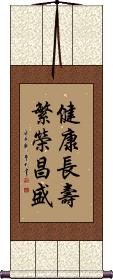
This means “Live Long And Prosper” in Chinese.
A phrase and greeting made famous by Leonard Nimoy in the role of Spock on the original Star Trek TV series.
Live and Let Die
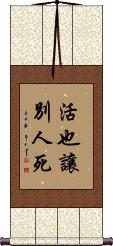
活也讓別人死 means “live and let die” in Chinese.
This is the Chinese translation of the song lyric by Guns 'n Roses for the James Bond 007 movie of the same name.
Live and Let Die
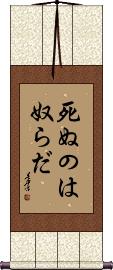
死ぬのは奴らだ means “live and let die,” in Japanese.
死ぬのは奴らだ is the Japanese title of the James Bond 007 movie of the same name.
Note: Because this selection contains some special Japanese Hiragana characters, it should be written by a Japanese calligrapher.
Live for What You Love
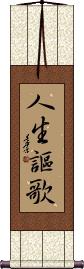
人生謳歌 means “live for what you love” in Japanese.
The first two characters mean “human life” or simply “living.” The last two characters mean “merit,” “prosperity,” or “what you enjoy.” This phrase can suggest working or staying busy for your own goals (in your career).
See Also: Prosperity
Live Free or Die
Give me liberty or give me death
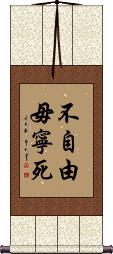
不自由毋寧死 means “Give me liberty or give me death” in Chinese.
This is also the best way to say, “Live free or die.”
The characters break down this way:
不 = Not; none; without.
自由 = Freedom; liberty; freewill; self-determination.
毋寧 = Rather; would rather; rather be.
死 = Dead; death.
This will go nicely next to your “Don't tread on me” flag. This phrase is known well enough in China that it's listed in a few dictionaries. Though I doubt you will find too many Chinese citizens willing to yell this on the steps of the capital in Beijing.
See Also: Death Before Dishonor
You Only Live Once
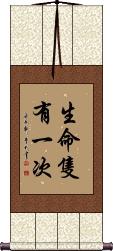
生命隻有一次 is the translation to Chinese of the popular English phrase, “You only live once.”
This is a more modern idea for Chinese people. The reason is, most Chinese people were taught quite the opposite idea from Buddhism.
Live Well
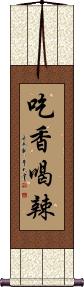
This Chinese proverb means “to eat delicious food and drink liquor.”
It is taken or understood to suggest living well.
Live Together and Help Each Other
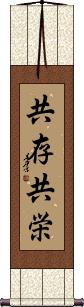
共存共栄 is a Japanese proverb that means “live together and help each other,” “existing together, thriving together,” or “co-existence and co-prosperity.”
Live Love Die
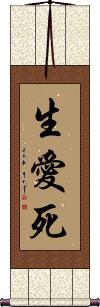
This came from a customer's request, but it's not too bad.
These three simple characters suggest that you are born, you learn to love, and then exit the world.
Life Goes On
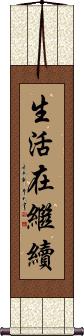
生活在繼續 means “No matter what happens, life goes on” or “For better or worse, life goes on.”
生活在繼續 is kind of modern Chinese proverb, but the meaning is generational.
生活 = to live; life; livelihood.
在 = (used before a verb to indicate an action in progress).
繼續 = to continue; to proceed with; to go on with.
Life Force
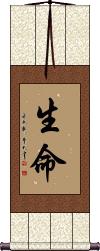
This Chinese, Korean and Japanese word means “life force” or simply “life.”
The first character means “life” or “birth.” The second means “life” or “fate.” Together they create the meaning of “life force,” though some will translate this as “existence” and sometimes “vitality.”
Everyday Life
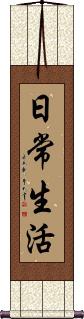
日常生活 simply means everyday life or regular life.
You can also translate it as “Living day to day.”
Birth / Life
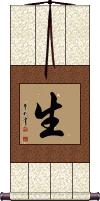
生 is a Chinese word that means “to be born” and “to give birth.”
Also, it's often used to refer to life itself, and sometimes “to grow.”
生 is used in a lot of compound words such as “yi sheng,” which means “doctor” (literally “healer of life”), “sheng ri” which means “birthday” (literally “birth-day”), and “xue sheng” which means student (literally “studying life” or “learner [about] life”). Few Chinese people will think of the literal meaning when this uses words like doctor and student - but it is interesting to note.
生 has the same root meaning in Korean Hanja and Japanese. However, in Japanese, there are many possible pronunciations, and this can be used to mean “raw” or “unprocessed” (as in draft beer). Therefore, not be the best if your audience is Japanese.
See Also: Vitality
Life Goes On
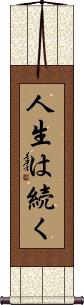
人生は続く is a Japanese phrase that expresses, “Life Goes On.”
The first two characters mean “life” (literally “human life”).
The third character is a particle that connects the ideas in this phrase.
The last two characters mean “to continue,” “to last,” “to go on,” and “to occur again and again.”
Note: Because this selection contains some special Japanese Hiragana characters, it should be written by a Japanese calligrapher.
Life is Short
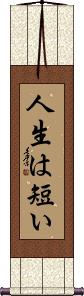
人生は短い is “life is short” in Japanese.
The character breakdown:
人生 (jinsei) life (i.e., conception to death); human life, living, lifetime.
は (ha/wa) particle (means “is” in this case).
短い (mijikai) short.
Note: Because this selection contains some special Japanese Hiragana characters, it should be written by a Japanese calligrapher.
Life is Short
A 100-year-old is but a traveler passing through this life
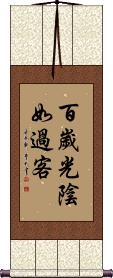
百歲光陰如過客 directly translates as: [Even a] hundred-year-old [person] is [just a] traveler passing by.
The simple message is, “Human life is short.” Of course, there is an unspoken suggestion that you should make the best of your time here on earth.
Alive
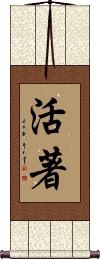
活著 is the word that means alive, as in the state of living or being alive (Chinese only).
Immortal / Immortality
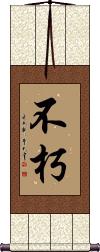
不朽 means immortal or immortality in Chinese, Japanese Kanji, and old Korean Hanja.
The literal translation is “without decay” or “never rotting.” This title speaks of something or someone who never dies and thus never rots or decays.
This can also be translated as everlasting, eternal, or imperishable.
Life is a Journey
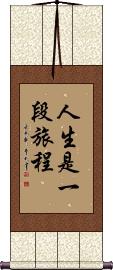
人生是一段旅程 is a proverb that means “Life is a Journey.”
If this matches your philosophy, this might be the perfect Chinese calligraphy for you.
A Life of Serenity Yields Understanding
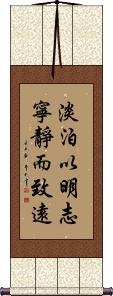
淡泊以明志寧靜而致遠 is a kind of complex ten-character proverb composed by Zhuge Liang about 1800 years ago.
This is a Chinese proverb that means “Leading a simple life will yield a clear mind, and having inner peace will help you see far (into the world).”
What I have translated as “simple life” means NOT being materialistic and NOT competing in the rat race.
The last word means “far” but the deeper meaning is that you will surpass what you can currently see or understand. Perhaps even the idea of opening up vast knowledge and understanding of complex ideas.
The whole phrase has a theme that suggests if you are NOT an aggressive cut-throat person who fights his way to the top no matter how many people he crushes on the way, and instead seek inner peace, you will have a happier existence and be more likely to understand the meaning of life.
See Also: Serenity
Optimism / Happy With Your Fate
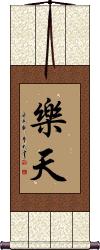
樂天 is about being optimistic and also making the best of whatever life throws at you.
This is hard to define. One dictionary defines this as “acceptance of fate and happy about it.” There is one English word equivalent, which is sanguinity or sanguinary.
You can also say that this means “Be happy with whatever Heaven provides,” or “Find happiness in whatever fate Heaven bestows upon you.” 樂天 suggests being an optimist in life.
Note: This is sometimes a given name in China.
 Please note that Japanese tend to write the first character in a slightly-different form (as seen to the right). Let us know if you have a preference when you place your order.
A Life of Happiness and Prosperity
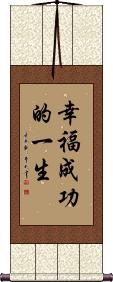
幸福成功的一生 means “A life of happiness and prosperity” or “A life of happiness and success.”
It's a very positive and inspirational wall scroll selection.
See Also: Prosperity
Die Without Regret
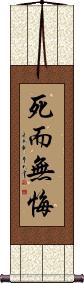
死而無悔 is how to say “die with no regrets” in Mandarin Chinese.
This proverb comes from the Analects of Confucius.
See Also: No Regrets
Live By The Sword Die By The Sword
Matthew 26:52
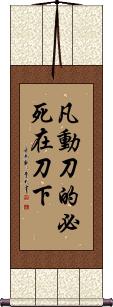
凡动刀的,必死在刀下 is the second part of Matthew 26:52 from the Chinese Union Bible where Jesus suggests that one who uses a sword will also die by it.
Galatians 5:25
If we live in the Spirit, let us also walk in the Spirit
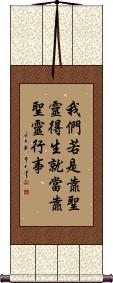
我們若是靠聖靈得生就當靠聖靈行事 is the translation of Galatians 5:25 into Mandarin Chinese via the Chinese Union Bible.
KJV: If we live in the Spirit, let us also walk in the Spirit.
NIV: Since we live by the Spirit, let us keep in step with the Spirit.
The annotation of this Chinese translation:
1.我们 wǒ men - we / us / ourselves
2.若是 ruò shì - if
3.靠 kào - depend upon / lean on / near / by / against / to support
4.圣灵 shèng líng - Holy Ghost
5.得 děi - to have to / must / ought to / degree or possibility
6.生就 shēng jiù - born one way or another (nervous, suspicious, etc.)
7.当 dàng - suitable / adequate / fitting / proper
8.靠 kào - depend upon / lean on / near / by / against / to support
9.圣灵 shèng líng - Holy Ghost
10.行事 xíng shì - how one does things / how one runs things (in this case, it suggests, “to walk in step with”)
Fatal error: Cannot redeclare foreignPrice() (previously declared in /home/gwest/web/chinesescrollpainting.com/public_html/includes/currencyconverter.php:22) in /home/gwest/web/orientaloutpost.com/public_html/includes/currencyconverter.php on line 22