Many custom options...


And formats...



Living Live Life in Chinese / Japanese...
Buy a Living Live Life calligraphy wall scroll here!
Personalize your custom “Living Live Life” project by clicking the button next to your favorite “Living Live Life” title below...
Living / Live Life
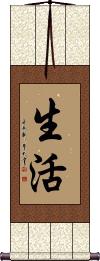
生活 means life, living, to live, or the state of being alive. It can also refer to your daily existence or livelihood. It can also be a suggestion to just “Live life.”
生活 is also the term used in other titles such as “healthy living” or Lance Armstrong's “Livestrong” campaign (Chinese title for Livestrong only).
If you need a reminder that you are alive and to take a breath, this might be the perfect wall scroll for you.
Alive
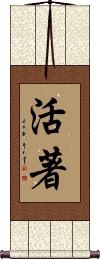
活著 is the word that means alive, as in the state of living or being alive (Chinese only).
Live For The Day
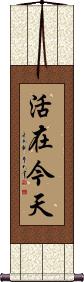
活在今天 is not an eastern concept, so it does not translate into a phrase that seems natural on a wall scroll.
However, if this is your philosophy, the characters shown here do capture your idea of living for today or living in the moment. 活在今天 says “Live in today,” and they are grammatically correct in Chinese.
Note: This kind of makes sense in Korean Hanja but the grammar is Chinese, so it’s not that natural in Korean.
Life is Short
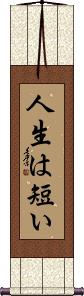
人生は短い is “life is short” in Japanese.
The character breakdown:
人生 (jinsei) life (i.e., conception to death); human life, living, lifetime.
は (ha/wa) particle (means “is” in this case).
短い (mijikai) short.
Note: Because this selection contains some special Japanese Hiragana characters, it should be written by a Japanese calligrapher.
Live for What You Love
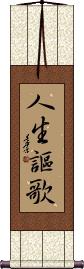
人生謳歌 means “live for what you love” in Japanese.
The first two characters mean “human life” or simply “living.” The last two characters mean “merit,” “prosperity,” or “what you enjoy.” This phrase can suggest working or staying busy for your own goals (in your career).
See Also: Prosperity
Everyday Life
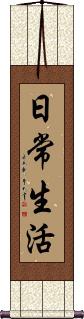
日常生活 simply means everyday life or regular life.
You can also translate it as “Living day to day.”
Embrace Life / Embrace Living
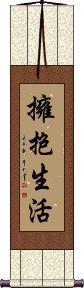
擁抱生活 is a Chinese title that means to embrace or to hug life, or embrace what it is to live.
Ikiru / To Live
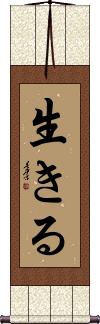
生きる is a Japanese title that means to live, to exist, to make a living, to subsist, to come to life, or to be enlivened.
生きる is also the title of a 1952 Japanese movie that uses the translated English title of “To Live.”
This term, when used in the context of baseball, and some Japanese games such as “go,” can mean “safe.”
Note: Because this selection contains some special Japanese Hiragana characters, it should be written by a Japanese calligrapher.
Live Strong
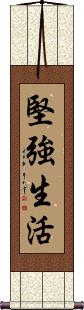
While hard to translate directly, 堅強生活 is the best way to write “Live Strong” in Chinese. If you are a cancer survivor or support Lance Armstrong's ideas, this is a nice selection for a wall scroll.
The first two characters mean strong or staunch. The last two mean living or life (daily existence). While the Chinese version is the reverse order of “Live Strong” it is the only way to write it in a natural form that is grammatically correct.
Note that we are in no way affiliated or connected to Lance or his foundation. This translation is offered because of multiple requests from customers whose philosophies or ideas match those of the Live Strong idea.
Thug Life
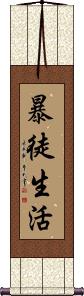
暴徒生活 is probably the best way to say “Thug Life” in Chinese, Japanese, and Korean.
It's a strange title, to be sure, so expect native Asian people to be confused when they see your Thug Life calligraphy.
The first two characters mean bandit, thug, ruffian, insurgent, rioter, or mob.
The last two characters mean life, live, or living.
Principles of Life
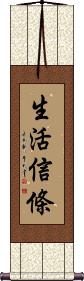
生活信條 is a Chinese proverb that means “principles of life” or “The personal obligations and rules that you live by.”
For instance, if you were a vegetarian, the act of not eating meat fits into this category.
This could also be translated as a “Way of living.”
Life in Every Breath
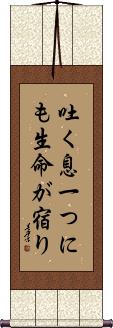
吐く息一つにも生命が宿り means “life in every breath” in Japanese.
This phrase is more like “every single breath as you live and dwell.”
The characters breakdown this way:
吐く息 (hakuiki) to breathe; exhaled air; one's breath; breathing.
一つ (hitotsu) one; only; just.
にも (nimo) also; too; as well; even.
生命 (seimei) life; existence; living.
が (ga) particle.
宿り (yadori) to lodge; to dwell; lodging; abode; shelter.
Note: Because this selection contains some special Japanese Hiragana characters, it should be written by a Japanese calligrapher.
Fatal error: Cannot redeclare foreignPrice() (previously declared in /home/gwest/web/chinesescrollpainting.com/public_html/includes/currencyconverter.php:22) in /home/gwest/web/orientaloutpost.com/public_html/includes/currencyconverter.php on line 22