Many custom options...


And formats...



Longevity in Chinese / Japanese...
Buy a Longevity calligraphy wall scroll here!
Personalize your custom “Longevity” project by clicking the button next to your favorite “Longevity” title below...
Longevity / Long Life
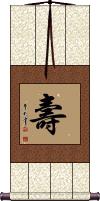
壽 can be defined as “long life” or “longevity” in the simplest form.
 Please note that Japanese use a simplified version of this character - it also happens to be the same simplification used in mainland China. Click on the character to the right if you want the Japanese/Simplified version.
Longevity / Long Life
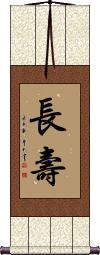
Used as a noun, this word means “longevity” or “the ability to live long.”
It can also be an adjective meaning “long-lived.”
Please note that Japanese use a simplified version of the second character of longevity - it also happens to be the same simplification used in mainland China. Click on the character to the right if you want the Japanese/Simplified version of this two-character longevity calligraphy.
Longevity / Long Life Wishes
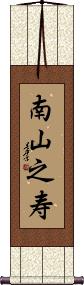
南山之壽 is a wish for long life for someone. The first part of this Japanese phrase is “Nan Zan,” which means “south mountain.” This mountain is one of the good wishes, good fortune, and prosperity. The title is often used as a salutation of good wishes.
The third Kanji is just a connector, and the last Kanji means long life or longevity.
I guess you could translate this phrase as “May your life be as long as Nan Zan is tall.”
Longevity / Long Life Wishes
A wish for a long and prosperous life
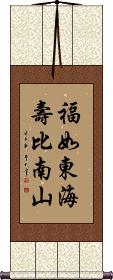
福如東海壽比南山 is a phrase that means “May you have good fortune as great as the eastern oceans, and may your life last as long as the southern mountains.”
In ancient Chinese mythology, the eastern oceans and southern mountains are where God resides (basically it is the same as saying “heaven”). So it's like saying, “May your good fortune and life be as vast as the heavens.”
There is also a longer, 14-character version of this phrase. Also, this can be cut into two scrolls (with half the phrase on each side - great for hanging on either side of a doorway). Just let me know if you'd like a special version (there is an additional cost).
Freedom from Anger and Worry Yields Longevity
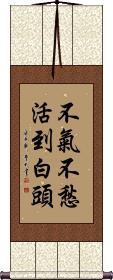
不气不愁活到白头 is a Chinese proverb that means “Without anger or worry, you will have a long life, until after all your hair is white.”
It more literally reads, “Don't get angry or worried [and you will] live [long] till [all your] hair [becomes] white.”
Peach / Peaches
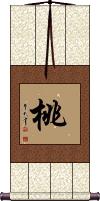
桃 means peach or peaches (Prunus persica) in Chinese, old Korean Hanja, and Japanese Kanji.
In Chinese culture, the peach represents longevity or long life.
This can also be the Japanese surname, Momosaki.
Banzai / Wansui
Old Japanese / Traditional Chinese & Korean
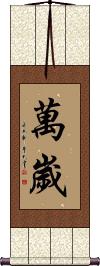
萬歲 is the traditional Chinese, Korean Hanja, and ancient Japanese way of writing banzai.
In modern times, the first character was simplified in Japan and China. So you might want to select the other entry for universal readability.
While it has become a popular, if not an odd, thing to scream as you jump out of an airplane (preferably with a parachute attached), banzai is actually a very old Asian way to say “hooray.” The Japanese word “banzai” comes from the Chinese word “wan sui,” which means “The age of 10,000 years.” It is actually a wish that the Emperor or the Empire live that long.
Imagine long ago when the Emperor made a rare public appearance. 萬歲 is what all people would yell to their leader in respect.
So if you like it as a hooray, or you want to wish someone that they live for 10,000 years, this is the calligraphy for you.
Other translations include Cheers! (not the drinking kind), hurrah!, long live [name]!, and congratulations!
To other things with banzai in their names, I am still waiting for the promised sequel to Buckaroo Banzai.
Notes: Sometimes people confuse banzai with bonsai. A bonsai is a miniature tree. They have nothing to do with each other.
Banzai
Modern Japanese Version
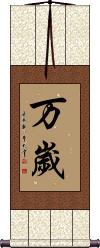
万歲 is the modern Japanese way to write banzai.
We've made two almost identical entries for this word, with just a variation on the first character. In the last century, 萬 was simplified to 万 in Japan and China. The new generation will expect it to be written as 万 but the old generation can still read the more traditional 萬 form. You must make your determination as to what version is best for you. If your audience is mostly Japanese, I suggest 万歲.
While it has become a popular, if not an odd, thing to scream as you jump out of an airplane (preferably with a parachute attached), banzai is actually a very old Asian way to say “hooray.” The Japanese word “banzai” comes from the Chinese word “wan sui” which means “The age of 10,000 years.” It is actually a wish that the Emperor or the Empire live that long.
Imagine long ago when the Emperor made a rare public appearance. This is what all of the people would yell to their leader in respect.
So if you like it as a hooray, or you want to wish someone that they live for 10,000 years, this is the calligraphy for you.
To other things with banzai in their names, I am still waiting for the promised sequel to Buckaroo Banzai.
Other translations: hurrah, long life, congratulations, cheers, live long.
Notes: Sometimes people confuse banzai with bonsai. A bonsai is a miniature tree. They have nothing to do with each other. Further, Bonzai is not a word at all - although it would make a great name for a calcium supplement for older people.
Crane
Graceful bird of longevity
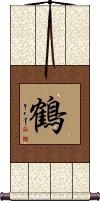
鶴 is a famous bird of China.
Known in China to be a very spiritual creature, the crane is a symbol of both longevity and the journey of the souls and spirits of ancestors.
Note: 鶴 can mean crane or stork in Japanese.
Fatal error: Cannot redeclare foreignPrice() (previously declared in /home/gwest/web/chinesescrollpainting.com/public_html/includes/currencyconverter.php:22) in /home/gwest/web/orientaloutpost.com/public_html/includes/currencyconverter.php on line 22