Many custom options...


And formats...



Love Will Find a Way in Chinese / Japanese...
Buy a Love Will Find a Way calligraphy wall scroll here!
Personalize your custom “Love Will Find a Way” project by clicking the button next to your favorite “Love Will Find a Way” title below...
Love Will Find A Way
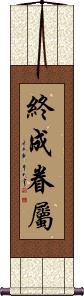
終成眷屬 is a Chinese proverb that translates roughly as “Love will find a way to come together.”
Love Will Find A Way
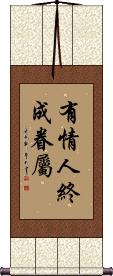
有情人終成眷屬 is the long version of the Chinese proverb that translates as “Where there are lovers, love will find a way (to come together).”
Love and Honor
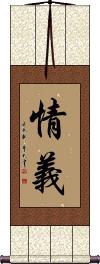
情義 means to love and honor in Chinese. 情義 is more or less the kind of thing you'd find in marriage vows.
The first character suggests emotions, passion, heart, humanity, sympathy, and feelings.
In this context, the second character means to honor your lover's wishes and treat them justly and righteously (fairly). That second character can also be translated as “obligation,” as in the obligation a husband and wife have to love each other even through difficult times.
In the context outside of a couple's relationship, this word can mean “comradeship.”
Japanese may see this more as “humanity and justice” than “love and honor.” It's probably best if your target is Chinese.
This is the short and sweet form, there is also a longer poetic form (you can find it here: Love and Honor if it’s not on the page you are currently viewing).
See Also: Love and Honor
Love and Honor
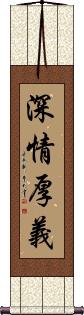
深情厚義 means to love and honor.
This is more or less the kind of thing you'd find in marriage vows.
The first two characters suggest deep love or deep emotions, passion, and feelings.
The last two characters mean generous justice or thick honor (the third character is an adjective that means generous or thick). It just means that you will honor your lover's wishes and treat them justly and righteously (fairly).
This is the longer four-character version, there is also a short and sweet two character version.
See Also: Love and Honor
Strength and Love in Unity
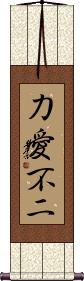
力愛不二 is a proverb that literally means:
“Strength [and] Love [are] Not Two [separate ideas/concepts/things].”
You'll find this proverb translated from Japanese to English as:
Love and strength are not separate.
Power and love are indivisible.
Strength and love in harmony.
Strength and love stand together.
Old Japanese grammar is quite different than English, and so this proverb says a lot within the brevity of just 4 characters. If you just read these characters directly as “Strength Love Not Two,” you'd probably miss the real meaning.
According to the Swedish Shorinji Kempo Federation, this is the second characteristic of Shorinji Kempo.
This post really explains the concept best in my opinion: Bushido by MS: Riki Ai Fu Ni, which states: "Riki Ai Funi" is the philosophy that power (Riki) and love (Ai) are indivisible. More concretely, a person, who is powerful but does not have love, cannot control and misuse his/her power; on the other hand, a person, who has loved ones but is not powerful enough, cannot protect himself/herself nor loved ones.
Best
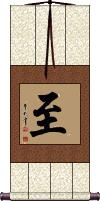
至 is a little strange as calligraphy, but 至 would be the character that means “best” or “extreme” in Chinese and Korean.
The problem is, this is seldom used alone. It's mostly used in combination with other characters to make words like “best friend,” “best food,” and “best love.”
I do not recommend this character for a wall scroll. It's better if you find a more specific term that fits your circumstances.
Note: This can be pronounced in Japanese and has a similar meaning but it is rarely if ever used in modern Japanese.
Generosity
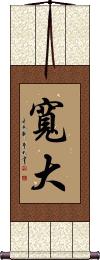
寬大 is a Chinese, Japanese, and Korean word that means Generosity.
Generosity is giving and sharing. You share freely, not with the idea of receiving something in return. You find ways to give others happiness and give just for the joy of giving. Generosity is one of the best ways to show love and friendship.
寬大 can also be translated as charitable, magnanimity, liberality, or in some contexts, broad-mindedness.
Note: There is a tiny deviation in the first character when written in Japanese. If you choose our Japanese master calligrapher, the little dot on the lower right of the first character will be omitted. With or without the dot, this can be read in Chinese, Japanese Kanji, and old Korean Hanja.
See Also: Benevolence | Altruism | Charity
Islam
(phonetic version)
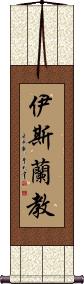
伊斯蘭教 both means and sounds like “Islam” in Mandarin Chinese.
The first three characters sound like the word “Islam,” and the last character means “religion” or “teaching.” It's the most general term for “Islam” in China. The highest concentration of Muslims in China is Xinjiang (the vast region in northwest China that was called The East Turkistan Republic until 1949 and is sometimes called Chinese Turkistan, Uyghuristan). Here you will find Uygurs, Kazakhs, Kyrgyz, and others that are descendants of Turkmen (possibly mixed with Persians and Arabs). Many of their ancestors were traders who traveled the silk road to buy and sell spices and silk and exchange other goods from the Orient and the Middle East.
I spent some time in Xinjiang and got to know this community. They are strong people who can endure much. They are friendly and love to have a good time. I was a stranger but was treated by villagers (near China's border with Afghanistan) as if I was a good friend.
However, I have heard that it's best not to cross them, as in this land, the law is the blade, and everything is “eye for an eye.” The Chinese government has little control in Xinjiang, with almost no police officers except in the capital of Urumqi (so it's a 60-hour roundtrip train ride to seek the aid of law enforcement in most cases).
While few seem devout, there are at least small mosques in every village. And you will never see a man or woman outside without a head covering.
It should be noted that these people are all citizens of China, but they are officially of the Caucasian race. A visit to Xinjiang will change your idea of what it means to be Chinese.
Fatal error: Cannot redeclare foreignPrice() (previously declared in /home/gwest/web/chinesescrollpainting.com/public_html/includes/currencyconverter.php:22) in /home/gwest/web/orientaloutpost.com/public_html/includes/currencyconverter.php on line 22