Many custom options...


And formats...



Love the Flower Love the Pot Also in Chinese / Japanese...
Buy a Love the Flower Love the Pot Also calligraphy wall scroll here!
Personalize your custom “Love the Flower Love the Pot Also” project by clicking the button next to your favorite “Love the Flower Love the Pot Also” title below...
Love the Flower, Love the Pot also
Love Me, Love My Dog
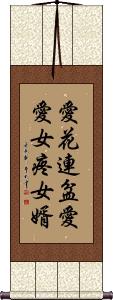
This proverb, 爱花连盆爱爱女疼女婿, literally translates as “If one loves a flower, [one will] love its pot; [if one really] loves [one's] daughter, [one will also] love [one's] son-in-law.”
Figuratively, is similar to the English proverbs:
Love me, love my dog.
Love for a person extends even to the crows on his roof.
Rose Flower
(The flower of love)
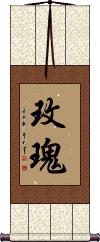
玫瑰 is the most common way to write rose (as in the flower) in Chinese.
Rose Flower
(The flower of love)
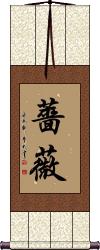
薔薇 is the universal way to write rose (as in the flower) because it is understood in both Chinese and Japanese (same characters in either language). 薔薇 is also a common way to write about roses in Asian poetry. This can be translated as “wild rose” if you are looking for that title.
薔薇 is also how to write “rose” in old Korean Hanja (though they now use Hangul, and most Koreans of this generation will not be able to read this without a dictionary).
Daisy
The yellow flower
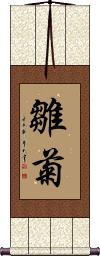
雛菊 is how they write “daisy” in Chinese and Japanese.
This is a good choice if you love daisies, or your name is Daisy. If you translated it directly, this means “chick flower” (as in baby chickens) or “baby chrysanthemum.” Of course, when an Asian person reads this, they just think “daisy.”
If you're into botany, this title represents “Bellis Perennis.”
In Japanese, this can be the female given name, Hinagiku.
Fatal error: Cannot redeclare foreignPrice() (previously declared in /home/gwest/web/chinesescrollpainting.com/public_html/includes/currencyconverter.php:22) in /home/gwest/web/orientaloutpost.com/public_html/includes/currencyconverter.php on line 22