Many custom options...


And formats...



Martial Arts Master in Chinese / Japanese...
Buy a Martial Arts Master calligraphy wall scroll here!
Personalize your custom “Martial Arts Master” project by clicking the button next to your favorite “Martial Arts Master” title below...
See also: Martial Arts Words and Phrases
2. Grand Master / Great Teacher
4. Teacher / Master / Old Sage
5. Sensei / Master / Teacher / Mister
6. Fatherly Master / Sifu / Shi Fu / Shifu
7. Ip Man
8. Shihan
11. Kenpo / Kempo / Quan Fa / Chuan Fa
12. Sword Saint
15. Taekwondo
16. Rank Holder
Martial Arts Master
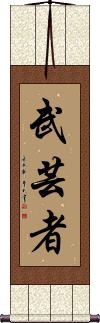
武芸者 is the Japanese Kanji title for “Martial Arts Master.” It suggests that you have reached at least the level of black belt and are probably to the level where you are ready to become an instructor.
Please consider carefully where you stand before ordering this phrase on a wall scroll. If you are not a master, this will make you look a bit foolish.
If you want to get this as a gift for your master at the dojo. Try to discreetly make sure this term is used in your school. Different schools and styles of Japanese martial arts use different terms. You may notice in the Romaji that the last two characters romanize as “geisha” which means “person skilled in arts” (what a geisha girl really is). The title here has the character for “martial,” “warrior,” and/or “military” in front of it. Therefore the literal translation is “martial art person.”
These Kanji are valid Chinese characters and Korean Hanja, but this title does not really make sense in Chinese and is not often used in Korean, though a Chinese or Korean would be able to guess the meaning by looking at the first and last characters.
Grand Master / Great Teacher
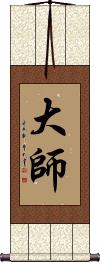
大師 is a way to title a great master, grand master, or great teacher.
This can be used in the context of martial arts or a Buddhist teacher. Thus, it can be used to title a living Buddha, Bodhisattva, or high-ranking monk.
Master / Skilled Worker
Secondary version of Sifu
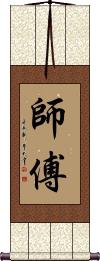
師傅 is “sifu” as in the “master” in the context of martial arts.
But two sifu titles are floating around. This one can simply mean “skilled worker.”
Historically, this term has been used for many things, such as “The tutor of a king or emperor.” But now it's more commonly used to mean master worker or qualified worker.
Currently, within the field of skilled labor, a master (Shifu) is higher than a journeyman and is considered to be one worthy of teaching others.
Note: In the 1970s and 1980s, this term was used as a common form of polite address between people. You might say, “master, do you know where Tian'anmen Square is?” to a person on the street at that time. This usage has almost passed; however, for some reason, people still often refer to taxi cab drivers as “master” in China (though I think/hope this is fading).
In Mandarin Chinese, this is pronounced like “Sure Foo,” and in Cantonese, like “See Foo.”
The second character is the difference between this sifu and the other. In this case, the second character by itself means tutor, instructor, or teacher.
Teacher / Master / Old Sage
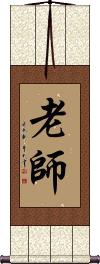
老師 directly translates as “old teacher,” “old master,” or “old sage.”
Together, they are understood as “teacher.” When you think about that, also realize that with age comes respect in Asian cultures. So calling someone old is a term of respect (not like the way we mean it in English). You could replace “old” with “respected” and be closer to how this is meant in Chinese.
Teachers, in general, are more respected by their students and the population in China. When I was a teacher in China, I certainly felt that.
This term is also used for masters of certain fields. For instance, a master calligrapher would respectfully be addressed as a “teacher.” In this case, “master” and “teacher” are synonymous.
Other artists (especially those who are famous or accomplished) should be addressed with this term. Also, some martial arts schools use this term of respect for their masters/teachers/instructors.
This title is recognized in Japanese as "roushi" with the same meaning but it’s rarely used in Japan.
Sensei / Master / Teacher / Mister
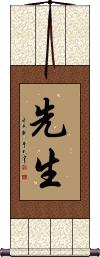
先生 is sensei, which is associated in the west with a master or instructor of karate, aikido, judo, and other Japanese martial arts.
In reality, this is a term of respect for almost any professional or skilled person (doctor, lawyer, teacher, etc.). Sometimes, it is used for musicians and artists who have achieved a certain level of fame, skill, or accomplishment.
It should be noted that this is also a courtesy title in Chinese but more like calling someone “mister” or “gentleman.” It doesn't have the “master” or “teacher” meaning in Chinese - see our Chinese “Master / Sifu / Shi Fu” entry if your audience is Chinese.
In Korean Hanja, this means teacher, instructor, schoolmaster, or schoolmistress.
This entry is for educational purposes. 先生 is kind of a strange thing to put on a wall scroll. It's a title that is used more orally to show respect rather than something written in calligraphy. If you feel it is appropriate in your circumstances, we will create a piece of sensei Japanese calligraphy artwork for you.
Fatherly Master / Sifu / Shi Fu / Shifu
Martial Arts Teacher
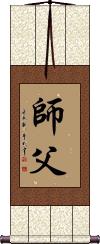
師父 means master in Chinese (occasionally used in Korean Hanja and Japanese). In the context of Martial Arts, this is the master and teacher who instructs students.
The second character by itself means father. Thus, you get the “Fatherly Master” translation. There's an old Chinese saying that goes something like, “One who is your teacher for one day is your father for life.”
Language notes: I've often seen this romanized as “sifu,” this is actually the Cantonese romanization. In Mandarin Chinese, it's “Shifu.” The pronunciation in Mandarin is actually like “sure foo” (using typical English pronunciation). There's an “R-sound” in there, which is not obvious from the romanization. Many martial arts studios incorrectly pronounce this like “she foo” (which is actually the Japanese pronunciation). In Cantonese, it sounds like “Sea foo” (almost like “seafood,” minus the “d” at the end).
師父 is kind of a weird selection for a calligraphy wall scroll; this entry is more for educational purposes. But you are welcome to buy it if it suits your circumstances.
Ip Man
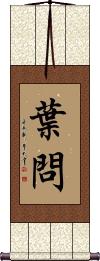
葉問 is the name of “Ip Man” or “Yip Man” (1893-1972).
He was a martial arts practitioner and master. He is perhaps most famous for being the master of Bruce Lee.
Shihan
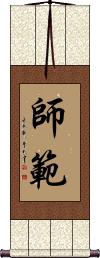
師範 or Shihan is a Japanese term, often used in Japanese martial arts.
In typical Japanese language, it can refer to a teacher or instructor. However, in martial arts, it's often an honorific title for an expert or master instructor.
Example: In Aikido the title can refer to someone with the rank of 7th dan. But other schools use it to mean a master who has earned the right to award black belts.
This term is also used in Chinese, where it refers to teacher-training or the art of teaching by example. It's used within the proper name of certain types of universities in China.
Fighting Spirit
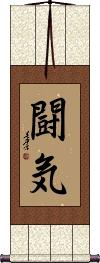
闘気 is an alternate Japanese title for “fighting spirit.”
This one is more like “fighting energy.” The second character is “ki,” the same “ki” in Aikido. This “ki” is the spiritual energy that all martial arts practitioners must master and focus on.
Perseverance is the Key
Skills cannot be perfected without perseverance in practice
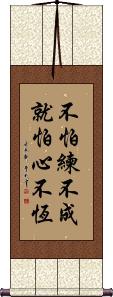
不怕练不成就怕心不恒 literally translates as: Do not worry about not being able to master [a skill]; What [one should] be concerned about is lack of perseverance.
Figuratively, this means: One's skills cannot be perfected without perseverance in practice.
For me, I've learned that you can only get so much from school or studying. You've really got to do “on-the-job training” to perfect your ability and skill.
For martial arts students: You can read about a kick in a book, or someone can tell you about a certain kick but until you practice the kick, there's no way you'll master it.
Kenpo / Kempo / Quan Fa / Chuan Fa
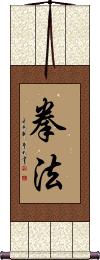
拳法 is a form of martial arts that can be translated in several ways.
Some will call it “fist principles,” “the way of the fist,” or even “law of the fist.” The first character literally means fist. The second can mean law, method, way, principle, or Buddhist teaching.
Kempo is really a potluck of martial arts. Often a combination of Chinese martial arts such as Shaolin Kung Fu with Japanese martial arts such as Karate, Jujutsu (Jujitsu), Aikido, and others. You may see the term “Kempo Karate,” which basically means Karate with other disciplines added. In this way, Kempo becomes an adjective rather than a title or school of martial arts.
These facts will long be argued by various masters and students of Kempo. Even the argument as to whether it should be spelled “kenpo” or “Kempo” ensues at dojos around the world (the correct Romaji should actually be “kenpou” if you precisely follow the rules).
The benefit of Kempo is that the techniques are easier to learn and master than pure Kung Fu (wu shu). Students are often taught basic Karate moves, kicks, and punches before augmenting the basic skills with complex Kung Fu techniques. This allows students of Kempo to achieve a level where they can defend themselves or fight in a relatively short amount of time (a few years rather than a decade or more).
Because the definition of this word is so fluid, I should make some notes here:
1. Purists in Okinawa will claim that “Okinawa Kenpo” or “Ryukyu Hon Kenpo” is the original and true version of this martial art from the old kingdom. It is actually little or no connection between Okinawa Kenpo and the way the word is used elsewhere.
2. In Chinese, where these characters are pronounced “quan fa” (sometimes Romanized as “chuan fa” because the Chinese-pinyin “q” actually sounds like an English “ch” sound), these characters do not hold the connotation of being a mixed martial art. It is simply defined as “the law of the fist.”
3. My Japanese dictionary oddly defines Kenpo as the “Chinese art of self-defense.” I personally don't feel this is the most common way that people perceive the word but just something you should know.
Sword Saint
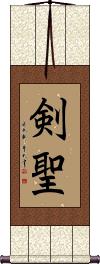
剣聖 can be translated as “Sword Saint,” “God of the Sword,” or “Saint of the Sword.” This is an ancient Japanese title bestowed on a master with the greatest of skills in swordsmanship.
Keep in mind that this is an antiquated term. It will only be understood in the context of martial arts. The pronunciation “kensei” also applies to other words like “constitutional government” and power (these words have different kanji and are completely unrelated).
Notes: This is sometimes Romanized as “kensei,” “ken sei,” and incorrectly as “Kensai.”
Chinese Note: This title is pronounceable in Chinese but seldom, if ever, used in Chinese. Also, the first character is an alternate character form for a sword, currently only used in Japan.
Kung Fu / Gong Fu
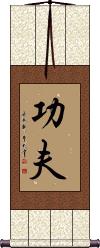
功夫 or Kung Fu is one of the most famous types of martial arts in the world - and not just because of Bruce Lee.
Some translate the meaning as “Accomplishment by Great Effort.” I think this is partially true, but directly translated, it literally means “Merit/Achievement/Accomplishment Man.” The word “fu” can sometimes mean “husband” or “porter,” but in this case, it can only mean “man.” However, few in China will think “man” when they hear the word “Gong Fu” spoken.
This term is also used for things other than martial arts. In fact, it's used to refer to a person with excellent skills in crafts that require a lot of effort to master, such as cooking, tea ceremonies, and calligraphy.
What a lot of people don't know is that the spelling of “Kung Fu” was actually taken from the old Wade Giles form of Romanization. Using this method, the sounds of the English “G” and “K” were both written as “K” and an apostrophe after the “K” told you it was supposed to sound like a “G.” Nobody in the west knew this rule, so most people pronounce it with a “K-sound.” And so, Gong Fu will always be Kung Fu for most westerners.
Also, just to educate you a little more, the “O” in “Gong” has a sound like the English word “oh.”
The popular Chinese dish “Kung Pao Chicken” suffers from the same problem. It should actually be “Gong Bao Chicken.”
Historical note: Many will claim that Kung Fu was invented by the monks of the Shaolin monastery. This fact is argued in both directions by scholars of Chinese history. Perhaps it is more accurate to say that the Shaolin Monks brought the original fame to Kung Fu many generations ago.
Japanese note: While most Japanese martial artists will recognize these characters, Katakana is more often used to approximate the pronunciation of "Kung Fu" with "カンフー." Some will argue as to whether this should be considered a Japanese word at all.
See Also: Bruce Lee
Korean CKD Virtues
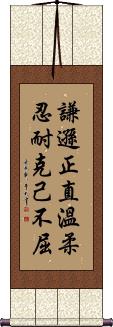
谦逊正直温柔忍耐克己不屈 are the virtues used by Choi Kwang Do Martial Arts.
| English | Hanja | Hangul | Pronunciation |
| 1. Humility (Humble / Modesty) | 謙遜 | 겸손 | gyeom son |
| 2. Honesty (Integrity) | 正直 | 정직 | jeong jig |
| 3. Gentleness | 溫柔 | 온유 | on yu |
| 4. Perseverance (To Endure) | 忍耐 | 인내 | in nae |
| 5. Self-Control (Self-Restraint) | 克己 | 극기 | geug gi |
| 6. Unbreakable Spirit (Unyielding / Unbending) | 不屈 | 불굴 | bur gur |
The characters shown here are in the ancient Korean Hanja form of writing. If you wish for a Korean Hangul form of these tenets, we can arrange that with our Master Calligrapher Xing An-Ping (click on the Hangul next to the South Korean flag above to order this in Hangul).
Taekwondo
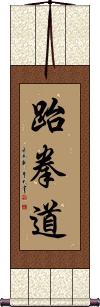
跆拳道 is one of the most widespread types of martial arts in the world as well as being an Olympic sport. Taekwondo was born in Korea with influences of Chinese and Japanese styles combined with traditional Korean combat skills. Some will define it as the “Korean art of empty-handed self-defense.”
In the simplest translation, the first character means “kick,” the second character can mean either “fist” or “punching,” and the third means “way” or “method.” Altogether, you could say this is the “Kick Punch Method.” When heard or read in various Asian languages, all will automatically think of this famous Korean martial art. It is written the same in Japanese Kanji, Chinese, and Korean Hanja characters - so the appearance of the characters is universal. However, you should note that there is another way to write this in modern Korean Hangul characters, which looks like the image to the right. 
We suggest the original Korean Hanja (Chinese characters) for a wall scroll, but if you need the Hangul version, you must use master calligrapher Cao Bin: Order Taekwondo in Korean Hangul
Note: Taekwondo is sometimes Romanized as Tae-Kwondo, Tae Kwon Do, Taekwon-do, Taegwondo, Tae Gweon Do, Tai Kwon Do, Taikwondo, Taekwando, Tae Kwan Do and in Chinese Taiquandao, Tai Quan Dao, Taichuando, or Tai Chuan Tao.
Rank Holder
The one who has achieved rank in martial arts
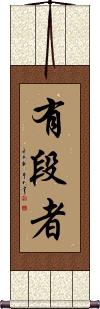
有段者 is a Japanese term for someone who holds rank in karate, judo, etc.
This term theoretically applies to anyone with rank (above a white belt). However, some schools or dojos may reserve this title for a holder of a black belt.
I'd suggest that you only order this phrase if you have honestly reached this level.
This title does kind of make sense in Chinese but only to those Chinese who practice “kong shou dao” (karate) or when used in the context of martial arts.
Fatal error: Cannot redeclare foreignPrice() (previously declared in /home/gwest/web/chinesescrollpainting.com/public_html/includes/currencyconverter.php:22) in /home/gwest/web/orientaloutpost.com/public_html/includes/currencyconverter.php on line 22