Many custom options...


And formats...



Military Discipline in Chinese / Japanese...
Buy a Military Discipline calligraphy wall scroll here!
Personalize your custom “Military Discipline” project by clicking the button next to your favorite “Military Discipline” title below...
Military Discipline
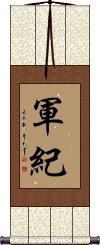
軍紀 means military discipline or military principles.
If maintaining your military discipline is important to you personally or important to your military unit, this is the wall scroll to have up behind your desk. In fact, it's the kind of thing I expect to see behind the desk of a First Sergeant or maybe a hardcore NCO.
Note: In some rare contexts, it could be extended to mean “morale,” but “discipline” is much closer to the commonly-held definition.
Note: This term is not well-known outside the military services in Asia (not used by the common person).
See Also: Self-Discipline
Discipline / Training / Tempering Character
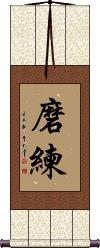
磨鍊 is a form of discipline which suggests training of the mind and character, aimed at producing self-control, obedience, etc.
One of my Chinese-English dictionaries even translates this as “tempering oneself” or turning yourself into hardened steel.
In old Korean Hanja, they use these characters in reverse order but with the same meaning. If you want the Korean version, please click this link instead of the button above: Korean version.
Training / Drill
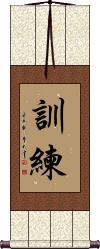
If training or drill is important to you (especially for military drill and training), 訓練 might be just the thing for a drill master to hang behind his/her desk.
This term is universal in Chinese, Japanese Kanji, and old Korean Hanja. It can also mean practice or exercise, depending on context.
Warriors: Quality Over Quantity
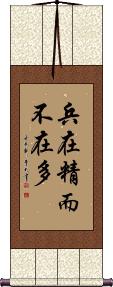
兵在精而不在多 is a Chinese proverb that means: [The value of] soldiers/warriors lies in [their] quality, not [just] in [their] quantity.
In simple terms, this says that regarding warriors, quality is better than quantity.
Most tacticians will agree that this can aid in the factor known as “force multiplication.” Having good troops of high morale, excellent training, and good discipline is like having a force that is three times larger.
See Also: 兵在精
Well-Disciplined / Orderly
Special Military Term
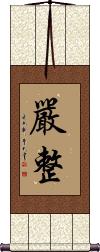
When reading an account of some battles in China, I came across the Chinese word, 嚴整. As it turns out, 嚴整 is only used in military circles to describe neat, orderly, and well-disciplined troops. Perhaps this is actually closer to the meaning I was taught while in the U.S. Marines.
The first character literally means stern, serious, strict, or severe (it can also mean airtight or watertight.
The second character means exact, in good order, whole, complete, and orderly.
Together, these two characters multiply each other into a word that expresses the highest military level of discipline.
See Also: Self-Control | Will-Power
Kenjutsu / Kenjitsu
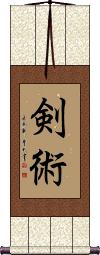
In Japanese, the modern definition, using simple terms, 剣術 is “A martial art involving swords” or “The art of the sword.”
However, in Chinese, this is the word for fencing (as in the Olympic sport).
I will suppose that you want this for the Japanese definition, which comes from skills and techniques developed in the 15th century. At that time, Kenjutsu (or swordsmanship) was a strictly military art taught to Samurai and Bushi (soldiers). The fact that swords are rarely used in military battles anymore, and with the pacification of Japan after WWII, Kenjutsu is strictly a ceremonial practice often studied as a form of martial art (more for the discipline aspect rather than practical purpose).
Language note: The Korean definition is close to the Japanese version described above. However, it should be noted that this can mean “fencing” depending on the context in Japanese, Chinese, and Korean.

 Character variation notes: There are slight variations possible with the second character. Either way is correct and understood by both Japanese and Chinese folks.
Since there are about 5 common ways to write the sword character, if you are particular about which version you want, please note that in the “special instructions” when you place your order.
Romanization note: This term is often Romanized as Kenjitsu; however, following the rules of Japanese Romaji, it should be Kenjutsu.
Fatal error: Cannot redeclare foreignPrice() (previously declared in /home/gwest/web/chinesescrollpainting.com/public_html/includes/currencyconverter.php:22) in /home/gwest/web/orientaloutpost.com/public_html/includes/currencyconverter.php on line 22