Many custom options...


And formats...



Mindfulness in Chinese / Japanese...
Buy a Mindfulness calligraphy wall scroll here!
Personalize your custom “Mindfulness” project by clicking the button next to your favorite “Mindfulness” title below...
Mindfulness
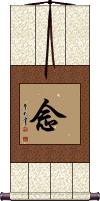
念 is the simplest way to write “mindfulness” in Chinese, Japanese Kanji, and old Korean Hanja.
念 can be defined these ways: To read; to study (a degree course); to read aloud; to miss somebody (keeping them in your mind); idea; remembrance; sense; thought; feeling; desire; concern; attention; recollection; memory; to think on/about; reflect; repeat, intone; a moment.
Obviously, the context in which the character is used determines which definition or meaning is perceived. As a single character, it's open and perhaps ambiguous. Thus, it can be read with any or all of these meanings.
念 is used in a Buddhist context (often written as 正念 or “right mindfulness”) with similar meanings of thought and contemplation.
In Japanese, this character is sometimes used as the name “Nen.”
See Also: Buddhism | Enlightenment
7. Right Mindfulness / Right Memory / Perfect Mindfulness
Samyak Smriti / Samyak Smrti / Samma Sati
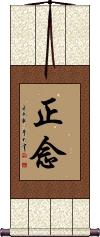
正念 is one of the Noble Eightfold Paths of Buddhism. Right Mindfulness, along with Right Effort and Right Concentration, constitute the path to Concentration or Perfect Thought.
Right Mindfulness is about remaining focused on one's body, feelings, mind, and mental qualities. It's also about being ardent, aware, and mindful, and supposes that you've already put aside worldly desire and aversion.
Monk Bhikkhu Bodhi described this as “The mind is deliberately kept at the level of bare attention, a detached observation of what is happening within us and around us in the present moment.” When practicing right mindfulness, the mind is trained to remain in the present, open, quiet, and alert, contemplating the present event.
Another definition: Ongoing mindfulness of body, feelings, thinking, and objects of thought.
This term is exclusively used by devout Buddhists. It is not a common term, and is remains an unknown concept to most Japanese and Chinese people.
See Also: Buddhism | Enlightenment | Noble Eightfold Path
Devotion / Dedication / Attentive / Focused
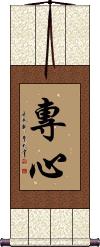
專心 makes a word that means “paying attention with your heart.”
It's often translated as “dedication,” as in “be absorbed in” or “concentrate one's efforts.” It's also used to mean “with the single mind,” “whole-heartedly,” “paying attention,” “undivided attention,” “concentration (-ed),” “engrossed,” “devotionally (listening/watching),” and/or “attentive.”
The first character means “for a particular person, occasion, or purpose,” “focused on one single thing,” “concentrated,” and sometimes, “special.”
The second character means “heart” or “mind” by itself.
My favorite translation, which comes from the Oxford Advanced Chinese/English Dictionary, is, “wholehearted devotion.”
If it seems like the meaning of this word is quite open, you are correct. The context in which the word is used matters a lot. It can mean different things depending on how you use it. This makes it kind of nice as you can decide what this means to you (within some limits). This is always positive in meaning, so even if a Chinese person reads it differently than you, it will still have a good meaning.
 In Japanese, they tend to use a variation of the second character which has one less stroke. If you want your calligraphy written this Japanese form, please click on the Kanji shown to the right instead of the button above. Note: Japanese and Chinese people will recognize either form.
8. Right Concentration / Perfect Concentration
Samyak Samadhi / Samma Samadhi
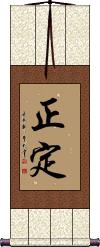
正定 is one of the Noble Eightfold Paths of Buddhism. Right Concentration, along with Right Effort and Right Mindfulness, constitute the path to Concentration or Perfect Thought.
Right Concentration has to do with leaving behind sensuality, unwholesome states, as well as pleasure and pain. 正定 is a complex idea, but once you have achieved the shedding of worldly sensation, you can truly concentrate and find a higher level of awareness.
Another definition: Concentration of mind that finds its high point in the four absorptions.
This term is exclusively used by devout Buddhists. It is not a common term, and is remains an unknown concept to most Japanese and Chinese people.
See Also: Buddhism | Enlightenment | Noble Eightfold Path
Concentration
Chung shin tong il
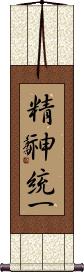
精神統一 means concentration of mind or mental concentration in old Korean Hanja and Japanese.
This concentration title is one of the 8 Key Concepts of Tang Soo Do.
You'll often see this romanized from Korean as “Chung Shin Tong Il.”
If you want to order the modern Korean Hangul version, click on the Hangul characters in the pronunciation box. Otherwise, this title is valid Korean Hanja (from the 1600 years that Korea used Chinese characters).
Fatal error: Cannot redeclare foreignPrice() (previously declared in /home/gwest/web/chinesescrollpainting.com/public_html/includes/currencyconverter.php:22) in /home/gwest/web/orientaloutpost.com/public_html/includes/currencyconverter.php on line 22