Many custom options...


And formats...



Muslim in Chinese / Japanese...
Buy a Muslim calligraphy wall scroll here!
Personalize your custom “Muslim” project by clicking the button next to your favorite “Muslim” title below...
Muslim
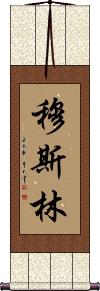
穆斯林 means Muslim in Chinese.
穆斯林 is a transliteration or phonetic way to say Muslim (this is meant to sound like Muslim, using Chinese sounds).
Islam
The religion of the Hui People
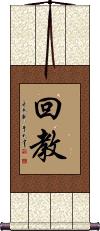
回教 means “Hui Religion” in Chinese.
It refers specifically to the Hui people (Huizu), who have typical Oriental looks but are Muslim (practice the religion of Islam). Hui people can be found throughout China, often establishing Muslim neighborhoods in many cities.
My Japanese dictionary lists this as the all-Kanji way to write Islam as well.
In Korean, the first character is used as a short name to say Muslim.
Allah / God of Islam
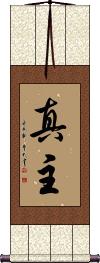
真主 is how Chinese Muslims refer to God (it literally means “True Master”).
Oddly, in China, two different names for God have emerged. Even though Muslims, Christians, and Jews all worship the same God of Abraham.
In Arabic, the word Allah is just the Arabic way to say, God. Arab Christians pray to Allah, just like Arab Muslims. Somehow in China, the title of God diverged.
If you are curious, there are millions of Muslims throughout China but especially in the northwest portion of China known as Xinjiang. Here you will find descendants of Turkmen, Persian, Arab, and other ethnicities. Some are mixed with Han-Chinese blood; others appear to be pure Turkmen. Many have fair complexions, green eyes, and light hair but all are citizens of China. A visit to Xinjiang will shift your paradigm and blow away all of your stereotypes about what it means to be Chinese.
Shii
Movement within Islam
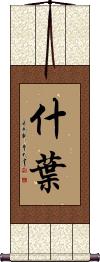
什葉 is how Shii, a well-established movement within Islam, is written in Chinese.
Shiite sect of Islam
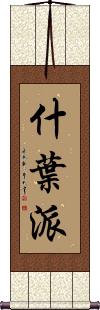
什葉派 is the Chinese title for the Shiite sect of Islam.
Sunni sect of Islam
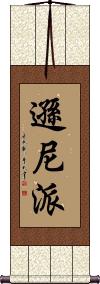
遜尼派 is the Chinese title for the Sunni sect of Islam.
Islam
(phonetic version)
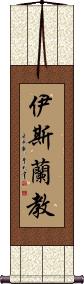
伊斯蘭教 both means and sounds like “Islam” in Mandarin Chinese.
The first three characters sound like the word “Islam,” and the last character means “religion” or “teaching.” It's the most general term for “Islam” in China. The highest concentration of Muslims in China is Xinjiang (the vast region in northwest China that was called The East Turkistan Republic until 1949 and is sometimes called Chinese Turkistan, Uyghuristan). Here you will find Uygurs, Kazakhs, Kyrgyz, and others that are descendants of Turkmen (possibly mixed with Persians and Arabs). Many of their ancestors were traders who traveled the silk road to buy and sell spices and silk and exchange other goods from the Orient and the Middle East.
I spent some time in Xinjiang and got to know this community. They are strong people who can endure much. They are friendly and love to have a good time. I was a stranger but was treated by villagers (near China's border with Afghanistan) as if I was a good friend.
However, I have heard that it's best not to cross them, as in this land, the law is the blade, and everything is “eye for an eye.” The Chinese government has little control in Xinjiang, with almost no police officers except in the capital of Urumqi (so it's a 60-hour roundtrip train ride to seek the aid of law enforcement in most cases).
While few seem devout, there are at least small mosques in every village. And you will never see a man or woman outside without a head covering.
It should be noted that these people are all citizens of China, but they are officially of the Caucasian race. A visit to Xinjiang will change your idea of what it means to be Chinese.
I've noticed you are searching for "Muslim". If you are interested, I can have your favorite verse from the Qur'an translated into Chinese and written on a wall scroll for you. You can contact me siting the verse or verses you want.
Fatal error: Cannot redeclare foreignPrice() (previously declared in /home/gwest/web/chinesescrollpainting.com/public_html/includes/currencyconverter.php:22) in /home/gwest/web/orientaloutpost.com/public_html/includes/currencyconverter.php on line 22