Many custom options...


And formats...



Nature in Chinese / Japanese...
Buy a Nature calligraphy wall scroll here!
Personalize your custom “Nature” project by clicking the button next to your favorite “Nature” title below...
1. Nature
3. Nature in Balance / Balanced Nature
5. The Nature of Enlightenment in One's Mind
7. Tathata / Ultimate Nature of All Things
8. Human Nature
Nature
The natural world
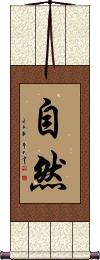
自然 is the simple way to express nature in Chinese, Japanese Kanji, and old Korean Hanja.
This can also be translated as “the natural world.”
In Japanese and Korean, this term is sometimes used to signify spontaneity or a spontaneous act.
In the context of Taoism or Daoism, this is a key concept that literally means “of its own” or “by itself” and thus naturally, natural, spontaneously, freely, or in the course of events.
Also known as known as ziran or tzu-jan
Mother Nature
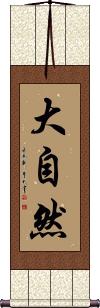
大自然 is the simple way to express “mother nature” in Chinese, Japanese Kanji, and old Korean Hanja.
This can also be translated as “the great nature” or “all of nature.”
Nature in Balance / Balanced Nature
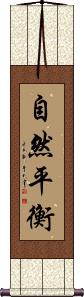
自然平衡 means “nature balanced.”
The first two characters mean nature (as in mother nature, or all biological life).
The second two characters mean balance or balanced.
Nature in Balance / Balanced Nature
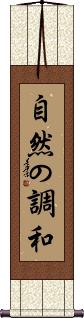
自然の調和 means “nature in harmony” in Japanese.
The first two Kanji mean nature (as in mother nature or the natural world).
The middle Hiragana is a possessive article that connects the two ideas.
The last two Kanji mean “in harmony” or “in balance.”
Nature in Balance / Balanced Nature
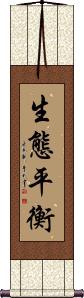
生態平衡 is a title about the way and balance of nature.
The first two characters mean nature or the way of life.
The second two characters mean balance or balanced.
Note: We have two versions of this title on our website. This is the one we recommend, as it is a little more natural (no pun intended).
Nature in Balance / Balanced Nature
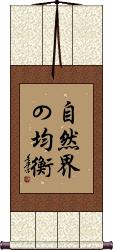
自然界の均衡 is a verbose way to say “nature in balance” in Japanese.
The first three Kanji have the meaning of “the natural world” or “the natural kingdom” (kind of like the animal kingdom but including plants and all things biological).
The third character is a Hiragana that acts to connect the two ideas here.
The last two Kanji mean equilibrium or balance.
Beauty of Nature
Ka-Chou-Fuu-Getsu
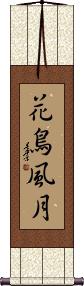
花鳥風月 is the Japanese Kanji proverb for “Beauties of Nature.”
The dictionary definition is “the traditional themes of natural beauty in Japanese aesthetics.”
The Kanji each represents an element of nature that constitutes beauty in traditional Japanese art and culture.
The Kanji breakdown:
花 = ka = flower (also pronounced “hana”)
鳥 = chou = bird (also pronounced “tori”).
風 = fuu = wind (also pronounced “kaze”).
月 = getsu = moon (also pronounced “tsuki”)
The Nature of Enlightenment in One's Mind
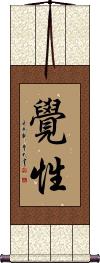
覺性 represents “The enlightened mind free from all illusion,” “The nature of enlightenment in one's mind,” or “The Buddha-nature.”
To reach this “enlightened nature,” one must form their mind into and utilize their mind as the agent of knowledge, or enlightenment.
The Nature of Martial Arts
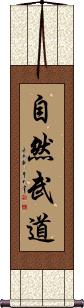
自然武道 is a means the Nature of Martial Arts.
The first two characters create a word that means nature, natural, or spontaneous.
The last two characters are often translated as martial arts.
Tathata / Ultimate Nature of All Things
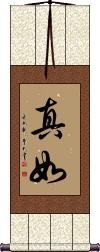
真如 comes from the Sanskrit and Pali word often romanized as “tathata” or “tathatā.” Originally written, “तथता.”
It's a Buddhist term often translated as “thusness” or “suchness,” but this does not explain it.
A better explanation may be “the ultimate nature of all things” or “ultimate truth.” However, this gives it too strong of a feeling. This concept is sometimes described as being in awe of the simple nature of something - like a blade of grass blowing in the wind or ripples on water. It is what it is supposed to be, these things follow their nature. Amazing in their mundane simplicity.
Every sect of Buddhism will have a slightly different flavor or explanation, so don't get fixated on one definition.
Notes: Sometimes Buddhists use the word dharmatā, a synonym to tathatā.
In Japan, this can also be the female given name Mayuki, or the surname Majo.
Human Nature
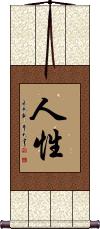
人性 is a title that is the essence of what it means to act and be human.
These two characters refer to the way we are as people.
人性 is also sometimes translated as human personality, human instinct, humanity, or humanism.
The first character literally means human or people.
The second character means nature. It can also mean property, quality, attribute, or essence. It can even be a modifier like “-ity” or “-ness,” which is why this word is also translated as “humanity.”
Kindness and Forgiving Nature
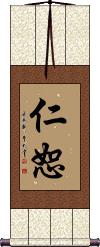
仁恕 is a word in Chinese and Japanese that means something like benevolence with magnanimity or kindness with a forgiving nature.
If this describes you, then you are the type of person that I would like to call my friend.
This may not be the most common word in daily use, but it's old enough that it transcended cultures from China to Japan in the 5th century when Japan lacked a written language and absorbed Chinese characters and words into their language.
Note: 仁恕 is not commonly used in Korean.
Seeing one’s Nature and becoming a Buddha
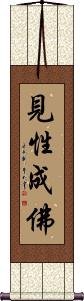
見性成佛 is a universal phrase that suggests that one may see one's nature and accomplish Buddhahood.
見性 suggests penetrating deep inside oneself to see one's “Original finally
Mind.”
成佛 refers to a sentient being who dispenses with illusions and delusions
through ascetic practice, is enlightened to the truth, and becomes a Buddha.
This is used by Mahayana, Chan, and Zen Buddhists in China, Korea, and Japan.
You will also see this with the last character written as 仏 in Japanese. In the religious context, 佛 is commonly used to mean Buddha. If you want the other version, see Kenshō Jōbutsu 見性成仏
Fatal error: Cannot redeclare foreignPrice() (previously declared in /home/gwest/web/chinesescrollpainting.com/public_html/includes/currencyconverter.php:22) in /home/gwest/web/orientaloutpost.com/public_html/includes/currencyconverter.php on line 22