Many custom options...


And formats...



Never Forget in Chinese / Japanese...
Buy a Never Forget calligraphy wall scroll here!
Personalize your custom “Never Forget” project by clicking the button next to your favorite “Never Forget” title below...
Never Forget
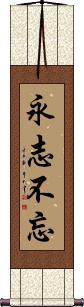
永志不忘 literally translates as “forever remember, never forget.”
But most will just understand this as “never forget” or “never forgotten” in Chinese.
Never Forget
Never forget your vow or path
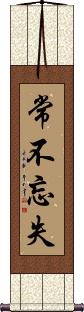
This title is used almost exclusively in a Buddhist context (not all Chinese or Japanese people will recognize it).
常不忘失 means “Never forget your vow/path” in Chinese characters and Japanese Kanji.
Never Forget Your First Resolution
Never Lose Your Beginner's Spirit
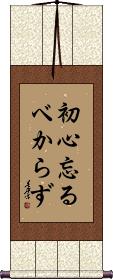
初心忘るべからず is an old Japanese proverb that suggests you try to never forget the enthusiasm you had as a child when you try new things (or even face the day-to-day). Basically, avoid having the mundane attitude that many people get with age.
You'll find this Japanese proverb translated in a few different ways. Here are some of them:
Don't forget your first resolution.
Never forget your childlike enthusiasm.
Forget not the beginner's mind.
Try never to lose your initial enthusiasm (freshness of attitude).
Note: This is sometimes written as 初心忘る可からず. The one shown above is used about 10x more often. There’s only one character difference between the two versions.
Note: Because this selection contains some special Japanese Hiragana characters, it should be written by a Japanese calligrapher.
Drinking the water of a well: One should never forget who dug it
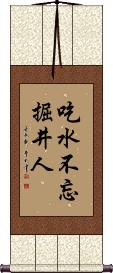
This proverb suggests that one should always be grateful to those who helped one succeed.
And remember your ancestors and those that came before you whose sacrifices made your present life better.
Some Chinese will separate the intended meaning from this proverb and translate this as “Don't forget the people who once helped you.” In Modern China, this idiom is virtually never used to refer to an actual well.
Note: This can be pronounced in Korean but it's not a commonly used phrase.
Past experience is the teacher for the future
Past events not forgotten serve as teachers for later events.
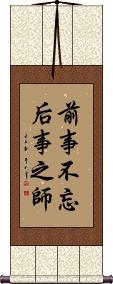
The most literal translation to English of this ancient 前事不忘后事之师 Chinese proverb is:
“Past events not forgotten serve as teachers for later events.”
However, it's been translated several ways:
Don't forget past events, they can guide you in the future.
Benefit from past experience.
Past experience, if not forgotten, is a guide for the future.
Past calamity is my teacher.
A good memory for the past is a teacher for the future.
The remembrance of the past is the teacher of the future.
If one remembers the lessons of the past; They will serve as a guide to avoid mistakes in the future.
The origin:
This proverb comes from the 5th century B.C., just before the Warring States Period in the territory now known as China.
The head of the State of Jin, Zhi Bo, seized power in a coup. He did this with help from the armies of the State of Han and Wei. Instead of being grateful for the help from Han and Wei, he treacherously took the land of Han and Wei. Never satisfied, Zhi Bo employed the armies of Han and Wei to attack and seize the State of Zhao.
The king of Zhao took advice from his minister Zhang Mengtan and secretly contacted the Han and Wei armies to reverse their plans and attack the army of Zhi Bo instead. The plan was successful, and the State of Zhao was not only saved but was set to become a powerful kingdom in the region.
Zhang Mengtan immediately submitted his resignation to a confused king of Zhao. When asked why, Zhang Mengtan said, “I've done my duty to save my kingdom, but looking back at past experience, I know sovereign kings are never satisfied with the power or land at hand. They will join others and fight for more power and more land. I must learn from past experiences, as those experiences are the teachers of future events.”
The king could not dispute the logic in that statement and accepted Zhang Mengtan's resignation.
For generations, the State of Zhao continued to fight for power and land until finally defeated and decimated by the State of Qin (which led to the birth of the Qin Dynasty in 221 B.C.).
Fatal error: Cannot redeclare function foreignPrice() (previously declared in /home/gwest/web/chinesescrollpainting.com/public_html/includes/currencyconverter.php:22) in /home/gwest/web/orientaloutpost.com/public_html/includes/currencyconverter.php on line 22