Many custom options...


And formats...



New Beginning in Chinese / Japanese...
Buy a New Beginning calligraphy wall scroll here!
Personalize your custom “New Beginning” project by clicking the button next to your favorite “New Beginning” title below...
New Beginning
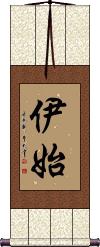
伊始 is a short version of “new beginning” or simply “beginning” in Chinese characters.
You can also translate this as “from this moment on,” “starting now,” or “henceforth.”
In the day-to-day speech, this word can apply to starting a new job, beginning a new career, entering a new chapter of your life, or taking a new position (in politics, scholarship, etc.).
New Beginning
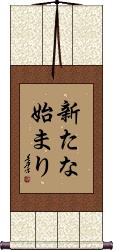
新たな始まり is a Japanese word that means “new beginning” or “new start.”
Here's the character breakdown:
新た (arata) = new; fresh; novel; newly; freshly; or this can be like the prefix “re-” like “re-start” or “reset.”
な (na) is kind of a connecting article. This glues “new” to “beginning.”
始まり (hajimari) = origin; beginning.
Note: Because this selection contains some special Japanese Hiragana characters, it should be written by a Japanese calligrapher.
New Beginning
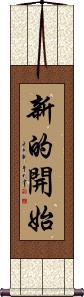
新的開始 literally means “new beginning” in Chinese characters.
The character means “new.”
The second is a possessive article connecting the ideas of new & beginning.
The last two characters can mean “to begin,” “beginning,” “to start,” “initial,” “commencement,” or “initiation.”
New Beginning
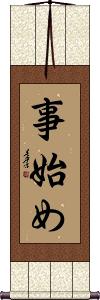
事始め is a Japanese word that means taking up a new line of work or the beginning of new things.
In another context, it can refer to starting the preparations for New Year's festivities or resuming work after the New Year's vacation.
New Beginning
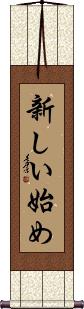
新しい始め is a verbose Japanese phrase that means “new beginning.”
The first three characters mean new, novel, fresh, recent, latest, up-to-date, or modern.
The last two characters mean beginning, start outset, opening, or origin.
Note: Because this selection contains some special Japanese Hiragana characters, it should be written by a Japanese calligrapher.
New Life
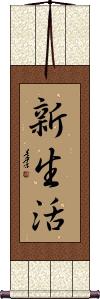
This literally means “new life” or “new livelihood” in Japanese Kanji.
新生活 is most appropriate if you are starting a new career or otherwise are starting a new chapter in your life or a new beginning.
Note: This is not the most common word selection for a calligraphy wall scroll. But if you’re a westerner, you can bend the rules a bit.
New Life
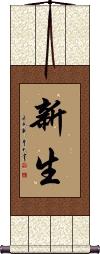
新生 literally means “new life” or “new birth” in Chinese, Japanese Kanji, and old Korean Hanja.
Depending on the context, this word can also mean newborn, new student, rebirth, new birth, or nascent.
In Japanese, this can be the given name Wakaki.
Note: This is not the most common word selection for a calligraphy wall scroll. But if you’re a westerner, you can bend the rules a bit.
Sho-Dan
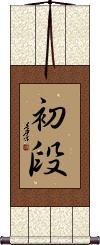
初段 is a Japanese Kanji word that literally means “beginning degree.”
初段 is the lowest black belt rank in Japanese martial arts and the game of Go.
The first Kanji means first, new, or beginning in Japanese.
Other ways to translate this title include “lowest grade” or “first grade.”
Lion Dance
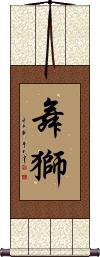
舞獅 is the Chinese title for “lion dance.”
舞獅 is the traditional Chinese costumed dance seen at festivals (especially Chinese New Year), ceremonies, and often at the beginning of Chinese martial arts events.
Good Luck / Good Fortune
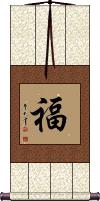
福 is pronounced “fu” in Chinese.
The character “fu” is posted by virtually all Chinese people on the doors of their homes during the Spring Festival (closely associated with the Chinese New Year).
One tradition from the Zhou Dynasty (beginning in 256 B.C.) holds that putting a fu symbol on your front door will keep the goddess of poverty away.
福 literally means good fortune, prosperity, blessed, blessedness, happiness, and fulfillment.
You'll also see this character in Vietnam (where Chinese characters were the written form until a romanization reform) where it is pronounced Phúc - a word commonly used in Vietnamese names because of its good meaning.
See Also: Lucky
Fatal error: Cannot redeclare function foreignPrice() (previously declared in /home/gwest/web/chinesescrollpainting.com/public_html/includes/currencyconverter.php:22) in /home/gwest/web/orientaloutpost.com/public_html/includes/currencyconverter.php on line 22