Many custom options...


And formats...



Nirvana in Chinese / Japanese...
Buy a Nirvana calligraphy wall scroll here!
Personalize your custom “Nirvana” project by clicking the button next to your favorite “Nirvana” title below...
1. Nirvana
2. Phoenix Rise from the Ashes
6. Bodhi - Awakening Enlightenment
11. The True and Complete Enlightenment
13. Luohan / Lohan
16. Kensho Jobutsu - Enlightenment - Path to Buddha
17. Gate
18. Self-Love / Love Yourself / Love Oneself
20. No Pain No Gain
Nirvana
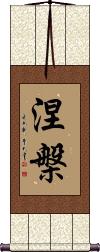
涅槃/涅盤 are the Chinese characters that mean Nirvāṇa. I will let you decide what Nirvana means to you.
This can also be translated as “Buddha's death and salvation” or “death of a Buddhist monk,” depending on the context. However, this is not seen with any bad meaning. You could replace “death” with “moving on,” as that is how it's seen in a Buddhist context.
More info from our dictionary: Nirvana
Phoenix Rise from the Ashes
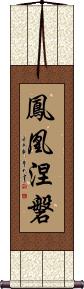
鳳凰涅磐 is a proverb that suggests “Legendary Phoenix rises from the ashes.” It means “Legendary Phoenix [reaches] Nirvana.”
There is a legend in China of a great bird reborn once every 500 years. This bird gathers all the ill will, suffering, desire, and other negative things of the world. The bird then plunges into the fire to burn away all negative things, sacrificing itself in the process (achieving Nirvana, or perhaps allowing others the opportunity to reach Nirvana).
500 years later, the phoenix is reborn from the ashes again, and the cycle repeats.
Pure Land / Jodo
Also a sect of Buddhism
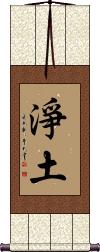
淨土 literally means “pure land” or “clean earth.”
淨土 is also the abbreviated title of a Buddhist sect that involves faith in the rebirth of Buddha Amitabha (Amitābha) in the Western Heaven. Sometimes this sect is translated as “Paradise of the West.” Other titles of this school of Buddhism include Amidism or Elysium.
See Also: Nirvana | Shin Buddhism
Namo Amitabha Buddha
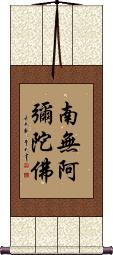
南無阿彌陀佛 is how to express “The Compassionate Amitabha Buddha” (especially for the Pure Land Buddhist Sect).
Some will translate as “Homage to Amitâbha Buddha” or “I seek refuge in the Amitâbha Buddha.”
This is valid in Chinese characters, Japanese Kanji, and old Korean Hanja.
Sometimes modern Japanese use a different version of the 4th and last Kanji, but the version shown here is the most universal.
This is used to pay homage to Amitabha Buddha.
See Also: Bodhisattva | Buddhism | Nirvana
Namu Amida Butsu
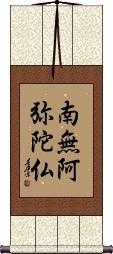
南無阿弥陀仏 is the modern Japanese version of “Namu Amida Butsu” or “The Compassionate Amitabha Buddha.”
Some will translate this as “I sincerely believe in Amitabha; Lord have mercy on me.”
This phrase especially applies to Japanese Pure Land Buddhists.
There is a universal version using ancient characters (with more strokes) for the 4th and last characters. That version is also used in Chinese, Korean, and occasionally Vietnamese.
This is used to pay homage to Amitabha Buddha.
See Also: Bodhisattva | Buddhism | Nirvana
Bodhi - Awakening Enlightenment
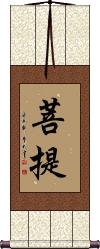
The Bodhi or 菩提 is the moment of completion in Buddhism.
It is when all things become known and you have completed your journey to enlightenment.
The reference is to the Bodhi tree where Siddhartha Gautama (the legendary man who established the Buddhist religion) achieved enlightenment. Sometimes this is referred to as “the tree of enlightenment,” but if you want the full version with the character for a tree at the end, please see the Bodhi Tree entry.
See Also: Buddhism | Buddha | Nirvana | Enlightenment
Silent / Solitary
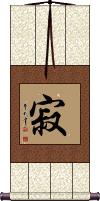
寂 means silent, solitary, quiet, calm, still, rest, or tranquil.
This also has a strong association with Buddhism where it can mean “entering into Nirvana.” In that context, this is sometimes used to refer to the passing of a Buddhist monk (he is silent, as he has entered Nirvana). For the living, this is about tranquility (especially of mind).
Some will also use this to mean “elegant simplicity.”
From Sanskrit, this can represent praśama, vivikta, śānti, or nibbāna (nirvāṇa).
Reincarnation (Buddhism)
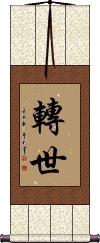
轉世 is the Buddhist idea of reincarnation or transmigration.
Other definitions of this term: “Attainer of Nirvana from within the desire realm,” “A practitioner who enters directly into Nirvana from the desire realm, without traversing the form and formless realms. One of the 27 kinds of Hinayana sages,” or simply, “to return again to this life.”
轉世 is also a Japanese title, but the first Kanji was slightly simplified after WWII. Just let us know if you want the modern Japanese version when you order.
Feng Huang Nie Pan
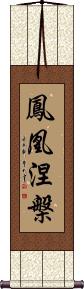
鳳凰涅槃 means Phoenix Nirvana in Chinese and is the title of a famous book.
The Noble Eightfold Path
Ashtangika Marga / Astangika-Marga / Atthangika Magga
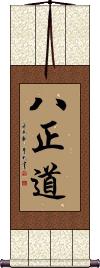
八正道 is a complex set of steps that Buddhists much take to cleanse karma, achieve enlightenment, eventually cease the cycle of rebirth and live in a state of Nirvana.
Note: This term is exclusively used by devout Buddhists. It is not a common term and remains an unknown concept to most Japanese and Chinese people. Sometimes written as 八聖道.
See Also: Buddhism | Enlightenment
The True and Complete Enlightenment
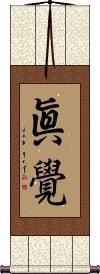
眞覺 means true and complete enlightenment.
This can refer to the perfect nirvana of the Buddha or the perception of ultimate truth or true awareness of all things (reality and unreality).
Endless / Without Limit
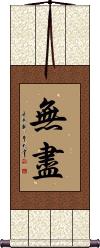
無盡 is the Chinese, Japanese Kanji, and old Korean Hanja for endless; inexhaustible; without limits; infinite.
In the Buddhist context, this can refer to the infinitude of living beings, of worlds, of space, of the dharmadhātu, of nirvāṇa, etc.
Luohan / Lohan
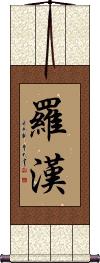
羅漢 is the title Lohan, achiever of Nirvana.
This can also be a place name and surname Rakan in Japanese.
In the Buddhist context, this can be arhan, arhat, saint, or perfect man of Hīnayāna. It can refer to the 16, 18, or 500 disciples appointed to witness Buddha's truth and save the world.
Stillness / Quiet / Calm
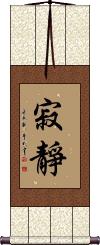
寂靜 is the Chinese and old Japanese word for calmness, stillness, and tranquility.
In the Buddhist context, this can refer to the calmness of the heart, enlightenment, or the state of being calm and quiet - free from temptation and distress. This can be thought of as being in a state of earthly nirvāṇa.
Note: The second character is written just slightly differently in modern Japanese (静 instead of 靜). Expect a slight variation if you order this from the Japanese master calligrapher. The version shown here is considered the ancient Japanese and original Chinese form.
Ksaya / Omega / Finality
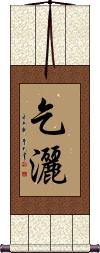
乞灑 is the Chinese and Japanese version of the Buddhist term “kṣaya.”
乞灑 is used in the sense of omega, or the end. This implies finality or nirvāṇa.
This term is only used in the context of Buddhism. Non-Buddhists may not recognize this word.
Kensho Jobutsu - Enlightenment - Path to Buddha
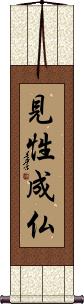
見性成仏 or Kenshō Jōbutsu is the initial enlightenment that leads to self-awareness, becoming Buddha, and the path to enter Nirvana.
Kenshō Jōbutsu is a complex concept in Japanese Buddhism. 見性成仏 is probably better translated as “Seeing one’s nature and becoming a Buddha.”
See Also: Buddhism | Enlightenment | Initial Enlightenment
Gate
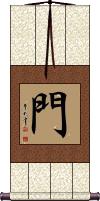
門 is the Chinese, Japanese Kanji, and old Korean Hanja for gate, door, gateway, doorway, opening, entrance, valve, or switch.
Most commonly, this is simply a gate or door.
門 is also a Chinese surname that romanizes as Men.
In Japanese, this can be surnames romanizing as Yuki, Mon, To, or Kado.
In the Buddhist context, beyond meaning a door or gate, this can be a counter for a Buddhist sect, teaching, or school (we might say “slice” of bread, this would be a “gate” of teaching). In this way, it kind of refers to one of several doors that lead to salvation or nirvana.
Self-Love / Love Yourself / Love Oneself
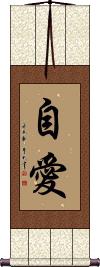
自愛 means self-love, self-regard, regard for oneself, cherishing one's good name, taking care of oneself, or love myself.
In the Buddhist context, this is the cause of all pursuit or seeking, which in turn causes all suffering. All Buddhas discharge themselves from self-love and all pursuits of personal gratification. Such elimination of self-love is a step towards nirvāṇa.
This title can be taken as positive or negative, depending on how you read it. Some will see it as arrogant, and others will read it as a token of self-respect. Because of this ambiguity, I do not recommend this title for a wall scroll.
Shiken Haramitsu Daikomyo
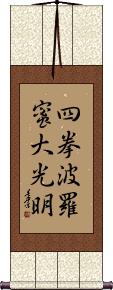
四拳波羅蜜大光明 is “shiken haramitsu daikōmyō,” a famous Japanese Buddhist mantra.
四拳 = shi-ken = four fists (many translate this as “four hearts”).
波羅蜜 = ha-ra-mitsu = A loanword representing pāramitā, or entrance into Nirvana. Awkwardly, it also means jackfruit.
大光明 = dai-kou-myo = big/great light bright (great bright light).
Shiken represents four hearts:
1. The Merciful Heart - Love and caring for all living things.
2. The Sincere Heart - Pursues righteousness, or the right path - sincerely trying to do what is right.
3. The Attuned Heart - Knows that nature and fate have their ways, and thus stay in tune with the universe.
4. The Dedicated Heart - Steadfast on the chosen path to the end.
No Pain No Gain
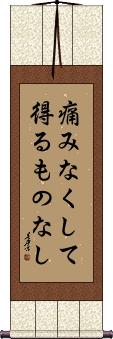
痛みなくして得るものなし is a Japanese phrase that means “no pain, no gain.”
This suggests that with pain, a gain must follow.
The pain Kanji here can also be translated as sorrow or suffering. The gain can also mean profit, advantage, or benefit. In the Japanese Buddhist context, that gain Kanji can mean rebirth in paradise, entering nirvana.
The character breakdown:
痛みなく (itami naku) pain; ache; sore; grief; distress. The naku part adds the meaning of “a lot of” or “extended”
して (shite) and then. (indicates a causative expression; acts as a connective particle)
得る (eru) to get; to acquire; to obtain; to procure; to earn; to win; to gain; to secure; to attain.
もの (mono) conjunctive particle indicating a cause or reason.
なし (nashi) none of; -less; without; no.
Note: Because this selection contains some special Japanese Hiragana characters, it should be written by a Japanese calligrapher.
Fatal error: Cannot redeclare function foreignPrice() (previously declared in /home/gwest/web/chinesescrollpainting.com/public_html/includes/currencyconverter.php:22) in /home/gwest/web/orientaloutpost.com/public_html/includes/currencyconverter.php on line 22