Many custom options...


And formats...



No Limits in Chinese / Japanese...
Buy a No Limits calligraphy wall scroll here!
Personalize your custom “No Limits” project by clicking the button next to your favorite “No Limits” title below...
No Limits
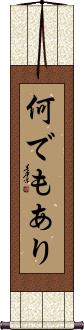
何でもあり is a Japanese phrase meaning, no holds barred, anything goes, or no limits.
Note: Because this selection contains some special Japanese Hiragana characters, it should be written by a Japanese calligrapher.
The Sea of Knowledge Has No Limits
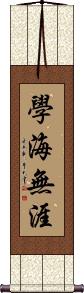
學海無涯 is a Chinese proverb that reads, “sea of learning, no horizon.”
Colloquially, it means there are no limits to what one still has left to learn.
This would be the Chinese equivalent to the quote from Hippocrates, “ars longa, vita brevis,” meaning “it takes a long time to acquire and perfect one's expertise.”
See Also: Learning is Eternal
Endless / Without Limit
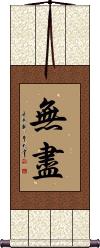
無盡 is the Chinese, Japanese Kanji, and old Korean Hanja for endless; inexhaustible; without limits; infinite.
In the Buddhist context, this can refer to the infinitude of living beings, of worlds, of space, of the dharmadhātu, of nirvāṇa, etc.
No Limitations
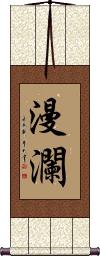
漫瀾 is the Chinese, Japanese Kanji, and old Korean Hanja for “Having no boundaries or limitations.”
This literally talks of the vastness of an ocean or river.
Character breakdown:
漫 = free; unrestrained; to inundate; overflowing; boundless.
澜 = swelling water; large wave.
Infinity / Infinite / Unlimited / Unbounded
Japanese = Infinity / Chinese = No limits
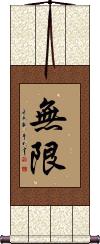
無限 is the Chinese and Japanese word meaning infinity, unlimited or unbounded.
無限 literally translates as “without limits” or “without [being] bound.”
The first character means “never” or “not,” like the prefix “un-.”
The second means “limited,” “restricted,” or “bound.”
Please note that the Japanese definition leans more toward “infinity” and the Chinese is more about being “boundless” or “without limits.”
In Korean, this means infinity, infinitude, or boundlessness. But in Korean, this term has many interpretations or contexts, so your intended meaning might be vague or ambiguous.
Wu Chi / Wuji
Without Limit
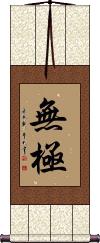
This is Wu Chi or Wuji in Chinese characters.
Wu Chi as a philosophy is often associated with Tai Chi (Taiji).
Fatal error: Cannot redeclare foreignPrice() (previously declared in /home/gwest/web/chinesescrollpainting.com/public_html/includes/currencyconverter.php:22) in /home/gwest/web/orientaloutpost.com/public_html/includes/currencyconverter.php on line 22