Many custom options...


And formats...



No One Knows a Son Better Than the Father in Chinese / Japanese...
Buy a No One Knows a Son Better Than the Father calligraphy wall scroll here!
Personalize your custom “No One Knows a Son Better Than the Father” project by clicking the button next to your favorite “No One Knows a Son Better Than the Father” title below...
1. No one knows a son better than the father
9. Bond
10. No man knows what he owes to his parents until he comes to have children of his own
11. Dear Grandfather
13. Dear Grandfather
14. Dear Grandmother
15. Dear Grandfather
19. Love Between Child and Parents
20. Hua Mulan
21. Daddy’s Girl / Daddy’s Boy
22. Fatherly Master / Sifu / Shi Fu / Shifu
23. The Holy Trinity
24. The Lord's Prayer / Luke 11:2-4
25. The Lord's Prayer / Mathew 6:9-13
26. Japanese Snapping Turtle / Chinese Soft Shell Turtle
27. Love for Parents
No one knows a son better than the father
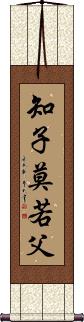
知子莫若父 can be translated as “No one knows a son better than his father.”
This idiom is based on the idea that after spending many years together, family members know everything about each other. Better than anyone else, a father knows the qualities and shortcomings of his son.
If you are looking for something about “father and son,” this is probably the best selection.
While this is the original proverb (very old), others have been composed about various combinations of mothers, sons, daughters, and fathers. Let me know if you need a custom version.
Loving Father
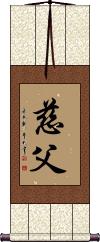
慈父 is the title of a loving father, affectionate father, or merciful father.
A great gift for your dad.
Father and Son
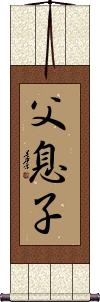
父息子 is “father and son” in Japanese.
A Father’s Love
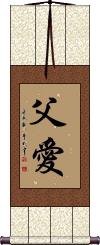
父愛 means “father's love” in Chinese.
A Father’s Love
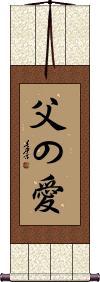
父の愛 means “father's love” in Japanese.
Father and Daughter
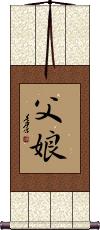
父娘 is a title for “father and daughter” in Japanese Kanji.
Father and Son
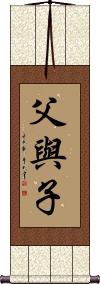
父與子 is the simple term for “Father and Son.”
However, we like some of our other tribute phrases to fathers better than this one.
Father and Daughter
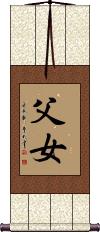
父女 is a title for “father and daughter” in Chinese.
Note: 父女 is an unusual word for a calligraphy wall scroll.
Daddy / Father
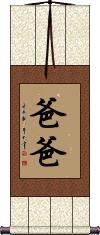
爸爸 is the colloquial way to say “Daddy” in Chinese.
Sometimes Chinese people will refer to their father with just one of these characters, “Ba,” which would be like “Dad.” With both characters, “Baba,” it's more like “Daddy.”
爸爸 is really a weird selection for a wall scroll, so consider this entry to be for educational purposes only (don't order this).
Bond
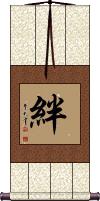
This Kanji represents a bond, as in the bond between mother and daughter, father and son, family ties, or a family bond.
絆 is the kind of character that says, no matter what happens (difficult times), we have this bond that cannot be broken.
If you go to the Japanese dictionary, the definition is the bonds (between people), (emotional) ties, relationship, connection, link, tether, or fetters.
Read this before ordering...
This Kanji is best if your audience is Japanese. While this is also a Chinese character, it has a completely different meaning in Chinese (it means to hinder or stumble in Chinese).
it’s
a very rare character in Korean Hanja but does mean bond in Korean (used in Korean words for certain kinds of glue and sticking plaster).
No man knows what he owes to his parents until he comes to have children of his own
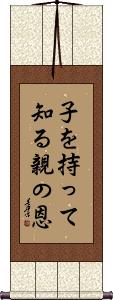
子を持って知る親の恩 literally translates as: Only after you have a baby, you would appreciate your parents (feel the way they do, etc).
This is a bit like the “walk a mile in another man's shoes” saying. Basically, it's about you cannot fully understand the plight of others until you experience it yourself. It also shows appreciation for the plight of parents.
This Japanese proverb can also be translated a few more ways:
No man knows what he owes to his parents till he comes to have children of his own.
One knows not what one owes to one's parents till one comes to have children of one's own.
Only after you have a baby, you will appreciate your parents or feel the way they do.
Only after becoming a parent yourself do you realize how much you owe [how indebted you are] to your own parents.
Note: Because this selection contains some special Japanese Hiragana characters, it should be written by a Japanese calligrapher.
Dear Grandfather
Paternal (Southern China)
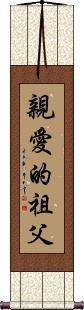
親愛的祖父 is how people in Southern China call their father's father (paternal grandfather) with the adjective/title “Dear” on the front.
Dear Grandfather
Paternal (Northern China)
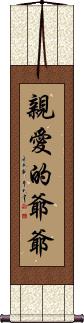
親愛的爺爺 is the most common way for people in Northern China to refer to their father's father (paternal grandfather) with the adjective/title “Dear” on the front.
Loving Grandfather
Paternal (Southern China)
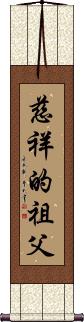
慈祥的祖父 is “Loving Grandfather” in the way people in Southern China call their father's father (paternal grandfather).
Loving Grandfather
Paternal (Northern China)
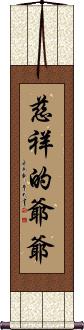
慈祥的爺爺 is “Loving Grandfather” using the most common way for people in Northern China to refer to their father's father (paternal grandfather).
Loving Grandfather
Maternal (Northern China)
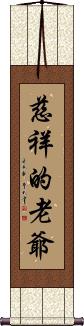
慈祥的老爺 is what you would call your maternal grandfather (mother's father) in Northern China with the adjective/title “Dear” on the front.
Dear Grandfather
Maternal (Northern China)
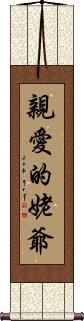
親愛的姥爺 is what you would call your maternal grandfather (mother's father) in Northern China with the adjective/title “Dear” on the front.
Dear Grandfather
Maternal (Southern China - Informal)
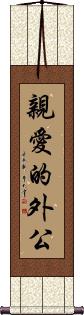
親愛的外公 is an informal way to call your maternal grandfather (mother's father) in Southern China with the adjective/title “Dear” on the front.
Dear Grandmother
Paternal (Southern China)
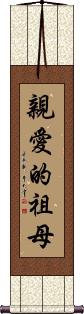
The most common way to refer to your father's mother (paternal grandmother) in Southern China with the adjective/title “Dear” on the front.
Dear Grandmother
Paternal (Northern China)
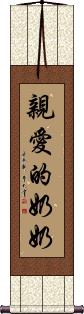
親愛的奶奶 is probably the most common way to refer to your father's mother (paternal grandmother) in northern China with the adjective/title “Dear” on the front.
Dear Grandfather
Maternal (Southern China)
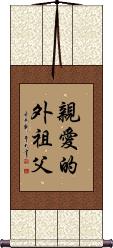
親愛的外祖父 is the formal way that people in Southern China usually call their mother's father (maternal grandfather) with the adjective/title “Dear” on the front.
Loving Grandfather
Maternal (Southern China - Informal)
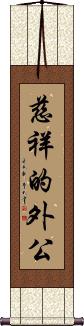
慈祥的外公 is “Loving Grandfather” using an informal way to call your maternal grandfather (mother's father) in Southern China.
Loving Grandmother
Paternal (Southern China)
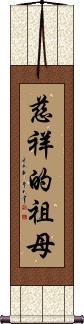
慈祥的祖母 is “Loving Grandmother” in the most common way to refer to your father's mother (paternal grandmother) in Southern China.
Loving Grandmother
Paternal (Northern China)
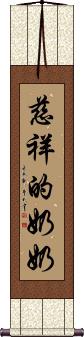
慈祥的奶奶 is “Loving Grandmother” in probably the most common way to refer to your father's mother (paternal grandmother) in northern China.
Loving Grandfather
Maternal (Southern China)
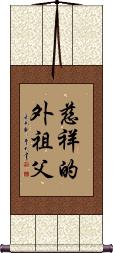
慈祥的外祖父 is “Loving Grandfather” in the formal way that people in Southern China usually call their mother's father (maternal grandfather).
Love Between Child and Parents
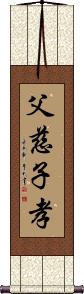
父慈子孝 is a Chinese proverb that means “benevolent father, filial son.”
Figuratively, this is the natural love between parents and children.
Hua Mulan
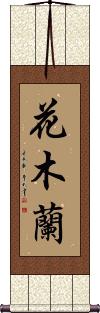
花木蘭 is the name of the famous Chinese woman warrior Hua Mulan.
She was made famous in the west by Disney's animated movie, “Mulan.”
Most of the historical information about her comes from an ancient poem. It starts with a concerned Mulan, as she is told a man from each family is to serve conscription in the army. Her father is too old, and her brother is too young. Mulan decides to take the place of her father. After twelve years of war, the army returns, and the best warriors are awarded great posts in the government and riches. Mulan turns down all offers and asks only for a good horse for the long trip home. When Mulan greets visiting comrades wearing her old clothes, they are shocked to find the warrior they rode into battle with for years is actually a woman.
Daddy’s Girl / Daddy’s Boy
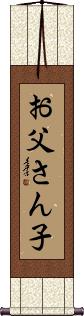
This modern Japanese word means Daddy’s Girl or Daddy’s Boy.
It refers to a child strongly attached to his/her father.
Note: Because this selection contains some special Japanese Hiragana characters, it should be written by a Japanese calligrapher.
Fatherly Master / Sifu / Shi Fu / Shifu
Martial Arts Teacher
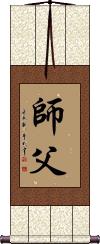
師父 means master in Chinese (occasionally used in Korean Hanja and Japanese). In the context of Martial Arts, this is the master and teacher who instructs students.
The second character by itself means father. Thus, you get the “Fatherly Master” translation. There's an old Chinese saying that goes something like, “One who is your teacher for one day is your father for life.”
Language notes: I've often seen this romanized as “sifu,” this is actually the Cantonese romanization. In Mandarin Chinese, it's “Shifu.” The pronunciation in Mandarin is actually like “sure foo” (using typical English pronunciation). There's an “R-sound” in there, which is not obvious from the romanization. Many martial arts studios incorrectly pronounce this like “she foo” (which is actually the Japanese pronunciation). In Cantonese, it sounds like “Sea foo” (almost like “seafood,” minus the “d” at the end).
師父 is kind of a weird selection for a calligraphy wall scroll; this entry is more for educational purposes. But you are welcome to buy it if it suits your circumstances.
The Holy Trinity
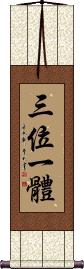
三位一體 is the Chinese and old Korean way to write Holy Trinity.
This would be understood in Japanese as well, but they tend to write it with the last character simplified like 三位一体 in modern Japan.
This can be translated literally as “Three Thrones, One Body.”
Asian Christians will understand this as the Trinity, God the Father, the Son, and the Holy Spirit.
The Lord's Prayer / Luke 11:2-4
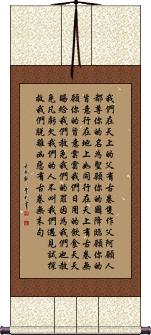
Here is the Lord's Prayer in Chinese from Luke 11:2-4.
The Chinese text with punctuation is:
Part of 11:2 ...我们在天上的父,有古卷只作父阿愿人都尊你的名为圣。愿你的国降临。愿你的旨意行在地上,如同行在天上。有古卷无愿你的旨意云云。
11:3 我们日用的饮食,天天赐给我们。
11:4 赦免我们的罪,因为我们也赦免凡亏欠我们的人。不叫我们遇见试探。救我们脱离凶恶。有古卷无末句。
Note that punctuation is not included in traditional Chinese calligraphy artwork.
From KJV, this is:
Part of 11:2 ...Our Father which art in heaven, Hallowed be thy name. Thy kingdom come. Thy will be done, as in heaven, so in earth.
11:3 Give us day by day our daily bread.
11:4 And forgive us our sins; for we also forgive everyone that is indebted to us. And lead us not into temptation, but deliver us from evil.
The Lord's Prayer / Mathew 6:9-13
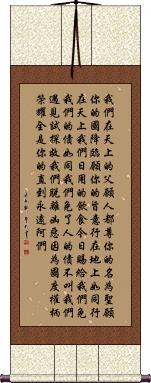
Here is the Lord's Prayer in Chinese from Mathew 6:9-13.
The Chinese text with punctuation is:
Part of 6:9 ...我们在天上的父,愿人都尊你的名为圣。
6:10 愿你的国降临,愿你的旨意行在地上,如同行在天上。
6:11 我们日用的饮食,今日赐给我们。
6:12 免我们的债,如同我们免了人的债。
6:13 不叫我们遇见试探,救我们脱离凶恶,因为国度,权柄,荣耀,全是你的,直到永远,阿们。
Note that punctuation is not included in traditional Chinese calligraphy artwork.
From KJV, this is:
Part of 6:9 ...Our Father which art in heaven, Hallowed be thy name.
6:10 Thy kingdom come. Thy will be done in earth, as it is in heaven.
6:11 Give us this day our daily bread.
6:12 And forgive us our debts, as we forgive our debtors.
6:13 And lead us not into temptation, but deliver us from evil: For thine is the kingdom, and the power, and the glory, forever. Amen.
Japanese Snapping Turtle / Chinese Soft Shell Turtle
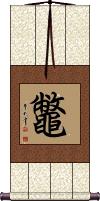
鼈 refers to a species of turtle.
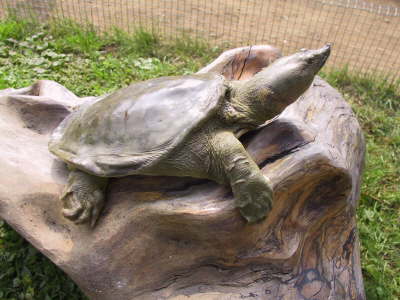
鼈 is Trionyx Sinensis.
鼈 refers to different turtles in different languages. See individual language notes below:
Japanese: 鼈 means “snapping turtle” or “mud turtle.” But rarely used as a single Kanji like this in Japanese.
Chinese: 鼈 means soft-shelled turtle. A specific species, Trionyx Sinensis is native to Asia.
In China, this species is related to the “wang ba,” a soft-shelled turtle sometimes known in English as a banjo turtle (due to its long neck, and general shape). Unfortunately, there is a word, “wang ba dan” which means the egg of this species of turtle. That term has come to mean “bastard” in Chinese (a turtle hatches from an abandoned egg, and does not know who his mother or father is). 鼈 is not a good selection for a wall scroll if your audience is Chinese.
In Korean, this character can be pronounced (though most Koreans would have to look it up in a dictionary). It has not been in common use in Korea for at least a few hundred years.
General notes: You may notice that the bottom half of this character is the same as some other turtle-related titles. That bottom half is actually an ancient character that means “toad.”  Though not seen in this way today, most turtle-related characters hold the meaning of “a toad with a shell” in their ancient origin. That toad character is rarely used alone anymore but you can see what it looks like in the image to the right.
Love for Parents
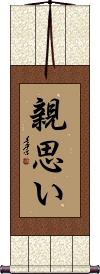
親思い is “love or affection for one's parents” in Japanese.
Fatal error: Cannot redeclare foreignPrice() (previously declared in /home/gwest/web/chinesescrollpainting.com/public_html/includes/currencyconverter.php:22) in /home/gwest/web/orientaloutpost.com/public_html/includes/currencyconverter.php on line 22