Many custom options...


And formats...



Not what you want?
Try other similar-meaning words, fewer words, or just one word.
One Direction in Chinese / Japanese...
Buy an One Direction calligraphy wall scroll here!
Personalize your custom “One Direction” project by clicking the button next to your favorite “One Direction” title below...
One Direction
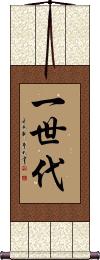
一世代 is a way to write “One Direction” in Chinese, referring to the British-Irish boy band.
They are commonly referred to as “1D” in Japan and China (no Chinese characters for that).
This title does not exactly mean “one direction.” It's closer to “one generation,” “one era,” or “one world.”
One Direction
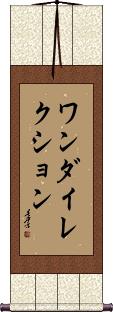
ワンダイレクション is a way to write “One Direction” in Japanese Katakana, referring to the British-Irish boy band.
They are commonly referred to as “1D” in Japan and China (no Japanese Kanji for that).
This title sounds like “One Direction” using Japanese sounds. Unlike Japanese Kanji words, this does not have any meaning, just pronunciation.
Note: Because this title is entirely Japanese Katakana, it should be written by a Japanese calligrapher.
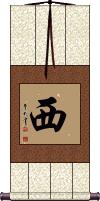
West
Direction
Love Yourself First
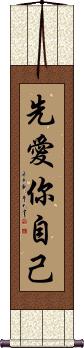
This directly translates as, “First, love yourself.”
Because this uses “yourself” instead of “myself,” this is a direction for those reading it. It could be the owner of the art or those who view it.
This would be weird as a tattoo, so please avoid it since for whom the tattoo is directed would be confusing.
See Also: Love Myself First
Samadhi
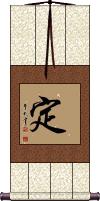
定 is the single-character way to express the idea of Samadhi in Chinese and Japanese.
A single-character title like this is open to a lot of interpretation. So 定 can mean to set, to fix, to determine, to decide, to order, certainly, truly, settle, or compose the mind.
In the Buddhist context, this means “Perfect absorption of thought into the one object of meditation,” “The mind fixed in one direction,” “Internal state of imperturbability or tranquility,” or “Exempt from all external sensations.”
Fong / Fang
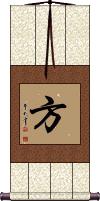
This is the most common version of a Chinese surname that romanizes as Fong from Taiwan or Fang from mainland China.
The meaning of this character is square, upright, honest, fair and square, direction, place, or side. Sometimes 方 can refer to a method, prescription, or way of doing things.
In Japanese, this can be the given names Michi, Masani, Masashi,Tamotsu, Tadashi. It can also be Japanese surnames Hon, Hou, Ho, Fuon, Pan, Ban, Tokukata, or Kata.
East
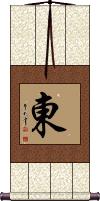
東 is the direction East in Chinese, Japanese Kanji, and old Korean Hanja.
Sometimes used as an abbreviation for the Eastern Hemisphere.
This can also be the surname Dong in China.
In Japan, this can be an abbreviation for a kind of six-stringed zither, or the personal name, Yamato.
東 is used as a suffix for many words in Asia. In fact, it's part of the CJK word 東方 meaning Orient or Oriental. The word 東方 more literally translates as “Eastern Kingdoms,” “Eastern Countries,” or simply “The East.”
Courage to do what is right
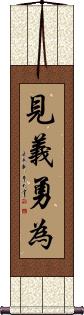
見義勇為 means the courage to do what is right in Chinese.
This could also be translated as “Never hesitate to do what is right.”
This comes from Confucian thought:
Your courage should head in an honorable direction. For example, you should take action when the goal is to attain a just result as, without honorable intent, a person’s gutsy fervor can easily lead them astray.
One who flaunts courage but disregards justice is bound to do wrong; someone who possesses courage and morality is destined to become a hero.
Some text above paraphrased from The World of Chinese - The Character of 勇
See Also: Work Unselfishly for the Common Good | Justice | Bravery
Push or Knock
To weigh one's words
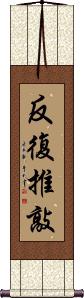
During the Tang Dynasty, a man named Jia Dao (born in the year 779), a well-studied scholar and poet, went to the capital to take the imperial examination.
One day as he rides a donkey through the city streets, a poem begins to form in his mind. A portion of the poem comes into his head like this:
“The bird sits on the tree branch near a pond,
A monk approaches and knocks at the gate...”
At the same time, he wondered if the word “push” would be better than “knock” in his poem.
As he rides down the street, he imagines the monk pushing or knocking. Soon he finds himself making motions of pushing and shaking a fist in a knocking motion as he debates which word to use. He is quite a sight as he makes his way down the street on his donkey with hands and fists flying about as the internal debate continues.
As he amuses people along the street, he becomes completely lost in his thoughts and does not see the mayor's procession coming in the opposite direction. Jia Bao is blocking the way for the procession to continue down the road, and the mayor's guards immediately decide to remove Jia Bao by force. Jia Bao, not realizing that he was in the way, apologizes, explains his poetic dilemma and awaits his punishment for blocking the mayor's way.
The mayor, Han Yu, a scholar and author of prose himself, finds himself intrigued by Jia Dao's poem and problem. Han Yu gets off his horse and addresses Jia Bao, stating, “I think knock is better.” The relieved Jia Bao raises his head and is invited by the mayor to join the procession, and are seen riding off together down the street, exchanging their ideas and love of poetry.
In modern Chinese, this 反復推敲 idiom is used when someone is trying to decide which word to use in their writing or when struggling to decide between two things when neither seems to have a downside.
Fatal error: Cannot redeclare foreignPrice() (previously declared in /home/gwest/web/chinesescrollpainting.com/public_html/includes/currencyconverter.php:22) in /home/gwest/web/orientaloutpost.com/public_html/includes/currencyconverter.php on line 22