Many custom options...


And formats...



Overcome in Chinese / Japanese...
Buy an Overcome calligraphy wall scroll here!
Personalize your custom “Overcome” project by clicking the button next to your favorite “Overcome” title below...
1. Overcome
4. Overcome: Regardless of the Rain and Wind
5. Regardless of the Weather, We Overcome Troubles Together
6. Overcome / Surpass / Rise Above
7. Warriors Adapt and Overcome
8. Use Hard Work to Overcome Adversity
10. Adapt Oneself
12. Resilient in the Face of Adversity
13. Indomitable Spirit / Indomitable Attitude
14. Mind Like Water
Overcome
Overcoming Hardships
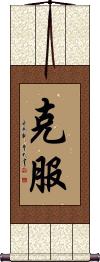
In Chinese, Japanese Kanji, and old Korean Hanja, 克服 means “overcome” (as in overcoming hardships, etc.). It can also mean to conquer, to put up with, or to endure.
This can be a conquest over a problem, disease, handicap, poverty, or illness. Other definitions include overcoming, bringing under control, subjugation, or victory over something.
This can be used as an inspirational wall scroll to remind someone to try to overcome difficulties that may arise in life.
Overcome the Devil
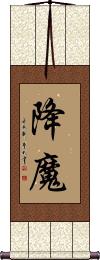
降魔 means to overcome the Devil, Satan, Demons, or Evil.
There are many ways to translate this, including conquering the devil, evil spirits, evil influences, or someone who habitually performs negative/evil acts.
In the Buddhist context, it means to overcome demons, e.g., as the Buddha did at his enlightenment.
Improvise Adapt Overcome
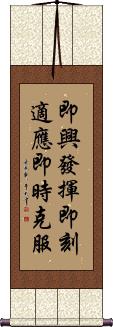
即興發揮即刻適應即時克服 is the coolest way to put together this famous word list, “Improvise Adapt Overcome.”
There are shorter ways to write “adapt,” and “overcome,” but “improvise” needs a four-character word to be expressed accurately in Chinese. To match them up, the other two are using four-character words as well. This makes it sound more natural in Chinese (though word lists are not a natural construct in Chinese grammar).
The words break down like this: 即興發揮, 即刻適應, 即時克服. I suggest the 3-column option when you customize your wall scroll. That way, the words will occupy one column each.
A great gift for a U.S. Marine, or anyone who follows this mantra.
Overcome: Regardless of the Rain and Wind
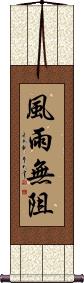
風雨無阻 is a proverb that is often translated as “Go ahead as planned regardless of the weather” or, “[Overcome] despite the rain and wind.”
This is a Chinese proverb that suggests that you are willing (or should be willing) to overcome any adversity, and accomplish your task at hand.
There is a second/optional part to this phrase that suggests that you should do this together with someone (see our other 8-character version if you want the full phrase).
Regardless of the Weather, We Overcome Troubles Together
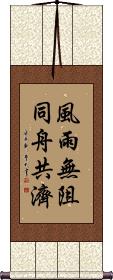
The first four characters are often translated as “Go ahead as planned regardless of the weather” or, “[Overcome] despite the rain and wind.” The last four characters can mean “Stick together” but literally means “Take the same boat [together].”
風雨無阻同舟共濟 is a Chinese proverb that suggests that you are willing (or should be willing) to overcome any adversity, and accomplish your task at hand. The second part (last four characters) is sometimes left off but this second part strongly suggests that you should overcome that adversity together.
Overcome / Surpass / Rise Above
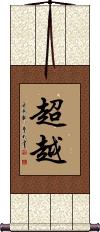
In Chinese, Japanese Kanji, and old Korean Hanja, 超越 means to overcome, surpass, transcendence, excel, exceed, go beyond, rise above, or transcend.
Warriors Adapt and Overcome
Soldiers need a fluid plan
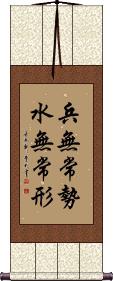
This literally translates as: Troops/soldiers/warriors have no fixed [battlefield] strategy [just as] water has no constant shape [but adapts itself to whatever container it is in].
Figuratively, this means: One should seek to find whatever strategy or method is best suited to resolving each individual problem.
This proverb is about as close as you can get to the military idea of “adapt improvise overcome.” 兵無常勢水無常形 is the best way to express that idea in both an ancient way, and a very natural way in Chinese.
Use Hard Work to Overcome Adversity
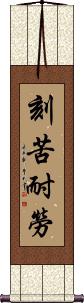
刻苦耐勞 is a Chinese proverb that suggests that you should always bear hardships and work hard.
Some will translate it as a suggestion to be assiduous and long-suffering.
My favorite is to use this to remind myself to be hard-working and capable of overcoming adversity.
Ability to Adapt
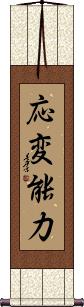
応変能力 is “the ability to take proper steps to meet the situation,” “the ability to adapt oneself to the requirement of the moment,” “the ability to adapt to circumstances,” or “adapt and overcome,” in Japanese Kanji.
Adapt Oneself
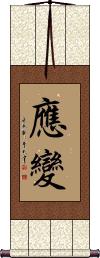
應變 means “to meet a contingency,” “to adapt oneself to changes,” or “to adapt to changes” in Chinese.
It's also used in Japanese but usually only in the context of Buddhism. 應變 is probably the shortest way to express the idea of adapting and overcoming whatever circumstances present themselves.
Conquer / Conquest
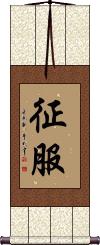
征服 means to conquer or conquest in Chinese, Japanese Kanji, and old Korean Hanja.
This can also be translated as vanquish, to subdue, subjugation, overcoming, or, to strike.
Note: This is kind of a violent term for a wall scroll but if you really want it, we’ll make it custom for you.
Resilient in the Face of Adversity
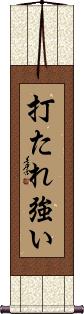
打たれ強い is often used as a martial arts term.
It means being able to take a lot of punishment or being able to take a hit. In Japanese baseball, it can also refer to the pitcher's ability to keep his cool when the batter gets a hit. 打たれ強い is generally about being resilient and strong in the face of criticism or adversity.
Note: Because this selection contains some special Japanese Hiragana characters, it should be written by a Japanese calligrapher.
Indomitable Spirit / Indomitable Attitude
Fukutsu no Seishin
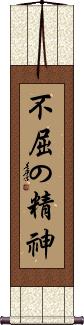
不屈の精神 is one of several versions or ways to write “Indomitable Spirit” in Japanese.
This one is the famous “Fukutsu no Seishin” phrase.
Mind Like Water
Mizu No Kokoro
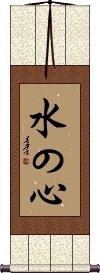
水の心 is the Japanese Buddhist and martial arts phrase, “Mizu no Kokoro,” which means “mind like water” or “heart of water.”
The phrase is a metaphor describing the pond that clearly reflects its surroundings when calm but whose images are obscured once a pebble is dropped into its waters.
Undaunted After Repeated Setbacks
Persistence to overcome all challenges
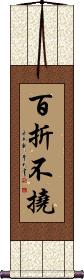
百折不撓 is a Chinese proverb that means “Be undaunted in the face of repeated setbacks.”
More directly translated, it reads, “[Overcome] a hundred setbacks, without flinching.” 百折不撓 is of Chinese origin but is commonly used in Japanese and somewhat in Korean (same characters, different pronunciation).
This proverb comes from a long, and occasionally tragic story of a man that lived sometime around 25-220 AD. His name was Qiao Xuan, and he never stooped to flattery but remained an upright person at all times. He fought to expose the corruption of higher-level government officials at great risk to himself.
Then when he was at a higher level in the Imperial Court, bandits were regularly capturing hostages and demanding ransoms. But when his own son was captured, he was so focused on his duty to the Emperor and the common good that he sent a platoon of soldiers to raid the bandits' hideout, and stop them once and for all even at the risk of his own son's life. While all of the bandits were arrested in the raid, they killed Qiao Xuan's son at first sight of the raiding soldiers.
Near the end of his career, a new Emperor came to power, and Qiao Xuan reported to him that one of his ministers was bullying the people and extorting money from them. The new Emperor refused to listen to Qiao Xuan and even promoted the corrupt Minister. Qiao Xuan was so disgusted that in protest, he resigned from his post as minister (something almost never done) and left for his home village.
His tombstone reads “Bai Zhe Bu Nao” which is now a proverb used in Chinese culture to describe a person of strong will who puts up stubborn resistance against great odds.
My Chinese-English dictionary defines these 4 characters as “keep on fighting despite all setbacks,” “be undaunted by repeated setbacks,” and “be indomitable.”
Our translator says it can mean “never give up” in modern Chinese.
Although the first two characters are translated correctly as “repeated setbacks,” the literal meaning is “100 setbacks” or “a rope that breaks 100 times.” The last two characters can mean “do not yield” or “do not give up.”
Most Chinese, Japanese, and Korean people will not take this absolutely literal meaning but will instead understand it as the title suggests above. If you want a single big word definition, it would be indefatigability, indomitableness, persistence, or unyielding.
See Also: Tenacity | Fortitude | Strength | Perseverance | Persistence
Fatal error: Cannot redeclare foreignPrice() (previously declared in /home/gwest/web/chinesescrollpainting.com/public_html/includes/currencyconverter.php:22) in /home/gwest/web/orientaloutpost.com/public_html/includes/currencyconverter.php on line 22