Many custom options...


And formats...



Patience Perseverance in Chinese / Japanese...
Buy a Patience Perseverance calligraphy wall scroll here!
Personalize your custom “Patience Perseverance” project by clicking the button next to your favorite “Patience Perseverance” title below...
2. Patience / Perseverance / To Endure / Tolerant
3. Patience Yields Peace of Mind
4. Gaman
5. Ninpo
Patience / Perseverance
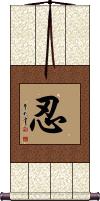
忍 contains the ideas of patience, equanimity, perseverance, forbearance, and endurance. Alone, this single character can be a bit ambiguous or flexible. It can also mean to endure, to bear, to put up with, or to conceal. If you want to simply decide what this character means to you within the general meaning but keep it a mystery to others, this is a good choice.
If you want to be more direct, you may want to choose one of our other selections that mean perseverance or patience (you will see this character within those larger words/phrases).
There is a secondary meaning in Japanese since this is the first character of the word ninja. Note that when writing this as Kanji, Japanese will tend to write it in the form shown to the right. If you select our Japanese master calligrapher, please expect this Kanji form (yes, it's just one stroke that is slightly different in location, crossing another stroke in the Japanese Kanji form).
See Also: Perseverance | Patience | Tenacious
Patience / Perseverance / To Endure / Tolerant
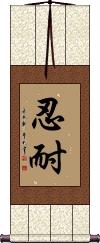
忍耐 is patience, the quiet hope, and trust that things will turn out right.
You wait without complaining. You are tolerant and accepting of difficulties and mistakes. You picture the end in the beginning and persevere to meet your goals.
忍耐 can also mean “to endure,” “restrain oneself,” or “forbearance,” and in some contexts, it can mean “perseverance” or “endurance.”
忍耐 is also used as a tenet of Taekwondo, Tang Soo Do, and other Korean martial arts where it's titled “Endurance” and romanized as “In Neh.”
Note that when writing this as Kanji, Japanese will tend to write the first character in the form shown to the right. If you select our Japanese master calligrapher, please expect this Kanji form (yes,
it’s
just one stroke that is slightly different in location, crossing another stroke in the Japanese Kanji form).
See Also: Peace | Harmony | Perseverance
Patience Yields Peace of Mind
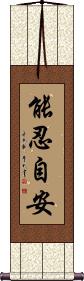
This ancient Chinese proverb can be translated as “Patience brings peace of mind,” “One who has patience finds peace,” and a few other ways.
Gaman
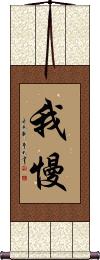
Gaman is a Zen Buddhist term from Japan that means “enduring the seemingly unbearable with patience and dignity.”
This title can also be translated as patience, perseverance, tolerance, or self-denial.
我慢 is also a Chinese Buddhist term with a different pronunciation. It comes from Sanskrit abhimāna or ātma-mada. Chinese Buddhism defines this very differently as “Egoism exalting self and depreciating others,” “self-intoxication,” or “pride.” Alone, the first character means “Me, I, or Self,” and the second character in a Buddhist context comes from Sanskrit māna and means pride, arrogance, self-conceit, looking down on others, superciliousness, etc.
I’m currently working with Japanese and Chinese translators to try and reconcile the true meaning or any commonality of this word between languages. For now, please only consider this if your audience is Japanese.
Ninpo
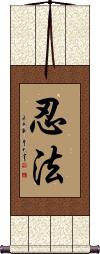
忍法 is Ninpo which can be translated as “Ninja Arts” from Japanese.
If you want this to mean “Ninja Arts,” you should consider this to be Japanese only. In Chinese, someone might read this as “patience law” or “the art of patience.”
The first character can be associated with “Ninja” since it is the “Nin” of “Ninja.” But the literal meaning is patience or perseverance. The second character means “law” or “method.” Often this is extended to mean or be translated as “arts.”
Within a Buddhist context (especially Chinese Buddhism), this is the method or stage of patience, the sixth of the seven stages of the Hīnayāna in the attainment of arhatship, or sainthood.
Osu No Seishin
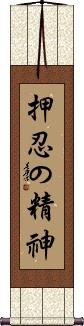
押忍の精神 is the name Osu No Seishin or “Spirit of Osu” in Japanese.
This Spirit of Osu is an essential concept in Karate. You will hear “Osu!” shouted in every Karate dojo which is not just a sign of respect and obedience to the Sensei but also means patience, determination, and perseverance. Shouting “Osu!” serves as a reminder to embody these qualities.
Taekwondo Tenets / Spirit of Taekwon-do
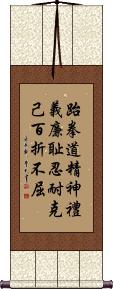
跆拳道精神禮義廉耻忍耐克己百折不屈 is General Choi's writing that is often called “The Tenets of Taekwon-do.”

The actual title would be translated as “Taekwondo Spirit” or “The Spirit of Taekwondo.” It was originally written in Korean Hanja (Chinese characters used in Korea for about 1600 years).
General Choi's original calligraphy is shown to the right. Your custom calligraphy will be unique, and not an exact match, as each calligrapher has their own style.In modern times, the common form of written Korean is Hangul (a phonetic character set). The table below shows the text in Hangul and Hanja along with a pronunciation guide and a brief English translation:
| Traditional Korean Hanja | Modern Korean Hangul | Pronunciation | English |
| 跆拳道精神 | 태권도정신 | tae gweon do jeong sin | Taekwondo Spirit |
| 禮儀 | 예의 | ye yi | Courtesy / Etiquette / Propriety / Decorum / Formality |
| 廉耻 | 염치 | yeom ci | Integrity / Sense of Honor |
| 忍耐 | 인내 | in nae | Patience / Perseverance / Endurance |
| 克己 | 극기 | geug gi | Self-Control / Self-Denial / Self-Abnegation |
| 百折不屈 | 백절불굴 | baeg jeor bur gur | Indomitable Spirit (Undaunted even after repeated attacks from the opponent) |
| Note that the pronunciation is the official version now used in South Korea. However, it is different than what you may be used to. For instance, “Taekwon-do” is “tae gweon do.” This new romanization is supposed to be closer to actual Korean pronunciation. | |||
Fatal error: Cannot redeclare function foreignPrice() (previously declared in /home/gwest/web/chinesescrollpainting.com/public_html/includes/currencyconverter.php:22) in /home/gwest/web/orientaloutpost.com/public_html/includes/currencyconverter.php on line 22