Many custom options...


And formats...



Peace Harmony in Chinese / Japanese...
Buy a Peace Harmony calligraphy wall scroll here!
Personalize your custom “Peace Harmony” project by clicking the button next to your favorite “Peace Harmony” title below...
2. Life in Harmony / Balanced Life
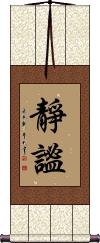
6. Peacefulness / Tranquility / Perfectly Quiet
7. Beautiful Life / Life in Perfect Harmony
8. Tranquil / Tranquility / Serenity
9. Patience / Perseverance / To Endure / Tolerant
10. Wado-Kai
11. Wado-Ryu
12. Peaceful Warrior
Peace / Harmony
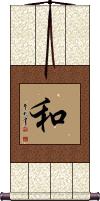
和 is the simplest form of peace and harmony.
和 can also be translated as the peaceful ideas of gentle, mild, kind, and calm. With a more harmonious context, it can be translated as union, together with, on good terms with, or on friendly terms.
Most people would just translate this character as peace and/or harmony. 和 is a very popular character in Asian cultures - you can even call it the “peace symbol” of Asia. In fact, this peace and harmony character was seen repeatedly during the opening ceremony of the 2008 Olympic Games in Beijing (a major theme of the games).
In old Chinese poems and literature, you might see this used as a kind of "and." As in two things summed together. As much as you could say, "the sun and moon," you could say "the sun in harmony with the moon."
See Also: Inner Peace | Patience | Simplicity
Life in Harmony / Balanced Life
Harmonious Life
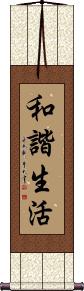
This 和諧生活 title suggests that you have, or want to get your life in balance.
The first two characters regard the idea of balance, harmony, and peace.
The second two characters mean “life.” More specifically this refers to your livelihood, career, and the daily activities that comprise your life or living. Some would translate those two characters as “one's daily existence.”
Note: We have a couple of titles for this idea. This version is more of a noun, thus "The Balanced Life" verses a verb form like "Balancing [Your] Life."
Peace of Mind
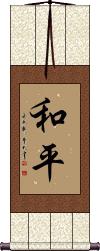
和平 is the Chinese order for these two characters, which means peace but can also be translated as amicability, specifically, or mildness. 和平 is often translated as a simple way to say “peace of mind.” This combination is used in Korean Hanja to mean “peace and harmony.”
Alone, the first character means peace and harmony.
The second character means balance when read by itself.
Note: 和平 are often seen in the opposite order in Japanese with the same meaning (You'll sometimes find them in this order in Japan, so either way is OK).
Peace / Peaceful
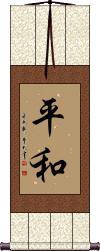
平和 is the Japanese and Korean order of these characters used most often to express the idea of peace, tranquility, and harmony.
It's just the reverse order of the Chinese. In this order in Chinese, it means takes the “mild” definition rather than “peace.” In Korean, the combination keeps the same meaning in either order.
The second character also means balance, so there is an element of harmony and balance along with peace.
Harmony / Balance
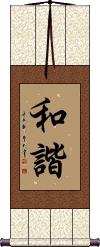
Harmony / Balance
Cho Wa
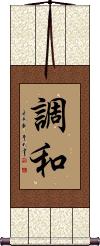
調和 is one of the several ways to express harmony in Chinese and Japanese.
Note: The first character means harmony but also suggests a musical meaning. It can also describe warriors marching in perfect cadence (in step) or to regulate something.
The second character carries the meaning of harmony and peace by itself.
Together, these characters create a word that can be defined as harmonious, to mediate, to reconcile, to compromise; mediation, temper, to mix, blend, blended, season, seasoning (getting the flavors of the food in balance), to placate, or be in harmonious proportion.
The meaning varies depending on the context. However, when hanging as a wall scroll, this will refer to the person (you) being balanced and in harmony while rational and under control simultaneously.
Peacefulness / Tranquility / Perfectly Quiet
Beautiful Life / Life in Perfect Harmony
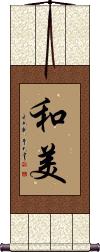
和美 is a word that means “harmonious” or, “in perfect harmony.”
The deeper meaning or more natural translation would be something like, “beautiful life.”
The first character means peace and harmony.
The second character means beautiful. But in this case, when combined with the first character, beautiful refers to being satisfied with what you have in your life. This can be having good relations, good feelings, comfort, and having enough (with no feeling of wanting).
Note: In Japanese, this is often used as the name "Wami." This title is probably more appropriate if your audience is Chinese.
Tranquil / Tranquility / Serenity
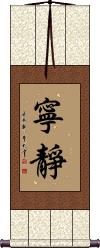
寧靜 expresses the idea of tranquility and serenity in Chinese.
See Also: Peace | Inner Peace | Harmony | Calm
Patience / Perseverance / To Endure / Tolerant
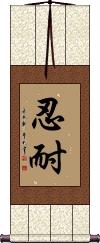
忍耐 is patience, the quiet hope, and trust that things will turn out right.
You wait without complaining. You are tolerant and accepting of difficulties and mistakes. You picture the end in the beginning and persevere to meet your goals.
忍耐 can also mean “to endure,” “restrain oneself,” or “forbearance,” and in some contexts, it can mean “perseverance” or “endurance.”
忍耐 is also used as a tenet of Taekwondo, Tang Soo Do, and other Korean martial arts where it's titled “Endurance” and romanized as “In Neh.”
 Note that when writing this as Kanji, Japanese will tend to write the first character in the form shown to the right. If you select our Japanese master calligrapher, please expect this Kanji form (yes,
it’s
just one stroke that is slightly different in location, crossing another stroke in the Japanese Kanji form).
Note that when writing this as Kanji, Japanese will tend to write the first character in the form shown to the right. If you select our Japanese master calligrapher, please expect this Kanji form (yes,
it’s
just one stroke that is slightly different in location, crossing another stroke in the Japanese Kanji form).
See Also: Peace | Harmony | Perseverance
Wado-Kai
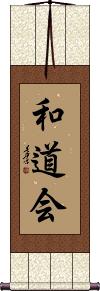
Wado-Kai is used as a title for styles of Karate and Aikido.
Breaking down the characters into the proper Japanese Romaji, you have “wa dou kai” or “wa dō kai.” The meaning is roughly-translated as “Harmony Way Club” or “Peace Method Association.” The first Kanji should probably be read as harmony, rather than peace in this case.
See Also: Wado-Ryu
Wado-Ryu
Style of Karate or Jujitsu
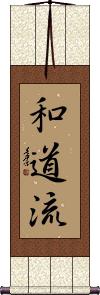
和道流 or Wado-Ryu is a style of Karate or Jujutsu (Jujitsu).
Note: Many will argue whether this is a style of Karate or Jujutsu.
While some find Wado-Ryu similar to Shotokan Karate, enough differences exist in perspective and technique that it stands by itself.
Breaking down the characters into the proper Japanese Romaji, you have “wa dou ryuu” or “wa dō ryū.” The meaning is roughly-translated as “Harmony Way Style” or “Peace Method Style.” The first Kanji should probably be read as harmony rather than peace in this case.
See Also: Wado-Kai
Peaceful Warrior
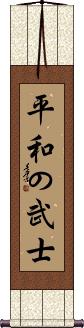
平和の武士 can be read as “Peaceful Warrior” or “Warrior for Peace” in Japanese. This sounds like an oxymoron in Japanese, so it's a weird title. Expect Japanese people to be perplexed when they see it.
Character breakdown:
平和 (heiwa) peace; harmony.
の (no) possessive particle.
武士 (bushi) warrior; samurai; soldier.
Fatal error: Cannot redeclare function foreignPrice() (previously declared in /home/gwest/web/chinesescrollpainting.com/public_html/includes/currencyconverter.php:22) in /home/gwest/web/orientaloutpost.com/public_html/includes/currencyconverter.php on line 22