Many custom options...


And formats...



Peaceful Heart in Chinese / Japanese...
Buy a Peaceful Heart calligraphy wall scroll here!
Personalize your custom “Peaceful Heart” project by clicking the button next to your favorite “Peaceful Heart” title below...
Peaceful Heart
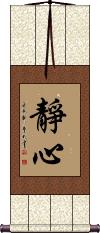
靜心 is how to write “peaceful heart” in Chinese.
The first character means peaceful, calm, and quiet. The second means heart but can also mean mind, soul, or spirit.
Because the word for heart/mind/soul is interchangeable in Chinese, this can also be translated as “a peaceful soul” or “a quiet mind.”
I have also seen this translated as “placid temperament” or “spirit of serenity,” especially in Japanese.
 While they once used the same first character form in Japan, they now use a slightly-simplified version in modern Japan (after WWII). This version is shown to the right, and can be selected for your wall scroll by clicking on that Kanji instead of the button above.
Peaceful Heart / Peace of Mind / Calm Mind
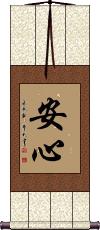
安心 can be defined as relief, peace of mind, feeling at ease, to be relieved, to set one's mind at rest, and easiness.
安心 is a nice word that encompasses great meanings within just two characters. Some of the other meanings include pacifying, settling the mind, and peace of mind. It's also the idea of feeling a sense of security, safety, and confidence in your state of well-being.
This can be used by everyone, but some consider it to be a Buddhist concept (You'll find it in your Zen dictionary).
Note: Can be romanized as Anshin or Anjin in Japanese.
No Worries
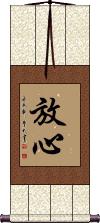
My Australian friends always say, “No worries, mate.” It's caught on with me, though I drop the “mate” part since it confuses my fellow Americans.
If you would like to express the idea of “no worries,” 放心 is the best and most natural way to say it in Chinese.
The characters you see to the left can be translated as “put your mind at rest” or “to be at ease.” You could literally translate “no worries,” but it doesn't “flow” like this simple Chinese version.
For your info, the first character means to release, to free, to let go, to relax, or to rest. The second character means your heart or your mind.
Note that in Japanese and Korean, this holds the similar meaning of “peace of mind” but can also mean absentmindedness or carelessness, depending on context.
Kokoro no Heiwa
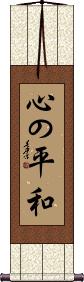
心の平和 means “heart of peace” or “peaceful heart” in Japanese.
Integrity
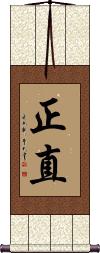
Integrity is living by your highest values. It is being honest and sincere. Integrity helps you to listen to your conscience, do the right thing, and tell the truth. You act with integrity when your words and actions match. Integrity gives you self-respect and a peaceful heart. Please note that the second Kanji sometimes has an alternate form in Japanese. Let us know if you want the alternate form shown to the right.
Note: This entry is cross-listed as “honesty” because it also fits that definition.
Beyond Integrity, this word also means "upright" and "honest" in Chinese. Means "integrity," "honesty" or "frankness" in Japanese.
Fatal error: Cannot redeclare foreignPrice() (previously declared in /home/gwest/web/chinesescrollpainting.com/public_html/includes/currencyconverter.php:22) in /home/gwest/web/orientaloutpost.com/public_html/includes/currencyconverter.php on line 22