Many custom options...


And formats...



Purity in Chinese / Japanese...
Buy a Purity calligraphy wall scroll here!
Personalize your custom “Purity” project by clicking the button next to your favorite “Purity” title below...
1. Purity
4. Chastity
5. Clarity
6. Humble
7. Blue Lotus
10. Be Like Water
11. White Lotus
Purity
Clean and Pure
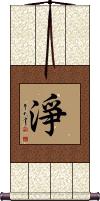
淨 is the most simple way to express purity or cleanliness in Chinese, Japanese Kanji, and old Korean Hanja.
As a single character, the concept is broad: This can be a verb (the act of cleaning, purifying, or cleansing) but it can also be the state of being clean, pure, and chaste. In some contexts, it can be a place to clean (like a bathing room for the soul in a Buddhist context). In Japanese, this can be a female given name “Jou” or “jō” (the Japanese equivalent of the English girl's name “Chastity”).
Purity of Mind
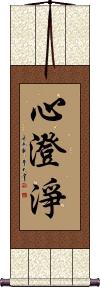
心澄淨 is the Buddhist concept of the pure and calm mind. It is believed that once you achieve a meditative state of pure focused thought, the mind becomes clear and calm. Although, others will say this means that achieving a calm mind will allow you to reach pure thought.
From Sanskrit, this is known as citta-prasāda. The concept of citta-prasāda is sometimes defined as “clear heart-mind,” or “the single and definitive aspiration.”
Chastity / Pure Heart
Also: Clean / Innocent / Pure
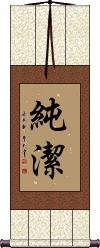
純潔 is associated with “chastity” but with the direct meaning of clean, innocent, and pure.
If you were expressing the idea of a “pure heart” in Chinese, while not literal, this would be the word you would use.
In Japanese, this word is sometimes used to express purity.
In Korean, it describes purity, chastity, virginity, and innocence (basically the same as the Chinese definition).
Chastity
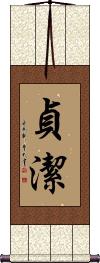
This Chinese and Japanese word is often used in variations of the Seven Heavenly Virtues to represent chastity.
Chastity
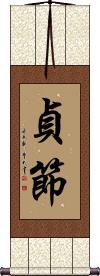
In Chinese, 貞節 would be defined as “The state of being sexually pure” or “chaste.”
Culturally, this especially applies to young women. 貞節 is not actually far off from our western view on this subject. In Japanese and Korean, this could also be used to express virtue, faithfulness, and fidelity.
See Also: Modesty
Clarity
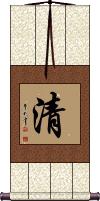
清 is a word that means clarity or clear in Chinese, Japanese Kanji, and old Korean Hanja.
Looking at the parts of this character, you have three splashes of water on the left, “life” on the top right, and the moon on the lower right.
Because of something Confucius said about 2500 years ago, you can imagine that this character means “live life with clarity like bright moonlight piercing pure water.” The Confucian idea is something like “Keep clear what is pure in yourself, and let your pure nature show through.” Kind of like saying, “Don't pollute your mind or body, so that they remain clear.”
This might be stretching the definition of this single Chinese character but the elements are there, and “clarity” is a powerful idea.
Korean note: Korean pronunciation is given above but this character is written with a slight difference in the "moon radical" in Korean. However, anyone who can read Korean Hanja, will understand this character with no problem (this is considered an alternate form in Korean). If you want the more standard Korean Hanja form (which is an alternate form in Chinese), just let me know.
Japanese note: When reading in Japanese, this Kanji has additional meanings of pure, purify, or cleanse (sometimes to remove demons or "exorcise"). Used more in compound words in Japanese than as a stand-alone Kanji.
Humble
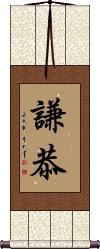
Blue Lotus
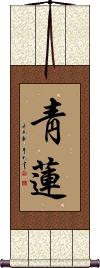
靑蓮 is a common title for Blue Lotus.
靑蓮 is often used in a Buddhist context for blue lotus from the Sanskrit “utpala.” This often refers to the clarity and purity of the lotus blue eyes possessed by a Living Buddha. It can also represent the purity of mind (without desire, suffering, fear, etc.).
Integrity / Honesty
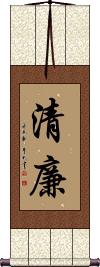
清廉 means honest, uncorrupted, honesty, integrity, purity, and unselfishness.
In Japanese, this can also be the given name Kiyoyuki.
Ultimate Goodness of Water
Quote from Lao Tzu
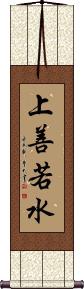
上善若水 is a quote that is sometimes presented as “Be like water.”
However, this is an ancient quote from the great philosopher Lao Tzu. It suggests that the ultimate goodness and purity (in the world) is water. Many take this as a suggestion to be like pure/good water.
Be Like Water
Quote from Lao Tzu
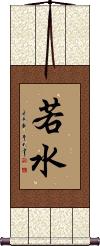
若水 is part of a very old saying from Lao Tzu.
In these two characters, there is a suggestion to be like water. The full phrase is about the goodness and purity of water. So, when this suggests being like water, it is actually a suggestion to be a good person (one who does not dishonor himself/herself, etc.).
White Lotus
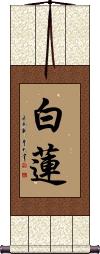
白蓮 is the title for the white lotus (flower) or a short name for the White Lotus society.
The white lotus represents purity or a pure heart and is often associated with Buddhism.
Notes: This can be the Japanese given name Byakuren. In the Buddhist context, the white lotus represented by these characters is originally puṇḍarīka in Sanskrit.
Elements of the Tea Ceremony
Wa Kei Sei Jaku
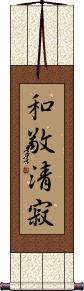
和, 敬, 清, 寂 or Wa, Kei, Sei, Jaku are the principles of the way of tea or 茶道.
The meanings are:
Harmony 和 (wa).
Respect 敬 (kei).
Purity 清 (sei).
Tranquility 寂 (jaku).
These principles or tenets were created by tea master Sen Rikyu (1522-1591). More about these ideas: Chanoyu
See Also: The Way of Tea
Lucky / Auspicious / Good Omen
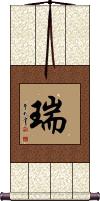
瑞 is a Chinese, Japanese, and old Korean word that means: lucky; auspicious; propitious; freshness; purity; luster; a good omen.
In Japanese, this can be the following female given names: Yutaka; Midzuho; Mizuho; Mizuki; Mizue; Mizu; Mio; Tamami. It can also be a Japanese surname, Zui or Shirushi.
In the Buddhist context, this can represent an auspicious jade token or good omen.
Fatal error: Cannot redeclare function foreignPrice() (previously declared in /home/gwest/web/chinesescrollpainting.com/public_html/includes/currencyconverter.php:22) in /home/gwest/web/orientaloutpost.com/public_html/includes/currencyconverter.php on line 22