Many custom options...


And formats...



Read in Chinese / Japanese...
Buy a Read calligraphy wall scroll here!
Personalize your custom “Read” project by clicking the button next to your favorite “Read” title below...
1. Read
3. Read / Study
4. Better to Travel 10,000 Miles than Read 10,000 Books
5. Read 10,000 Books, Travel 10,000 Miles
6. Mindfulness
Read
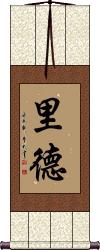
里德 is the name Read in Chinese (Mandarin).
Read
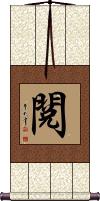
閱 is a Chinese character that means to read. It can also refer to observing (the world, and learning from it), or gaining life experiences. 閱 is a good character to relay the idea of being “well-read,” which can include reading books, studying, and learning through experience.
The dictionary definition also includes: to inspect; to review; to peruse; to go through; to experience.
Technically, this is also a Japanese Kanji but only some Japanese Buddhists use it (most of the population will not recognize it).
In Chinese and Japanese Buddhism, this means examining, inspecting, and/or looking over.
Read / Reading
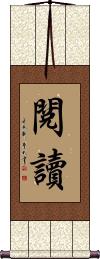
閱讀 is a Chinese word that refers to the act of reading or a suggestion to read (presumably books but could refer to any reading materials or text).
Read / Study
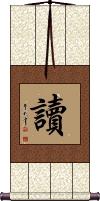
讀 is a Chinese character that means “to read out loud,” or “to study books.”
Very seldom used in Japanese anymore (except occasionally in Buddhism).
Better to Travel 10,000 Miles than Read 10,000 Books
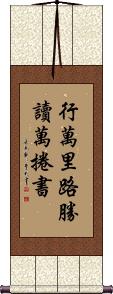
行万里路胜读万卷书 translates a few ways:
To travel ten thousand miles beats reading ten-thousand books.
Better to travel ten thousand li than to read ten thousand books. (a “li” is an ancient Chinese mile)
Traveling thousands of miles is better than reading thousands of books.
No matter how you slice it, this Chinese proverb is claiming that experience is more profound and meaningful than what you can get from a book. Go do it! Don't just read about it.
Read 10,000 Books, Travel 10,000 Miles
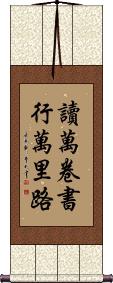
讀萬卷書行萬里路 is a lifelong suggestion for expanding your horizons by gaining knowledge, experience, and seeing the world.
Of course, this was written long ago when it was hard to travel 10,000 miles (at least 1000 years before the invention of the airplane).
With air travel and the business I'm in, I often achieve that lifetime goal on a monthly basis.
However, I am a little behind in the book count.
Note: An ancient Chinese mile (里 or lǐ) referred to in this proverb is about a third of a British/American mile. However, at that time, this was a great distance to travel.
Mindfulness
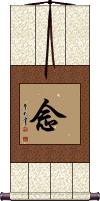
念 is the simplest way to write “mindfulness” in Chinese, Japanese Kanji, and old Korean Hanja.
念 can be defined these ways: To read; to study (a degree course); to read aloud; to miss somebody (keeping them in your mind); idea; remembrance; sense; thought; feeling; desire; concern; attention; recollection; memory; to think on/about; reflect; repeat, intone; a moment.
Obviously, the context in which the character is used determines which definition or meaning is perceived. As a single character, it's open and perhaps ambiguous. Thus, it can be read with any or all of these meanings.
念 is used in a Buddhist context (often written as 正念 or “right mindfulness”) with similar meanings of thought and contemplation.
In Japanese, this character is sometimes used as the name “Nen.”
See Also: Buddhism | Enlightenment
Diligent Study Proverb
Drill a hole in the wall to get light to read by.
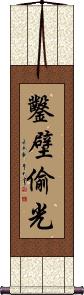
鑿壁偷光 is a Chinese proverb that means “Bore a hole in the wall to make use of the neighbor's light to study.”
This is a nice gift for a very studious person.
Kuang Heng was born during the Western Han period. He has been very fond of reading ever since he was young. However, he could not attend school since his family was poor, and he had to borrow books from people to learn.
To borrow these books, he normally did chores for people who had them. When he became older, he had to work in the field from sunrise to sunset since his family's financial situation did not improve. Thus, he tried to study at night, but he had no lamp.
One day, he noticed the light from the neighbor's house coming through a crack in the wall. This made him very happy, so he dug a larger hole from the crack and read in the light that shone through. This diligent study eventually made him an accomplished person.
Fatal error: Cannot redeclare foreignPrice() (previously declared in /home/gwest/web/chinesescrollpainting.com/public_html/includes/currencyconverter.php:22) in /home/gwest/web/orientaloutpost.com/public_html/includes/currencyconverter.php on line 22