Many custom options...


And formats...



Respect in Chinese / Japanese...
Buy a Respect calligraphy wall scroll here!
Personalize your custom “Respect” project by clicking the button next to your favorite “Respect” title below...
1. Respect
4. Love and Respect / Kindness and Respect
5. Respect out of fear is never genuine; Reverence out of respect is never false
Respect
Politeness, Gratitude and Propriety
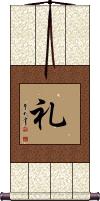
礼 is one of the five tenets of Confucius.
Beyond respect, 礼 can also be translated as propriety, good manners, politeness, rite, worship, or an expression of gratitude.
We show respect by speaking and acting with courtesy. We treat others with dignity and honor the rules of our family, school, and nation. Respect yourself, and others will respect you.
 Please note that Japanese use this simplified 礼 version of the original 禮 character for respect. 礼 also happens to be the same simplification used in mainland China. While 禮 is the traditional and original version, 礼 has been used as a shorthand version for many centuries. Click on the big 禮 character to the right if you want the Traditional Chinese and older Japanese versions.
This is also a virtue of the Samurai Warrior
See our page with just Code of the Samurai / Bushido here
See Also: Confucius
Respect / Honor / Esteem
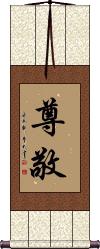
尊敬 is how to express the ideas of respect, honor, reverence, esteem, nobility, and sometimes the state of being noble, all in one word. Most of the time, this is used as “giving respect,” but depending on the context, it can suggest that you should try to be “worthy of respect.”
Although pronounced differently, the Chinese characters, Japanese Kanji, and Korean Hanja are the same across these languages. This is an indication that this word is very old and crosses many barriers and cultures in the Orient (East Asia).
Self-Respect / Self-Esteem
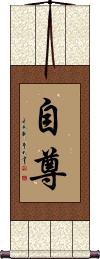
自尊 means self-respect or self-esteem in Chinese, Korean and Japanese. It can also mean “pride in oneself.”
Note: Japanese sometimes put the character for the heart after these two. However, this two-character word is universal between all three languages (which is often better since more than a third of the world's population can read this version as a native word).
Love and Respect / Kindness and Respect
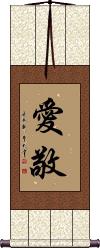
愛敬 is a Chinese, Japanese Kanji, and old Korean Hanja title that can mean “love and respect,” “kindness and respect,” “to love with reverence,” “charm,” “amiability,” “winsomeness,” “courtesy,” or “ingratiating behavior.”
Note: The wide-ranging definitions show that this word is a bit ambiguous without the context of being used in a sentence.
Respect out of fear is never genuine; Reverence out of respect is never false
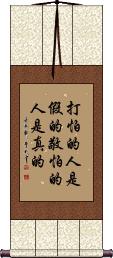
打怕的人是假的敬怕的人是真的 is a proverb that seems to be aimed at world leaders or others in power. Perhaps a suggestion to avoid the practice of “fear-mongering” opting instead for a policy of benevolence and justice.
An example: When the Bush administration told Pakistan they could either join America in the “war on terror,” or expect some bombs to be coming their way, Bush gained this kind of “less-than-genuine respect” from Pakistanis.
Leaders in places like North Korea and even Saudi Arabia reap the same bogus respect from their own citizens.
Note that calligraphers do not like to repeat the same characters in exactly the same way in the same piece of artwork. So expect the characters that are repeated to be written in different forms in the real artwork (unlike the way they are displayed to the left).
Love and Respect
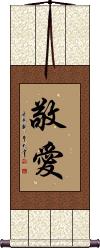
敬愛 is the short and sweet way to say “love and respect” in Chinese, Japanese Kanji, and old Korean Hanja.
Besides “respect and love,” this could be translated as “respect and affection,” “Reverence and love,” or “reverent love.”
In Japanese, this can also be the personal name Yoshinari.
Love and Respect
Love each other and show mutual respect
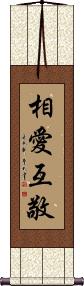
相愛互敬 is a nice way to say “Love and Respect” in Chinese.
This proverb is about the mutual exchange of love and respect within a good relationship.
The first two characters create a word that means “to love each other” or “mutual love.”
The third character means mutual, interlocking, or in some contexts, “to dovetail” (as in how joints are made in fine furniture).
The last character means “to respect,” “to venerate,” “to salute,” “reverence,” or simply “respect.”
Love and Respect
Love and respect each other
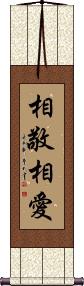
相敬相愛 is an old Chinese proverb that suggests love and respect go together and are to be exchanged between people (especially couples).
The first two characters mean “exchanging respect” or “mutual respect.”
The last two characters create a word that means “to love each other” or “mutual love.”
You'll notice that the first and third characters are the same. So you can read this literally as something like “Exchange respect, exchange love” or “Mutual respect, mutual love.” In English, we'd probably just say, “Mutual love and respect.” Grammar differs in every language - So while the literal translation might sound a bit awkward in English, this phrase is very natural in Chinese.
Mutual Respect
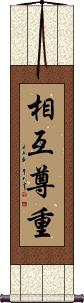
相互尊重 means mutual respect in Chinese, Japanese Kanji, and old Korean Hanja.
The first two characters are a word that means each other, mutual or reciprocal.
The last two characters are a word that means to respect, honor, value, eminent, or hold in high esteem.
Respect, Honor, Truth
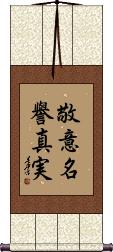
This means “Respect, Honor, Truth” in Japanese.
This is a word list, which is not the most natural kind of composition in Japanese (usually there is a subject, object, and verb - or a single word).
Respect, Honor, Truth
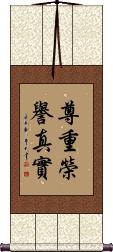
尊重, 榮譽, 真實 means “Respect, Honor, Truth” in Chinese.
This is a word list, which is not the most natural kind of composition in Chinese (usually there is a subject, object, and verb - or a single word).
Love Loyalty Respect
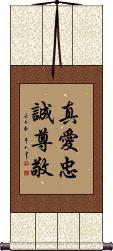
真愛忠誠尊敬 is a Chinese word list that means love, loyalty, and respect.
Respect and Loyalty
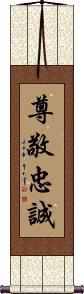
尊敬忠誠 means respect and loyalty in Chinese.
This is a word list (not a normal Chinese or Japanese phrase).
Word lists like this are not very common or natural in Chinese, so try to look for a better phrase to match your idea before you settle on this.
Love Loyalty Respect
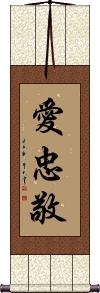
愛忠敬 is a Chinese word list that means love, loyalty, and respect.
愛忠敬 is the shortest way to express these words/ideas. Word lists are not as natural in Chinese as they are in English - phrases or proverbs are more common.
Fatal error: Cannot redeclare foreignPrice() (previously declared in /home/gwest/web/chinesescrollpainting.com/public_html/includes/currencyconverter.php:22) in /home/gwest/web/orientaloutpost.com/public_html/includes/currencyconverter.php on line 22