Many custom options...


And formats...



River in Chinese / Japanese...
Buy a River calligraphy wall scroll here!
Personalize your custom “River” project by clicking the button next to your favorite “River” title below...
1. River
2. Large River
6. River of Literacy, Sea of Learning
7. The incompetent boat pilot blames the river for his shortcomings
River
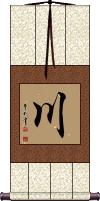
川 means river or stream in Chinese, Japanese Kanji, and old Korean Hanja.
In Japanese, this can be a surname when pronounced as Sakigawa.
Large River
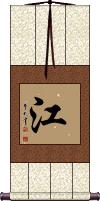
江 means large river in Chinese, Japanese Kanji, and old Korean Hanja. This generally refers to a river big enough that it's navigable by cargo boats, passenger boats, or small ships.
In Japanese, this can be a surname when pronounced as Minkou or just Kou.
Yangtze River
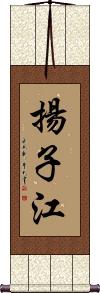
揚子江 is the title for the Yangzi or Yangtze River (in China).
Even though it's a Chinese place name, this is also how the title is written in Japanese.
High Mountain Long River
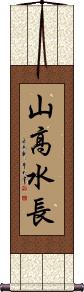
山高水長 is a Chinese idiom that means “high as the mountain and long as the river.”
It figuratively means “noble and far-reaching.”
Not sure this is valid or commonly used in Korean. It probably was borrowed into Korean a few hundred years ago but is obscure now.
Kawa no Kami / River God
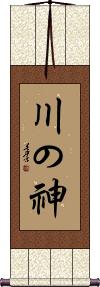
川の神 is the title of Kawa no Kami - a River deity of Japanese folklore.
River of Literacy, Sea of Learning
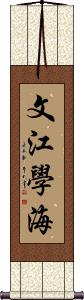
文江學海 is a Chinese proverb that reads, “river of literacy, a sea of learning”
This suggests that there is a lot to learn in the world, with an eternal amount of reading and things to study.
文江學海 is one way to translate the quote from Hippocrates, “ars longa, vita brevis,” meaning “it takes a long time to acquire and perfect one's expertise.”
See Also: Learning is Eternal
The incompetent boat pilot blames the river for his shortcomings
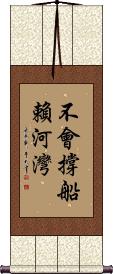
不會撐船賴河灣 literally translates as: [One who] cannot steer the boat blames the bends in the river.
Figuratively, this means: One who is incompetent always tries to shift the blame elsewhere.
This is similar to the English idiom, “a poor workman/craftsman blames his tools.”
One who walks by the river may end up with wet feet
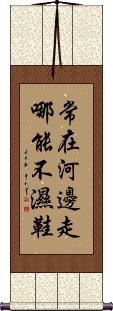
常在河邊走哪能不濕鞋 is an old Chinese proverb that is sometimes compared to the English saying “Shit Happens.”
It's a reflection that there are risks in life, and you should not be surprised when things don't go your way.
A secondary translation might be, “When walking by a river, often one cannot avoid wet shoes.”
No Limitations
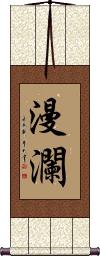
漫瀾 is the Chinese, Japanese Kanji, and old Korean Hanja for “Having no boundaries or limitations.”
This literally talks of the vastness of an ocean or river.
Character breakdown:
漫 = free; unrestrained; to inundate; overflowing; boundless.
澜 = swelling water; large wave.
Fatal error: Cannot redeclare foreignPrice() (previously declared in /home/gwest/web/chinesescrollpainting.com/public_html/includes/currencyconverter.php:22) in /home/gwest/web/orientaloutpost.com/public_html/includes/currencyconverter.php on line 22