Many custom options...


And formats...



Sacrifice in Chinese / Japanese...
Buy a Sacrifice calligraphy wall scroll here!
Personalize your custom “Sacrifice” project by clicking the button next to your favorite “Sacrifice” title below...
1. Sacrifice
3. Sacrifice / Devotion / Dedication
4. Better to sacrifice your life than your principles
5. Discipline
6. Bodhisattva
Sacrifice
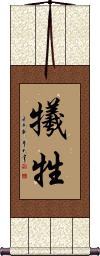
犧牲 means sacrifice in Chinese, Japanese Kanji, and old Korean Hanja.
There is a suggestion in this word that this regards sacrificing your life.
Note: Depending on the context, this can also mean victim or scapegoat in Japanese.
In original and ancient Chinese, this word referred to sacrificial animals. It can still have this meaning in a Buddhist context.
 The version of the first character used in modern Japan looks like the image to the right. If you order this from the Japanese master calligrapher, it will be written in this Japanese version.
Self Sacrifice
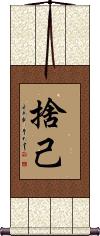
捨己 is a Chinese and Japanese word that means selfless, self-sacrifice (to help others), self-renunciation, or altruism.
Sacrifice / Devotion / Dedication
(complete bodily devotion)
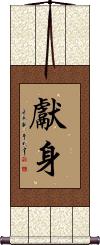
獻身 is used to describe being so devoted to something that you will make sacrifices for that goal/thing/person.
You can also translate this word as any of the following:
Sacrifice one's life for...
To dedicate oneself to...
Self-devotion
Dedication
Devote to...
Self-sacrifice
Giving your whole body to...
This can be a dedication to or for someone but is often used as a dedication or making sacrifices for your country, public service, or a cause. For instance, an Olympic athlete makes great sacrifices to train in his/her sport for their country and compatriots.

 While the form shown to the upper-left is considered an ancient Japanese version, in modern Japan, they use the simplified version of the first Kanji (shown to the right). Click on the Kanji at the right instead of the button above if you want this modern Japanese version.
If you are looking for a more religious meaning of devotion, see Faith.
See Also: Confidence | Dedication
Better to sacrifice your life than your principles
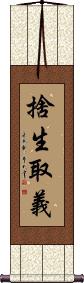
捨生取義 is a Chinese proverb that comes from the philosopher Mencius.
It can be translated in a few different ways:
To give up life for righteousness.
To choose honor over life
Better to sacrifice one's life than one's principles.
Discipline
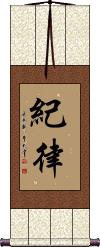
紀律 is a Chinese and Korean word that conveys the idea of extreme self-control and perhaps self-sacrifice, and obedience.
This word matches the kind of “discipline” I was in the Marine Corps. There is also an additional idea of maintaining order or being orderly in your tasks.
This idea would also fit an athlete training for the Olympics who gives up many pleasures to stay focused on their training.
See Also: Self-Control | Will-Power
Bodhisattva
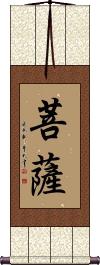
菩薩 is the title of a Buddhist deity that exists to help you reach enlightenment.
In Buddhist beliefs, a bodhisattva (bodhisatta) is dedicated to helping us achieve enlightenment. Bodhisattva means enlightenment truth which is bodhi sattva in Sanskrit.
This term is sometimes used to refer to a kindhearted person, one who will sacrifice himself/herself for others and lacks ego or desire but is instead devoted to the good and well-being of others.
See Also: Buddha | Namo Amitabha
Honorable Death - No Surrender
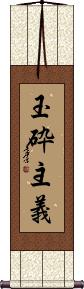
This ancient Japanese proverb can be translated as “The principle of honorable death and no surrender,” or simply “No surrender.”
If you directly translate this, you get something that means “Doctrine of suicide,” or “Ideology of honorable death.”
玉砕主義 is a specifically-Japanese proverb that embraces the long history of honorable suicide or self-sacrifice for honor in Japanese culture.
Daodejing / Tao Te Ching - Chapter 54
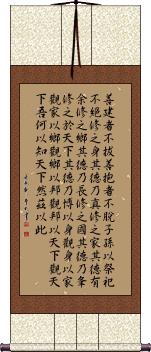
This is the Mawangdui version of Daodejing chapter 54.
By its virtue alone can one generation after another carry on the ancestral sacrifice.
Apply it to yourself, and by its power, you will be freed from dross.
Apply it to your household, and your household shall thereby have abundance.
Apply it to the village, and the village will be made secure.
Apply it to the kingdom, and the kingdom shall thereby be made to flourish.
Apply it to an empire, and the empire shall thereby be extended.
Therefore just as through oneself, one may contemplate Oneself;
So through the household one may contemplate the Household;
And through the village, one may contemplate the Village;
And through the kingdom, one may contemplate the Kingdom;
And through the empire, one may contemplate the Empire.
How do I know that the empire is so? By this.
What is firmly rooted cannot be pulled out;
What is tightly held in the arms will not slip loose;
Through this, the offering of sacrifice by descendants will never come to an end.
Cultivate it in your person, and its virtue will be genuine;
Cultivate it in the family, and its virtue will be more than sufficient;
Cultivate it in the hamlet, and its virtue will endure;
Cultivate it in the state, and its virtue will abound;
Cultivate it in the empire, and its virtue will be pervasive.
Hence look at the person through the person;
Look at the family through the family;
Look at the hamlet through the hamlet;
Look at the state through the state;
Look at the empire through the empire.
How do I know that the empire is like that?
By means of this.
Fatal error: Cannot redeclare function foreignPrice() (previously declared in /home/gwest/web/chinesescrollpainting.com/public_html/includes/currencyconverter.php:22) in /home/gwest/web/orientaloutpost.com/public_html/includes/currencyconverter.php on line 22