Many custom options...


And formats...



Salvation in Chinese / Japanese...
Buy a Salvation calligraphy wall scroll here!
Personalize your custom “Salvation” project by clicking the button next to your favorite “Salvation” title below...
1. Salvation
4. Salvation: To Save or Rescue
5. In the Abyss of Infinite Bitterness - Turn to the Shore
6. Nirvana
7. Gate
Salvation
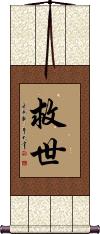
救世 is salvation in Chinese characters and Japanese Kanji.
This can refer to the saving, rescue, or salvation of one's life, the life or lives of others, a generation, an era, or even the whole world. As you can see, this is a rather generic and broad way to say salvation.
Redemption / Salvation

済度 means redemption or salvation in Japanese Kanji.
This is usually used in the context of Japanese Buddhism.
Salvation / Save / Rescue
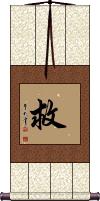
救 is a single character that can mean to save, to assist, to rescue, or imbue salvation.
This can also be a Japanese surname that romanizes as Sukui, Kyuu, or Kyu.
Salvation: To Save or Rescue
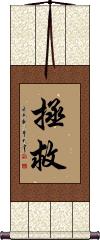
The first character, 拯, means to raise, aid, support, save or rescue.
The second character, 救, has a similar meaning of save, assist or rescue.
Together 拯救 reinforce each other to create a compound word that means salvation or rescue.
In the Abyss of Infinite Bitterness - Turn to the Shore
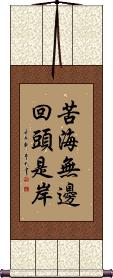
苦海無邊, 回頭是岸 can be translated almost directly as “The sea of bitterness has no bounds, turn your head to see the shore.”
Often this proverb refers to how Buddhist enlightenment can allow one to shed off the abyss of worldly suffering. But it can apply to other religions. If you find yourself trapped in the hardship of this worldly life, take a new turn, and seek a path to salvation.
Nirvana
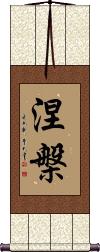
涅槃/涅盤 are the Chinese characters that mean Nirvāṇa. I will let you decide what Nirvana means to you.
This can also be translated as “Buddha's death and salvation” or “death of a Buddhist monk,” depending on the context. However, this is not seen with any bad meaning. You could replace “death” with “moving on,” as that is how it's seen in a Buddhist context.
More info from our dictionary: Nirvana
Gate

門 is the Chinese, Japanese Kanji, and old Korean Hanja for gate, door, gateway, doorway, opening, entrance, valve, or switch.
Most commonly, this is simply a gate or door.
門 is also a Chinese surname that romanizes as Men.
In Japanese, this can be surnames romanizing as Yuki, Mon, To, or Kado.
In the Buddhist context, beyond meaning a door or gate, this can be a counter for a Buddhist sect, teaching, or school (we might say “slice” of bread, this would be a “gate” of teaching). In this way, it kind of refers to one of several doors that lead to salvation or nirvana.
Goddess of Mercy and Compassion
This is the long or more formal version of this title
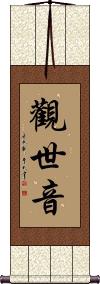
觀世音 is the longer and perhaps more formal title for the Buddhist deity known as the Goddess of Mercy or Bodhisattva of Compassion.
The longer title of this bodhisattva is Romanized in the following ways:
Mandarin Chinese: Guanshi Yin, Kuan-shih Yin.
Japanese: Kanzeon.
Sanskrit: Bodhisattva Avalokitesvara.
Korean: Gwan-se-eum.
Vietnamese: Quan Thế Âm.
Thai: Prah Mae Kuan Eim.
English: Bodhisattva of Mercy and Salvation, Goddess of Compassion, Buddha of Mercy, et al.
Please view our more common and shorter version, “Guan Yin” before you make a decision. Also, note that the first character has a slight variation in Japanese. If your audience is specifically Japanese, you may want to select that version.
Goddess of Mercy and Compassion
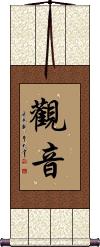
觀音/観音 is the Buddhist deity known as the Goddess of Mercy or Bodhisattva of Compassion.
In Chinese, the proper name of this being is Guan Yin. There is some debate as to whether Guan Yin is female. The argument comes from some scripture that suggests Buddhist deities take on the male form. Others say that Guan Yin has no sex. And still, others are okay with the female representation of Guan Yin.
This bodhisattva is also known or Romanized in the following ways:
Mandarin Chinese: Guan Yin, Kuan Yin, Kwan Yin.
Japanese: Kannon, Kwannon.
Sanskrit: Bodhisattva Avalokitesvara.
Korean: Gwan-eum.
Vietnamese: Quan Âm.
Thai: Kuan Eim.
English: Bodhisattva of Mercy and Salvation, Goddess of Compassion, Buddha of Mercy, et al.
Note: The first character has a slight variation in Japanese. If your audience is specifically Japanese, you may want to select that version.
See Also: Buddhism | Goddess | Namo Amitabha | Bodhisattva
Fatal error: Cannot redeclare foreignPrice() (previously declared in /home/gwest/web/chinesescrollpainting.com/public_html/includes/currencyconverter.php:22) in /home/gwest/web/orientaloutpost.com/public_html/includes/currencyconverter.php on line 22