Many custom options...


And formats...



Sangha in Chinese / Japanese...
Buy a Sangha calligraphy wall scroll here!
Personalize your custom “Sangha” project by clicking the button next to your favorite “Sangha” title below...
Sangha
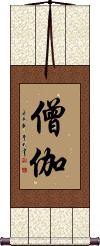
In Buddhism, 僧伽 refers to a community of monks and/or nuns (one of the “Three Jewels”). In general terms, it can simply mean “all followers of the Buddha.”
Notes: Though there are not vast numbers of Chinese Hindus, in the Hindu faith, this term means “community together.”
The original Sanskrit word is also Romanized as samgha.
The first character means “monk.” The second character means Buddha or Shakyamuni.
僧伽 is a transliteration of the original Sanskrit, but it uses two very profound Chinese characters related to Buddhism.
Some may pronounce this as “seng qie” or “seng jia” in Mandarin (two possible pronunciations for the second character). Note that “qie” sounds like “chee-ah” using typical English pronunciation. Chinese Romanization is not actually designed to match English sounds.

 Note that when writing this as Kanji, Japanese will tend to write the first character in the form shown to the right. If you select our Japanese master calligrapher, please expect this special Kanji form. However, it should also be noted that this is not a common term in Japanese (except by certain sects of Buddhism or perhaps devout Buddhists in Japan).
Buddha Dharma Sangha
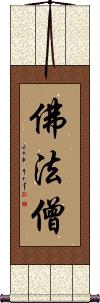
佛法僧 is the Buddha, Dharma, and Saṅgha.
These three characters are the “Triple Gem” of Buddhism or the Buddhist Trinity.
Sangha / Order of Monks
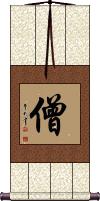
僧 is the single-character or short form of Sangha, the Buddhist idea of community or order (of monks, nuns, or followers of the Buddha).
Alone, this character can simply mean “monk” (Just means monk in Japanese).
Note that when writing this as Kanji, Japanese will tend to write this in the form shown to the right. If you select our Japanese master calligrapher, please expect this special Kanji form.
Sariputra
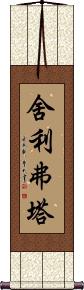
舍利弗塔 is the name Sariputra or Śāriputra in Chinese (Mandarin).
Often written in a shorter form as 舍利弗 (shě lì fú). This name comes from the Sanskrit शारिपुत्र or Śāriputra, and from Pali as Sāriputta.
This name comes from the closest disciple of the Buddha, Śāriputra, who helped establish the legacy of the Sangha (community of monks).
Three Treasures of Buddhism
The Triple Gem
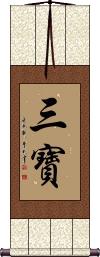
三寶 is the title for “Three Precious Treasures of Buddhism” or “The Triple Gem.”
These three treasures are the Buddha 佛, the Dharma 法 (teachings or the law of the Buddha), and the Sangha 僧 (the community of monks or followers).
This term is used by most (perhaps not all) Buddhists in China, Japan, and South Korea (written the same in the original form but pronounced differently in each language). Non-Buddhists may just read this as “Three Treasures” without the religious context. For instance, there is also a “Three Treasures of Chinese Medicine” that is sometimes titled the same way.
In modern Japanese and Simplified Chinese, this is written 三宝 instead of 三寶.
Fatal error: Cannot redeclare function foreignPrice() (previously declared in /home/gwest/web/chinesescrollpainting.com/public_html/includes/currencyconverter.php:22) in /home/gwest/web/orientaloutpost.com/public_html/includes/currencyconverter.php on line 22