Many custom options...


And formats...



Seeing is Believing in Chinese / Japanese...
Buy a Seeing is Believing calligraphy wall scroll here!
Personalize your custom “Seeing is Believing” project by clicking the button next to your favorite “Seeing is Believing” title below...
Seeing is Believing
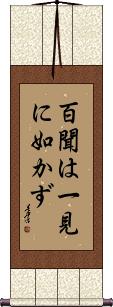
百聞は一見に如かず is the Japanese version of an ancient Chinese proverb that means “Seeing once is better than hearing one hundred times.”
It is the rough equivalent of “seeing is believing,” “one eye-witness is better than many hearsays,” or “a picture is worth a thousand words.”
Sometimes it's simply more prudent to verify with your own eyes.
Note: Because this selection contains some special Japanese Hiragana characters, it should be written by a Japanese calligrapher.
See Also: Hearing a Hundred Times is Not as Good as Seeing Once
Seeing is Believing
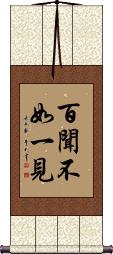
百聞不如一見 is a proverb that means “Better to see something once rather than hear about it one hundred times” or “Telling me about something 100 times is not as good as seeing it once.”
In English, we have the similar proverb of “Seeing is believing” but this has a bit of the “A picture paints a thousand words” meaning too.
Sometimes it's simply more prudent to verify with your own eyes.
Faith
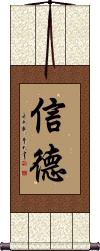
信德 is a term used often in Buddhism to express faith.
信德 is sometimes translated as the merit of the believing heart, faith of virtue, the power of faith, or virtuous faith.
In this context:
信 = Faith
德 = Virtue
Hearing a Hundred Times is Not as Good as Seeing Once
百聞不如一見 is a Chinese proverb that means “Seeing once is better than hearing one hundred times” which is similar to the idea of “Seeing is believing.”
You can also get the idea, “Seeing for oneself is better than hearing from many others.”
If you break it down directly, you get “100 hears/listens (is) not as-good (as) one sight.”
Trust No One / Trust No Man
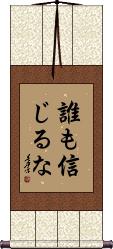
誰も信じるな is as close as you can get to the phrase “trust no man” in Japanese, though no gender is specified.
The first two characters mean everyone or anyone but change to “no one” with the addition of a negative verb.
The third through fifth characters express the idea of believing in, placing trust in, confiding in, or having faith in.
The last character makes the sentence negative (without the last character, this would mean “trust everyone,” with that last character, it's “trust no one”).
Note: Because this selection contains some special Japanese Hiragana characters, it should be written by a Japanese calligrapher.
Zen Buddhism
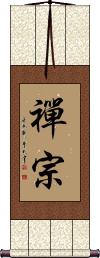
禪宗 is one way to title “Zen Buddhism.” Because the original pronunciation of Zen in Chinese is Chan, you'll also see this expressed as Chan Buddhism.
From the Buddhist Dictionary:
The Chan, meditative or intuitional, sect is usually said to have been established in China by Bodhidharma, the twenty-eighth patriarch, who brought the tradition of the Buddha-mind from India. This sect, believing in direct enlightenment, disregarded ritual and sūtras and depended upon the inner light and personal influence for the propagation of its tenets, founding itself on the esoteric tradition supposed to have been imparted to Kāśyapa by the Buddha, who indicated his meaning by plucking a flower without further explanation. Kāśyapa smiled in apprehension and is supposed to have passed on this mystic method to the patriarchs. The successor of Bodhidharma was 慧可 Huike, and he was succeeded by 僧璨 Sengcan, 道信 Daoxin, 弘忍 Hongren, 慧能 Huineng, and 神秀 Shenxiu, the sect dividing under the two latter into the southern and northern schools: the southern school became prominent, producing 南嶽 Nanyue and 靑原 Qingyuan, the former succeeded by 馬祖 Mazu, the latter by 石頭 Shitou. From Mazu's school arose the five later schools.
Fatal error: Cannot redeclare foreignPrice() (previously declared in /home/gwest/web/chinesescrollpainting.com/public_html/includes/currencyconverter.php:22) in /home/gwest/web/orientaloutpost.com/public_html/includes/currencyconverter.php on line 22