Many custom options...


And formats...



Self-Reliance in Chinese / Japanese...
Buy a Self-Reliance calligraphy wall scroll here!
Personalize your custom “Self-Reliance” project by clicking the button next to your favorite “Self-Reliance” title below...
2. Prideful Mind / Self-Respecting Heart
3. Independence
Self-Reliance
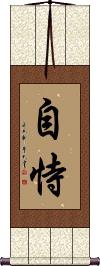
自恃 means self-reliance but is often used to mean self-confidence or the state of being self-assured.
Basically, this means you can rely on yourself (with a slight suggestion that others can rely on you as well).
The first character means “oneself,” while the second means “to rely upon.”
See Also: Confidence | Self-Confidence
Prideful Mind / Self-Respecting Heart
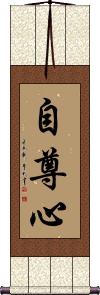
自尊心 is a Japanese and Korean word that means “pride” or “self-respect.”
The first Kanji/Hanja means oneself. The second can mean revered, valuable, precious, noble, or exalted. And the last Kanji/Hanja means heart, mind, and/or spirit.
While these characters make sense and hold the same general meaning in Chinese, this is not a normal Chinese word. This selection should only be used if your audience is Japanese or Korean.
See Also: Respect | Pride | Self-Reliance | Self-Control | Self-Discipline
Independence
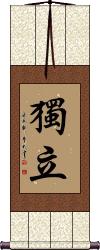
Besides meaning “to be independent,” this can also mean “to stand alone,” self-reliance or self-support.
 Modern Japanese use a simplified version of the first character of independence.
it’s
the same simplified version currently used in mainland China, so understood by most Chinese and all Japanese people. Click on the character to the right if you want the simplified/Japanese version.
Modern Japanese use a simplified version of the first character of independence.
it’s
the same simplified version currently used in mainland China, so understood by most Chinese and all Japanese people. Click on the character to the right if you want the simplified/Japanese version.
Standing by Oneself / Walking by Oneself
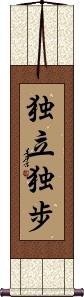
獨立獨步 is a Japanese proverb that, Dokuritsu-Doppo, is an indication of independence, self-reliance, standing on one's own two feet, or making one's way in life.
The Supreme Mahayana Truth
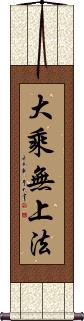
大乘無上法 means the supreme Mahāyāna truth.
This refers to the ultimate reality in contrast with the temporary and apparent. Other translations include “the reliance on the power of the vow of the bodhisattva” or “the peerless great vehicle teaching.”
Note: This may suggest that Mahayana Buddhism, as practiced in China, Japan, Korea, Vietnam, and other regions is superior (with subtle arrogance) to the original Theravada (or old school) Buddhism. Mahayana and Theravada Buddhists generally get along better than Catholics and Protestants, but there have been schisms.
Trust / To Have Faith
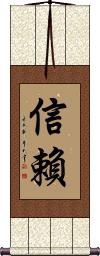
信賴 can also be translated as confidence, reliance, or dependence; thus, it can also mean “to rely on” or “to depend on.”
Trust is having faith in someone or something. It is a positive attitude about life. You are confident that the right thing will happen without trying to control or make it happen. Even when difficult things happen, trust helps us to find the gift or lesson in it.
 There is a slight deviation in the Japanese Kanji form of the second character. If you want the modern Japanese version, please click on the special Kanji shown to the right instead of the button above. Note that the traditional Chinese form is still readable and understood by Japanese people.
See Also: Confidence | Truth | Honor
Fatal error: Cannot redeclare foreignPrice() (previously declared in /home/gwest/web/chinesescrollpainting.com/public_html/includes/currencyconverter.php:22) in /home/gwest/web/orientaloutpost.com/public_html/includes/currencyconverter.php on line 22