Many custom options...


And formats...



Shinto in Chinese / Japanese...
Buy a Shinto calligraphy wall scroll here!
Personalize your custom “Shinto” project by clicking the button next to your favorite “Shinto” title below...
1. Shinto
4. Tenshin Shoden Katori Shinto-ryu
5. Shintai
7. Okami / God
9. Divine Hall / Sacred Temple
10. Tengu
Shinto
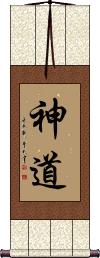
神道 is how to write Shinto, a Japanese national religion.
The meaning is “Way of the Gods.”
This term also has meaning for Chinese Buddhists, where it means the spirit world of devas, asuras, and pretas. It can also be understood as doctrines concerning the soul.
Katori Shinto-ryu
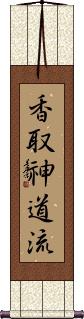
香取神道流 is the Japanese Kanji for the Katori Shintō-ryū martial arts.
Shinto Muso-Ryu
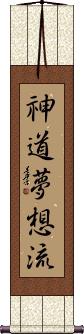
神道夢想流 is Shintō Musō-ryū, or Shindō Musō-ryū.
This is usually used in the context of jōdō, a traditional school of the Japanese martial art of jōjutsu (the art of wielding the short staff).
Tenshin Shoden Katori Shinto-ryu
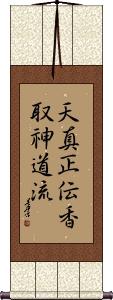
天真正伝香取神道流 is Tenshin Shōden Katori Shintō-ryū, a very old form of Japanese martial arts.
Shintai
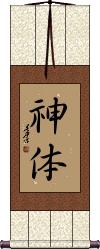
In the context of the Japanese Shinto religion, shintai/shin-tai or 神体 is an object of worship believed to contain the spirit of a deity, typically housed in a shrine.
This may not the the Shintai that you are looking for. This is NOT the Shintai massage technique.
身体 (body/health) and 心体 (heart/mind body) also romanize as Shintai. But I don't know what Saul Goodman is referring to as "light body" though the second character should be 体 which means body.
Makoto no Kokoro

誠の心 or “Makoto no Kokoro” means heart of truth or truthful heart in Japanese.
This concept is often associated with the Shinto religion of Japan.
Okami / God
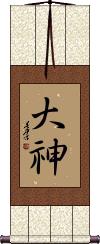
大神 is Okami, an honorific title for God (used in Shinto and other religions).
If you directly translate this, you get something like “Big Spirit” or “Great Spirit.”
There are other titles that romanize as "Okami" in Japanese, so make sure this is the right meaning for you. Another common okami means wolf but is a completely different Kanji and meaning.
Amaterasu Oomikami
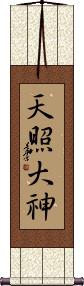
天照大神 is the Japanese Shinto deity often referred to as the Sun Goddess.
The full name is often romanized as Amaterasu Oomikami/Omikami.
Sometimes also written as 天照大御神 (just the addition of 御 near the end) or 天照皇大神 (with 皇 added in the middle).
Divine Hall / Sacred Temple

神殿 means “Divine Hall” or “Sacred Temple.”
Other meanings include “Temple of the Gods” or “Sacred Shrine Hall.”
In the simplest terms, it means temple, shrine, or sanctuary. This can also be a Japanese surname when pronounced as Kodono.
This title has strong religious and spiritual resonance. Commonly seen in Shinto-themed decor, dojo walls, and meditation rooms.
Tengu
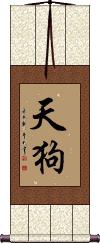
天狗 is the Japanese title for Tengu, which roughly translates as “heavenly dog.”
Tengu is a type of legendary creature found in Japanese folk religion and is also considered a type of Shinto god (kami) or yōkai (supernatural being).
The origin is Chinese, though this term is seldom used in Chinese anymore. It was a dog-like Chinese demon (Tiangou)
Although the title contains the word “dog,” the tengu are often depicted with human and bird-like characteristics. Sometimes they have large noses or beaks like birds.
Safety and Well-Being of the Family
Kanai Anzen
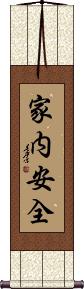
家內安全 is the Japanese way of saying “Family First.”
It's a Japanese proverb about the safety and well-being of your family and/or peace and prosperity in the household.
Some Japanese will hang an amulet in their home with these Kanji. The purpose is to keep your family safe from harm.
According to Shinto followers, hanging this in your home is seen as an invocation to God to always keep family members free from harm.
We were looking for a way to say “family first” in Japanese when this proverb came up in the conversation and research. While it doesn't say “family first,” it shows that the safety and well-being of your family is your first or most important priority. So, this proverb is the most natural way to express the idea that you put your family first.
See Also: Peace and Prosperity
Fatal error: Cannot redeclare foreignPrice() (previously declared in /home/gwest/web/chinesescrollpainting.com/public_html/includes/currencyconverter.php:22) in /home/gwest/web/orientaloutpost.com/public_html/includes/currencyconverter.php on line 22