Many custom options...


And formats...



Simplicity in Chinese / Japanese...
Buy a Simplicity calligraphy wall scroll here!
Personalize your custom “Simplicity” project by clicking the button next to your favorite “Simplicity” title below...
Simplicity
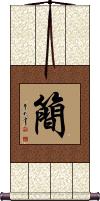
簡 expresses the idea of something simple or the essence of simplicity in life in Chinese.
This can also refer to a simple slip of bamboo for taking notes or writing a letter (especially in Korean Hanja).
Technically this is a word meaning simplicity and brevity in Japanese but it's rarely used in modern Japanese. Therefore, you should probably only select this character if your audience is Chinese.
See Also: Brevity
Tanjun / Simplicity
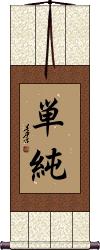
単純 or Tanjun is a Japanese word that means simplicity, simple, and/or uncomplicated.
Do you want to live the “tanjun lifestyle”? Maybe this wall scroll will remind you to uncomplicate your life.
Simplicity / Modesty
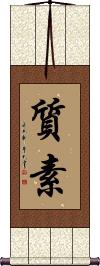
Inner Peace
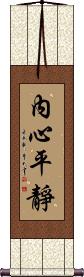
內心平靜 is a Chinese and Japanese phrase that is a direct translation of the western idea of inner peace.
The first two characters contain the idea of “heart,” “innermost being,” or “deep in the/your inner mind.”
The last two characters mean “tranquil” and “serene.”
I have seen this phrase used as “inner peace” for art prints and even on the side of coffee cups. But I think the translation is too literal. It feels like a direct translation from English rather than a nicely composed Chinese or Japanese phrase. See my other entries for “inner peace.”
See Also: Serenity | Simplicity | Peace
Peace / Harmony
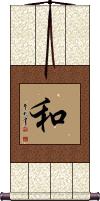
和 is the simplest form of peace and harmony.
和 can also be translated as the peaceful ideas of gentle, mild, kind, and calm. With a more harmonious context, it can be translated as union, together with, on good terms with, or on friendly terms.
Most people would just translate this character as peace and/or harmony. 和 is a very popular character in Asian cultures - you can even call it the “peace symbol” of Asia. In fact, this peace and harmony character was seen repeatedly during the opening ceremony of the 2008 Olympic Games in Beijing (a major theme of the games).
In old Chinese poems and literature, you might see this used as a kind of "and." As in two things summed together. As much as you could say, "the sun and moon," you could say "the sun in harmony with the moon."
See Also: Inner Peace | Patience | Simplicity
Shitsujitsu Goken
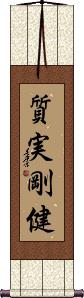
質実剛健 is a Japanese word that can mean “unaffected and sincere, with fortitude and vigor” or “simplicity and fortitude.”
The first two characters, 質実 mean simplicity or the “essence of something.”
The last two, 剛健, mean strength, fortitude, or strong composure.
Wabi Sabi

侘び寂び is Wabi-Sabi, the aesthetic sense in Japanese art emphasizing quiet simplicity and subdued refinement.
侘び represents the beauty to be found in poverty and simplicity, subdued taste, quiet refinement, and sober refinement.
寂び conveys solitude, tranquility, silence, quiet, calm, or stillness.
This is the full four-character version of Wabi-Sabi. There is also an abbreviated version, 侘寂, which you may see in logos or when a Kanji-only version of Wabi-Sabi is desired.
More about this subject at Wikipedia: Wabi Sabi
Note: Because this selection contains some special Japanese Hiragana characters, it should be written by a Japanese calligrapher.
Wabi Sabi
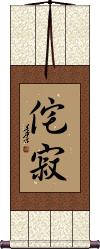
侘寂 is Wabi-Sabi, the aesthetic sense in Japanese art emphasizing quiet simplicity and subdued refinement.
This two-character version is an abbreviation of 侘び寂び, which is the full version of Wabi-Sabi.
More about this subject at Wikipedia: Wabi Sabi
Mysterious
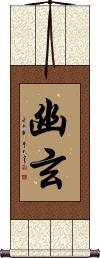
幽玄 is the Chinese, Japanese Kanji, and old Korean Hanja word meaning dim, deep, mysterious, subtle grace, hidden beauty, mysterious profundity, elegant simplicity, or subtle and profound.
This can also be the Japanese personal name Yuugen or Yugen.
Silent / Solitary
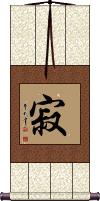
寂 means silent, solitary, quiet, calm, still, rest, or tranquil.
This also has a strong association with Buddhism where it can mean “entering into Nirvana.” In that context, this is sometimes used to refer to the passing of a Buddhist monk (he is silent, as he has entered Nirvana). For the living, this is about tranquility (especially of mind).
Some will also use this to mean “elegant simplicity.”
From Sanskrit, this can represent praśama, vivikta, śānti, or nibbāna (nirvāṇa).
Heijoshin / Presence of Mind
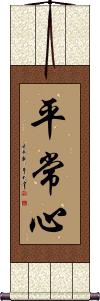
平常心 is the title Heijoshin, as associated with Kendo and Aikido schools of Japanese martial arts.
平常心 is also a word in Japanese that can be translated as “one's self-possession” or “presence of mind.”
In Chinese and Korean, this means “simplicity heart,” “composure,” “calmness,” or a “sense of orderliness.” In Chinese and Korean, this implies that you enjoy what you have, keep your heart in balance, and have no over-blown ambitions.
Tathata / Ultimate Nature of All Things
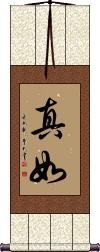
真如 comes from the Sanskrit and Pali word often romanized as “tathata” or “tathatā.” Originally written, “तथता.”
It's a Buddhist term often translated as “thusness” or “suchness,” but this does not explain it.
A better explanation may be “the ultimate nature of all things” or “ultimate truth.” However, this gives it too strong of a feeling. This concept is sometimes described as being in awe of the simple nature of something - like a blade of grass blowing in the wind or ripples on water. It is what it is supposed to be, these things follow their nature. Amazing in their mundane simplicity.
Every sect of Buddhism will have a slightly different flavor or explanation, so don't get fixated on one definition.
Notes: Sometimes Buddhists use the word dharmatā, a synonym to tathatā.
In Japan, this can also be the female given name Mayuki, or the surname Majo.
Fatal error: Cannot redeclare foreignPrice() (previously declared in /home/gwest/web/chinesescrollpainting.com/public_html/includes/currencyconverter.php:22) in /home/gwest/web/orientaloutpost.com/public_html/includes/currencyconverter.php on line 22