Many custom options...


And formats...



Spirit in Chinese / Japanese...
Buy a Spirit calligraphy wall scroll here!
Personalize your custom “Spirit” project by clicking the button next to your favorite “Spirit” title below...
1. Spirit
2. Warrior Soul / Heroic Spirit
3. Warrior Soul / Spirit of a Fighter
10. Free Spirit
11. Divine Spirit
12. Free Spirit
14. Fighting Spirit
16. Beautiful Spirit
17. Body Mind Spirit
18. Fighting Spirit
20. Dragon Spirit
21. Heroic Spirit
22. The Spirit of Dragon and Tiger
23. Dragon Spirit
24. Fighting Spirit
25. Spirit / Soul
28. Goddess of Beauty / Beautiful Spirit
30. Purified Spirit / Enlightened Attitude
31. Heroic Spirit / Great Ambition
33. Esprit de Corps / Team Spirit
34. Advance Bravely / Indomitable Spirit
35. The Spirit of the Dragon Horse
36. Spirit Of The Dragon Martial Arts
37. Old, But More Vigorous in Spirit
38. The Spirit of the Dragon Horse and Power of a Tiger
39. Warrior Essence / Warrior Spirit / Martial
41. Spiritual Strength / Strength of Spirit
42. Independent Spirit / Independent Heart
43. Beautiful Heart / Beautiful Spirit
44. Indomitable Spirit / Indomitable Attitude
Spirit
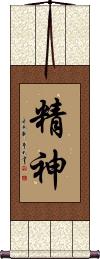
精神 is the kind of spirit you have if you perform well in sports or competitions. It is the idea of having a good attitude and putting your all into something - so much so that others can see or feel your spirit. It is the essence of your being that can only be subjectively described because there are no words that can fully explain what “spirit” really is.
For your information:
My Japanese dictionary further tries to explain this word by comparing it to mind, soul, heart, or intention.
My Chinese dictionary compares these characters to meanings like vigor, vitality, drive, and mentality.
My Korean dictionary defines this as mind, spirit, and soul.
Warrior Soul / Heroic Spirit
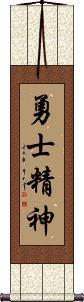
勇士精神 can be translated as the warrior's spirit or warrior's soul. The first two characters can be translated as “warrior” or literally “brave soldier/man,” although some will translate this word as “hero.” Therefore, this is also how to say “heroic spirit.”
The second two characters mean vigor, vitality, drive, spirit, mind, heart, mental essence, and psychological component. Basically “your soul.”
We have two versions of this phrase. The only difference is the first two and last two characters are swapped. The version here suggests that you admire or like the idea of the spirit of a warrior. The other version suggests that you are the warrior or hero.
Warrior Soul / Spirit of a Fighter
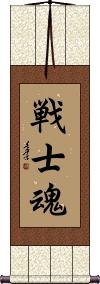
戦士魂 is “warrior soul” or “warrior spirit” in Japanese.
Here's the breakdown of the Kanji:
戦士 (senshi) warrior; soldier; combatant; fighter.
魂 (damashii/tamashii) soul; spirit; can sometimes mean “ghost.”
Mind Body Spirit
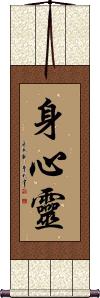
身心靈 is probably the best way to express the idea of “Body, Mind, and Spirit” in Chinese and old Korean Hanja. We are actually using the word “heart” here because, for thousands of years, the heart was thought to be the place where your thoughts, feelings, and emotions came from. We do something similar in the west when we say “warm-hearted” or “I love you with all of my heart.” In this context, heart = mind in Asian language and culture.
The very literal translation of these three characters is “body, heart & spirit,” which could also be interpreted as “body, mind & soul.”
We have arranged these characters in this order because it simply “feels” like the proper order in the Chinese language. Word lists like this are not so common for calligraphy artwork, so we must be careful to put them in the most natural order. It should be noted that this is not a common title in Asia, nor is it considered an actual phrase (as it lacks a clear subject, verb, and object).
 In Japanese Kanji, they use an alternate form of the character for soul or spirit. If you want this using the Japanese alternate, please click on the Kanji shown to the right instead of the button above.
Japanese disclaimer: This is not a natural phrase/list in Japanese. While not totally-natural in Chinese, this word list is best if your audience is Chinese.
Spirit / Spiritual Essence
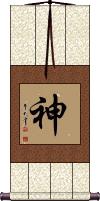
神 is the simplest way to write spirit in Chinese, Japanese Kanji, and old Korean.
This single character alone will conjure up ideas of the spiritual world. 神 can also be translated as “vital awareness” as in the fact that one must know they exist to exist (I think, therefore, I am).
Other translations include:
God, deity, mysterious, divine essence, lively, spiritual being, divinity, supernatural, soul, mind, nerves, and energy. In some extended context, it can mean genius or unusual.
Japanese romanizations vary a lot when this character is combined into other words. However, shin is the original pronunciation taken from Chinese into Japanese. You'll also see it romanized as kami, gami, jin, and a few others, depending on context.
Indomitable Spirit
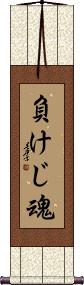
負けじ魂 is a Japanese proverb that means “indomitable spirit” or “unyielding spirit.”
Note: Because this selection contains some special Japanese Hiragana characters, it should be written by a Japanese calligrapher.
Fighting Spirit
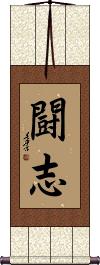
This literally means “fighting spirit” or “the will to fight.”
As in the spirit that a warrior, soldier, athlete, or fighter must possess.
Soul / Spirit
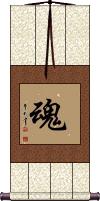
魂 means soul or spirit as in the immortal soul that can be detached from the body.
This can also refer to one's Yang energy or spirit.
In the Buddhist context, this can be the soul, conscious mind, or vijñāna.
Independent Spirit
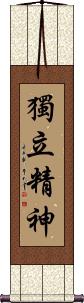
獨立精神 means independent spirit in Chinese.
The first two characters mean independent, independence, or to stand alone.
The last two characters mean spirit, spiritual, vigor, vitality, drive, mind, consciousness, thought, essence, heart, or soul.
With this information, you can make your translation combination such as “independent heart,” “stand-alone spirit,” or more creatively, “the drive to stand alone” in English. There are a lot of ways to interpret 獨立精神.
Free Spirit
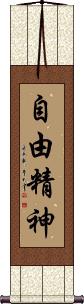
The first two characters mean freedom or liberty.
The second two characters mean spirit, heart, mind, or soul.
Together, 自由精神 is a title that is very similar to the English term “free spirit.”
See Also: Freedom | Independence
Divine Spirit
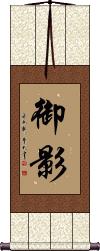
御影 is a Japanese word that means divine spirit or honorific language for “spirit of the dead.”
This can also refer to an image of a deity, buddha, royal, noble, etc.)
In the Buddhist context, it can mean (wooden) images of saints or deities.
御影 is also a Japanese name, Mikage.
Note: This is also a word in Chinese but not used very often in China (except perhaps by certain Buddhists).
Free Spirit
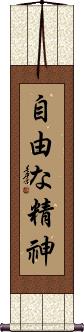
自由な精神 is very similar to the English term “free spirit.”
The first two characters mean freedom or liberty.
The middle character is a connecting Hiragana which is needed for Japanese grammar.
The last two characters mean spirit, heart, mind, or soul.
See Also: Freedom | Independence
Inugami / Dog Spirit
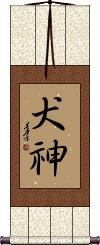
犬神 is the title Inugami, meaning dog spirit or dog god in Japanese.
In some cases, this is an evil spirit of a dog, but it depends on the context.
Fighting Spirit
The Will to Fight
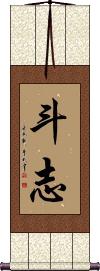
斗志 literally means fighting spirit in Chinese.
As in the spirit that a warrior, soldier, athlete, or fighter must possess.
 Note: There is more than one way to write the first character of this word. It is sometimes written like the version shown to the right (yes, it's completely different but has the same meaning & pronunciation). If you have a preference, please let us know in the special instructions about your order.
Fruit of the Spirit
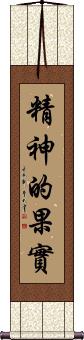
精神的果實 means “Fruit of the Spirit” in Chinese.
Beautiful Spirit
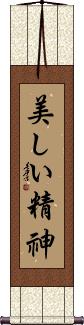
美しい精神 is a common way to write “Beautiful Spirit” in Japanese.
Note: Because this selection contains some special Japanese Hiragana characters, it should be written by a Japanese calligrapher.
Body Mind Spirit
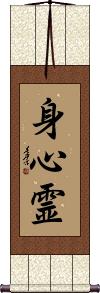
身心霊 means “body mind spirit” in Japanese.
This refers to your physical, mental, and spiritual presence.
This can also be translated as “body heart spirit” as 心 can mean mind or heart.
Note that this is a "word list" and not a proper phrase (with a subject, verb, and object) nor a typical title in Japanese. So it's not too commonly seen in Japan. However, the term 身心霊整合性医療 that refers to holistic medicine is gaining popularity.
Fighting Spirit
Alternate Japanese version
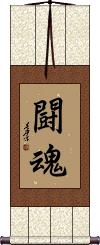
闘魂 is an alternate title with the meaning “fighting spirit” or “the will to fight.”
Courageous Spirit
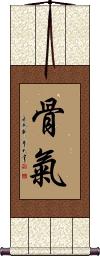
骨氣 is a Chinese title that means “unyielding character,” “courageous spirit,” “integrity,” or “moral backbone.”
Dragon Spirit
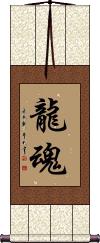
龍魂 means “Dragon Spirit” or “Dragon Ghost.”
Heroic Spirit
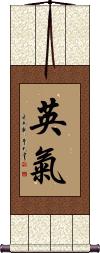
英氣 is a way to write heroic spirit in Chinese.
This may be an arrogant thing to hang on your wall.
The Spirit of Dragon and Tiger
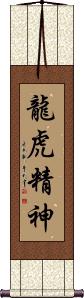
龍虎精神 means the spirit of the dragon and tiger.
It speaks to the vitality and vigor that is the nature of these two creatures.
Beyond “spirit,” the last two characters can also mean mind, soul, or heart. Therefore, you can also say this means “Heart of the Dragon and Tiger,” etc.
龍虎精神 is often titled “Ryukoseishin” in many Japanese martial arts.
Dragon Spirit
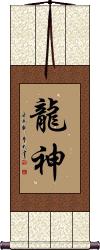
龍神 is a Chinese, Japanese Kanji, and old Korean Hanja title that can mean “dragon god,” “dragon king,” or “dragon spirit.”
In the context of Buddhism, this is one of eight kinds of spiritual beings found in Mahāyāna texts.
Fighting Spirit
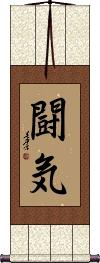
闘気 is an alternate Japanese title for “fighting spirit.”
This one is more like “fighting energy.” The second character is “ki,” the same “ki” in Aikido. This “ki” is the spiritual energy that all martial arts practitioners must master and focus on.
Spirit / Soul
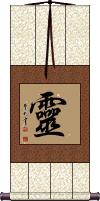
靈 is spirit or soul in Chinese, Japanese Kanji, and old Korean Hanja.
If you look in the dictionary, you'll also find definitions for this character like:
quick; alert; efficacious; effective; departed soul; coffin; spiritual; energy; effective; clever.
There is a modern Japanese version of this character. The button above will get you the traditional/ancient form. But, if you want the modern Japanese, click on the Kanji to the right instead.
Heart / Mind / Spirit
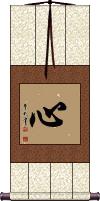
心 would often be translated as “heart.”
However, because it was believed in Chinese culture for thousands of years that your consciousness and thoughts came from the big red organ in the middle of your chest, it also means “mind” or “spirit” and sometimes even “soul.”
In Korean, beyond heart, mind, and spirit, this character can mean moral, nature, mind, affections, intentions, core, and center. In fact, it is used in Chinese to mean “center” as well but only with another character in front of it. For instance, “medical center” or even “shopping center.” Separately and alone, it will not be read with that “center” meaning unless thought of as “the center of your soul.”
Heroic Spirit / Heroism
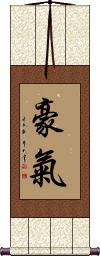
豪氣 is heroic spirit or heroism in Chinese and old Korean Hanja.
This might come across as a bit arrogant to hang on your wall.
Goddess of Beauty / Beautiful Spirit
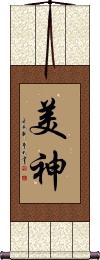
In Chinese, 美神 means Goddess of Beauty.
The first character means beauty or beautiful.
The second character means spirit (can also mean god, goddess, or soul).
Some will use this as a short way to say, “Beautiful Spirit.”
This has a similar meaning in Japanese but is used more often as a female given name in Japan. As a Japanese given name, it can be pronounced Mikami, Mikan, or Binasu.
Indomitable Spirit
Korean Only
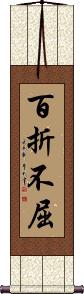
百折不屈 is a Korean proverb that means “indomitable spirit,” at least, that is the way it is commonly translated in martial arts circles (Taekwondo, Hapkido, etc.).
The literal translation is “[one] hundred [times] broken [still] don't succumb.”
Or more naturally translated, “Even if attacked/beaten one hundred times, still be undaunted/indomitable.”
Notes:
Some will say this is one long word rather than a proverb.
This is also a proverb/word in Chinese though rarely used in modern times.
Purified Spirit / Enlightened Attitude
A Japanese martial arts title/concept
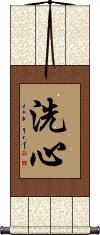
The first Kanji alone means to wash, bathe, primness, cleanse or purify.
The second Kanji means heart, mind, soul, or essence.
Together, these two Kanji create a word defined as “purified spirit” or “enlightened attitude” within Japanese martial arts.
洗心 is one of the five spirits of the warrior (budo) and is often used as a Japanese martial arts tenet. Under that context, it's often defined as a spirit that protects and harmonizes the universe. Senshin is a spirit of compassion that embraces and serves all humanity and whose function is to reconcile discord in the world. It holds all life to be sacred. It is the Buddha mind.
This title will only be familiar to Japanese who practice certain martial arts. Others may not recognize this word at all.
洗心 does not show up as a word in too many Chinese dictionaries, but it can be read and has the same meaning in Chinese.
 There is an issue with the first character. The original, and probably most correct version is shown above. However, many dojo documents and other sources have used a more simple first character. Arguments ensue about which version is correct. If you want to be correct in the Japanese language, use the "Select and Customize" button above. If you want to match the Kanji used by your dojo, click the Kanji shown to the right. There is a slightly different meaning with this first character which means before, ahead, previous, future, precedence.
Heroic Spirit / Great Ambition
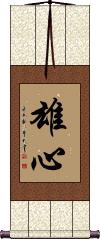
雄心 are the Chinese characters and Japanese Kanji for great ambition, lofty aspiration, or heroic spirit.
Ghost / Soul / Spirit
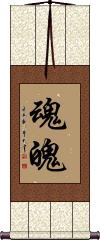
魂魄 is a Chinese, Japanese Kanji, and old Korean Hanja term for ghost, soul, or spirit.
It's used in the context of Buddhism as:
Animus and anima; the spiritual nature or mind, and the animal soul; the two are defined as mind and body or mental and physical, the invisible soul inhabiting the visible body, the former being celestial, the latter terrestrial.
Esprit de Corps / Team Spirit
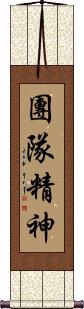
團隊精神 is a Chinese word that can mean “esprit de corps” or “team spirit.”
Other translations include collectivism, teamwork, or solidarity.
Advance Bravely / Indomitable Spirit
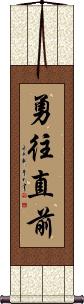
This proverb creates an image of a warrior bravely advancing against an enemy regardless of the odds.
This proverb can also be translated as “indomitable spirit” or “march fearlessly onward.”
See Also: Indomitable | Fortitude
The Spirit of the Dragon Horse
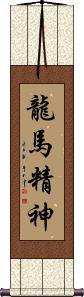
龍馬精神 is an old proverb that is used to wish someone good health and success combined as a great compliment.
The meaning is “The vigor and spirit of the legendary dragon-horse.” These four characters are often accompanied by four more which mean “...and the power and prestige of the tiger.” Here we are just offering the first part which is considered the short version.
By giving a wall scroll like this to someone, you were either wishing or telling them that they have an amazing quality. There is also a suggestion of good health - at least anyone with the vigor of a dragon horse would seem to also be in good health.
Note: In Japanese, this would be read as the spirit of 坂本龍馬 (Sakamoto_Ryōma), a beloved rebel who help abolish the old Japanese feudal system. This can be confusing, so I am declaring this proverb to be Chinese only.
Spirit Of The Dragon Martial Arts
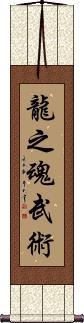
龍之魂武術 is the title Spirit Of The Dragon Martial Arts in Chinese.
This can also be translated as “Dragon Soul Martial Arts.”
Old, But More Vigorous in Spirit
Age is just a number
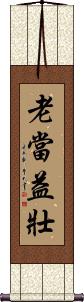
老當益壯 is a Chinese proverb that means “old but vigorous” or “hale and hearty despite the years.”
Said of someone who is more spirited when he/she grows older.
The story behind this Chinese proverb:
In the Eastern Han Dynasty, there was a man named Ma Yuan. He had been planning to herd animals on the frontier since he was young. When he grew up, Ma became a minor official of a county.
Once, he was sending some prisoners to another location. He felt pity for them, so he set them free, and then he fled to another county in the north. He herded animals there, and thus his dream came true. He always said: “If you want to be a great man, the poorer you are, the firmer in spirit you have to be; the older you are, the more spirited you should be.”
Later, when he was even older, Ma Yuan became a famous general of the Eastern Han Dynasty and contributed to many battles.
The Spirit of the Dragon Horse and Power of a Tiger
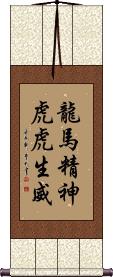
龍馬精神虎虎生威 is an old proverb that is used to wish someone great health and success combined as a great compliment.
The meaning is “The vigor and spirit of the legendary dragon-horse and the power and prestige of the tiger.”
By giving a wall scroll like this to someone, you were either wishing or telling them that they have these qualities. There is also a suggestion of good health - at least anyone with the vigor of a dragon horse would seem to also be in good health.
Warrior Essence / Warrior Spirit / Martial
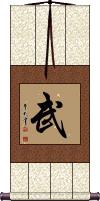
武 is the essence or spirit of a warrior. 武 is part of the word “wu shu” which is sometimes translated as “martial arts” or “kung fu.”
In more modern speech and another context, this can mean military, martial, warlike, fierce, and perhaps violent but usually as a prefix for a longer word or phrase.
Holy Spirit / Holy Ghost
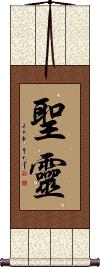
聖靈 is the title for the Holy Spirit or Holy Ghost as used by Jewish, Catholic, and Protestant (and other Christian) Chinese people.
And yes, Chinese Jews do exist, but there are not many of them.
The first character means Holy, Sacred, Saint, or Sage. The second means ghost, spirit, efficacious, or intelligence.
This is valid in Chinese characters and old Korean Hanja. This will be recognized in Japan but see the note below...
In modern Japan, they now use a variant/simplified Kanji of the second character of Holy Spirit. If you want this Japanese version, click on the Kanji to the right instead of the button above.
Spiritual Strength / Strength of Spirit
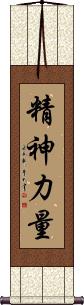
精神力量 is a title that speaks of one's soul or spirit and the capacity or strength that soul possesses.
The first two characters mean mind, heart, spirit, and/or soul.
The last two characters mean strength, capacity, or ability.
Note: Separately, these are two words in Japanese and can be pronounced, but this does not make a natural title in Japanese (best if your audience is Chinese).
Independent Spirit / Independent Heart
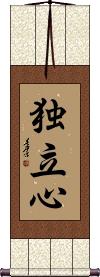
獨立心 means independent spirit or independent heart in Japanese.
The first two characters mean independent or independence. The third character means spirit, heart, or mind.
獨立心 is a Japanese term, although Chinese people could guess the meaning (the characters make sense individually in Chinese but are not often used this way). Also, the first character would be written 獨 in Traditional Chinese versus 独 which is the Simplified Chinese and modern Japanese version.
Beautiful Heart / Beautiful Spirit
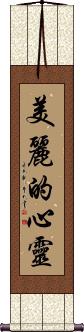
美麗的心靈 means a beautiful heart, a beautiful mind, or a beautiful spirit in Chinese.
Indomitable Spirit / Indomitable Attitude
Fukutsu no Seishin
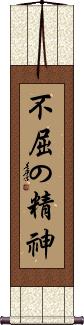
不屈の精神 is one of several versions or ways to write “Indomitable Spirit” in Japanese.
This one is the famous “Fukutsu no Seishin” phrase.
Inner Beauty / Beauty of Spirit
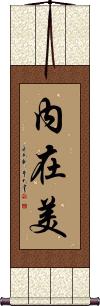
內在美 is a title that speaks of beauty on the inside.
It's not about outward or physical beauty but rather the inner beauty possessed by someone. This can also be translated as “beauty of spirit.”
Inner Beauty / Beauty of Spirit
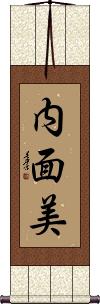
内面美 is a three-character title that speaks of beauty on the inside.
It's not about outward or physical beauty but rather the inner beauty possessed by someone. This can also be translated as “beauty of spirit.”
Wolf Spirit / Soul of a Wolf
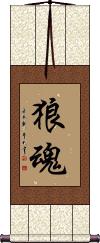
狼魂 means wolf spirit, but is an unusual title in Chinese and Japanese.
Many people have searched for this title, so I added it. The wolf is not usually seen in a positive light in Asian culture, so this may not be the best title to label yourself.
Fatal error: Cannot redeclare foreignPrice() (previously declared in /home/gwest/web/chinesescrollpainting.com/public_html/includes/currencyconverter.php:22) in /home/gwest/web/orientaloutpost.com/public_html/includes/currencyconverter.php on line 22