Many custom options...


And formats...



Strong Minded in Chinese / Japanese...
Buy a Strong Minded calligraphy wall scroll here!
Personalize your custom “Strong Minded” project by clicking the button next to your favorite “Strong Minded” title below...
4. Strong Hearted / Strong Willed
5. Perseverance
7. Determination to Achieve / Will-Power
10. Discipline
11. Self-Control
12. Self-Discipline / Will-Power
13. Well-Disciplined / Orderly
14. Discipline
16. Self-Control
Strong Minded
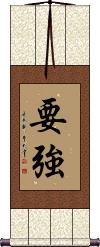
要強 means “strong-minded” in Chinese.
This refers to someone who is or encourages someone to be eager to excel or eager to get ahead in life.
Strong-Minded Woman
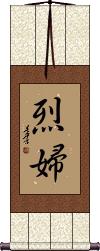
烈婦 is a Japanese title for a strong-minded woman, virtuous woman, or heroin.
In some contexts, it can refer to a pure or chaste woman.
Mental Toughness
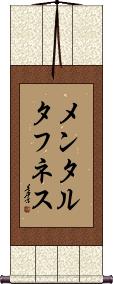
メンタルタフネス is a Japanese Katakana word for mental toughness.
Katakana is a character set used in Japanese to approximate borrowed English or foreign words. So this is supposed to sound like mental toughness does in English.
Note: Because this title is entirely Japanese Katakana, it should be written by a Japanese calligrapher.
Strong Hearted / Strong Willed
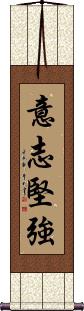
意志堅強 can mean either “strong-hearted,” “strong-willed” or “determination.”
The first two characters can be translated as “will,” “willpower,” “determination,” “volition,” “intention,” or “intent.” But, it should be noted that this first part possesses the element of “heart” in the lower portion of both characters (they also partially carry the meaning “with the whole heart”).
The last two characters mean “strong” or “staunch.”
Chinese word order and grammar are a bit different than English, so in this case, they are in reverse order of English but have the correct meaning in a natural form.
See Also: Strong Willed | Discipline | Will-Power
Perseverance
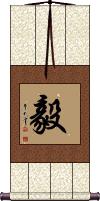
毅 is the simplest way to express perseverance in Chinese and Korean Hanja.
This single-character version leaves a bit of mystery about what kind of perseverance you might want to convey.
In Korean, this is usually associated with “strength of character.”
In Japanese, this character can be pronounced in a dozen different ways (so we have left out the Japanese pronunciation guide that normally appears above). In Japanese, this Kanji would usually be translated as “strong” (perhaps strong-willed).
Perseverance / Will-Power
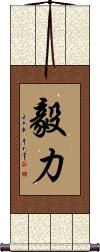
毅力 is a way to express “perseverance” with the idea of “willpower” in Chinese and old Korean Hanja. It can also mean “strong-willed.”
The first character means “strong” and “persistent,” while the second means “strength” and “power.”
Determination to Achieve / Will-Power
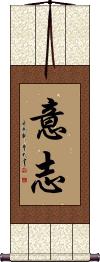
意志 is a Chinese, Korean, and Japanese word that means “determination to achieve.” It can also be translated as: will; willpower; determination; volition; intention; or intent.
In Japanese, this can also be the given name, Ishi.
Will-Power / Self-Control
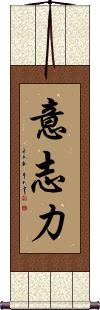
意志力 is a form of willpower or self-control and is about having the determination or tenacity to keep going.
In Japanese, this is the power of will, the strength of will, volition, intention, intent, or determination.
Determination
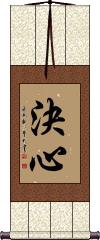
決心 is a Chinese, Japanese, and Korean word that holds the dictionary definition of determination but literally means determined heart.
The first character means to determine or determined.
The second character means heart, mind, or soul, so you can imagine that this form of determination partially means putting your heart into something. It can also be translated as resolve, resolution, or decision (as in a decision made and followed).
See Also: Devotion | Tenacious | Passion | Dedication | Will-Power
Discipline
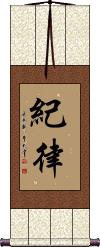
紀律 is a Chinese and Korean word that conveys the idea of extreme self-control and perhaps self-sacrifice, and obedience.
This word matches the kind of “discipline” I was in the Marine Corps. There is also an additional idea of maintaining order or being orderly in your tasks.
This idea would also fit an athlete training for the Olympics who gives up many pleasures to stay focused on their training.
See Also: Self-Control | Will-Power
Discipline
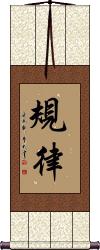
規律 is a Japanese word for discipline that relays the ideas of keeping order, and observance (of rules, laws, regulations).
This is also a word in Chinese and old Korean Hanja where it suggests that you are one who follows a certain law of behavior or has a regular and dependable pattern of behavior, personal regime, or rhythm.
See Also: Self-Control | Will-Power
Self-Control
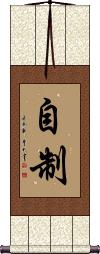
The short and sweet version of self-control.
Note: This can also mean self-restraint.
See Also: Will-Power | Discipline
Self-Discipline / Will-Power
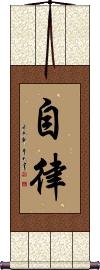
自律 means self-discipline and self-control.
It is doing what you really want to do rather than being tossed around by your feelings like a leaf in the wind. You act instead of reacting. You get things done in an orderly and efficient way. With self-discipline, you take charge of yourself.
Not sure if this one works for a Japanese audience.
See Also: Discipline | Self-Control
Well-Disciplined / Orderly
Special Military Term
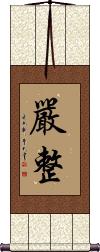
When reading an account of some battles in China, I came across the Chinese word, 嚴整. As it turns out, 嚴整 is only used in military circles to describe neat, orderly, and well-disciplined troops. Perhaps this is actually closer to the meaning I was taught while in the U.S. Marines.
The first character literally means stern, serious, strict, or severe (it can also mean airtight or watertight.
The second character means exact, in good order, whole, complete, and orderly.
Together, these two characters multiply each other into a word that expresses the highest military level of discipline.
See Also: Self-Control | Will-Power
Discipline

鍛練 is the Japanese Kanji and Korean Hanja word used for discipline.
This has a meaning like “forging or creating something from lots of training and practice.” My Japanese dictionary translates this as “tempering, forging, hardening, disciplining, training.”
This is for Japanese and Korean only. In Chinese, these characters might be translated as (physical) “exercise.”


The modern form of the second Japanese Kanji looks like the first image to the right. There’s also an alternate modern form after that, and finally, an alternate traditional form. Because calligraphy is an art, the calligrapher could choose any of these possible forms. Let us know if you have a preference.
See Also: Self-Control | Will-Power
Strength / Vigor / Energy
Physical Strength
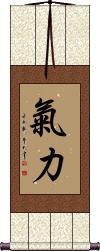
氣力 can mean any of the words in the title above, and in some contexts, can also mean effort, will-power, or talent.
This refers mostly to physical strength (as opposed to mental or spiritual).
 In modern Japan, they use a simplified first character for this word. If you want to order this title with that special Japanese version, click on the character to the right instead of the button above.
Self-Control
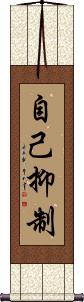
自己抑制 has a meaning like “to restrain oneself” in Chinese, Japanese, and old Korean.
The first two characters mean “regarding oneself,” and the second two mean “to refrain” or “to restrain.”
See Also: Discipline | Will-Power
Discipline / Training / Tempering Character
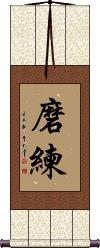
磨鍊 is a form of discipline which suggests training of the mind and character, aimed at producing self-control, obedience, etc.
One of my Chinese-English dictionaries even translates this as “tempering oneself” or turning yourself into hardened steel.
In old Korean Hanja, they use these characters in reverse order but with the same meaning. If you want the Korean version, please click this link instead of the button above: Korean version.
Fatal error: Cannot redeclare foreignPrice() (previously declared in /home/gwest/web/chinesescrollpainting.com/public_html/includes/currencyconverter.php:22) in /home/gwest/web/orientaloutpost.com/public_html/includes/currencyconverter.php on line 22