Many custom options...


And formats...



Student in Chinese / Japanese...
Buy a Student calligraphy wall scroll here!
Personalize your custom “Student” project by clicking the button next to your favorite “Student” title below...
1. Student
3. The Sea of Knowledge Has No Limits
4. River of Literacy, Sea of Learning
5. There is No Royal Road to Learning
6. Confucius: Universal Education
8. Birth / Life
9. Uchi-Deshi
10. Meibukan
11. New Life
13. It is better to be a warrior in a garden than a gardener in a war
Student
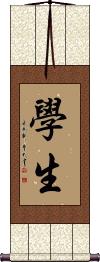
學生 is how to write “student” in Chinese, pre-WWII Japanese Kanji, and old Korean Hanja.
If you are a “student of life,” this might be an interesting wall scroll to hang in your reading room.
The first character means “study” or “learning.”
The second character means “life” or “birth.” Don't read too much into that second character unless you decide that this means “the birth of studies” or “the life of learning.” Everyone in China, Japan (and those who can read Hanja in Korea) will just read this word with the meaning of “student.”
If you put the character for “little” in front of this word, it becomes “elementary school student.” Prefixed with “middle,” it becomes “middle school student.” Prefixed with “big,” it becomes “university student” (though when these two characters for student are seen alone, it often suggests “university student”). The term “high school student” is written differently.
 There is a very common simplified version of the first character for this word. You will see this form in modern Japan and mainland China, Singapore, and other places. If you want this simplified version, please click on the character shown to the right instead of the "select and customize" button above.
Always with a Book in Hand
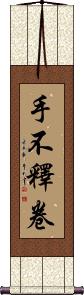
手不釋卷 is a Chinese proverb that literally means “always with a book in hand.”
It's a proverb said of a hardworking scholar or student.
This may refer to a student or scholar who is diligent and hardworking. It's a great gift for a student or scholar who loves books.
The Sea of Knowledge Has No Limits
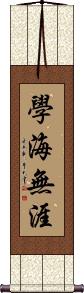
學海無涯 is a Chinese proverb that reads, “sea of learning, no horizon.”
Colloquially, it means there are no limits to what one still has left to learn.
This would be the Chinese equivalent to the quote from Hippocrates, “ars longa, vita brevis,” meaning “it takes a long time to acquire and perfect one's expertise.”
See Also: Learning is Eternal
River of Literacy, Sea of Learning
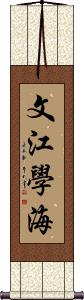
文江學海 is a Chinese proverb that reads, “river of literacy, a sea of learning”
This suggests that there is a lot to learn in the world, with an eternal amount of reading and things to study.
文江學海 is one way to translate the quote from Hippocrates, “ars longa, vita brevis,” meaning “it takes a long time to acquire and perfect one's expertise.”
See Also: Learning is Eternal
There is No Royal Road to Learning
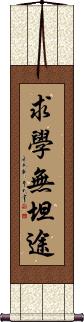
求學無坦途 is a Chinese proverb that translates as “There is no royal road to learning.”
This suggests that the path of learning can never be smooth, there will be difficulties and troubles along the way.
See Also: Learning is Eternal
Confucius: Universal Education
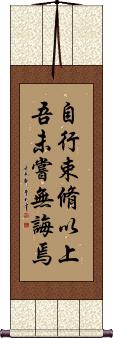
自行束脩以上吾未尝无诲焉 means, for anyone who brings even the smallest token of appreciation, I have yet to refuse instruction.
Another way to put it is: If a student (or potential student) shows just an ounce of interest, desire, or appreciation for the opportunity to learn, a teacher should offer a pound of knowledge.
This quote is from the Analects of Confucius.
This was written over 2500 years ago. The composition is in ancient Chinese grammar and phrasing. A modern Chinese person would need a background in Chinese literature to understand this without the aid of a reference.
Kyousei / Kyōsei
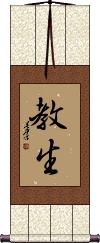
教生 is a Japanese name that can be romanized as Norio, Kyousei, or Atsuo.
These Kanji are sometimes an abbreviation for “student teacher.”
Birth / Life
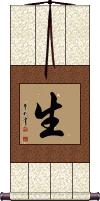
生 is a Chinese word that means “to be born” and “to give birth.”
Also, it's often used to refer to life itself, and sometimes “to grow.”
生 is used in a lot of compound words such as “yi sheng,” which means “doctor” (literally “healer of life”), “sheng ri” which means “birthday” (literally “birth-day”), and “xue sheng” which means student (literally “studying life” or “learner [about] life”). Few Chinese people will think of the literal meaning when this uses words like doctor and student - but it is interesting to note.
生 has the same root meaning in Korean Hanja and Japanese. However, in Japanese, there are many possible pronunciations, and this can be used to mean “raw” or “unprocessed” (as in draft beer). Therefore, not be the best if your audience is Japanese.
See Also: Vitality
Uchi-Deshi

内弟子 is a Japanese term for a live-in student, pupil, or apprentice.
In the context of martial arts, it is an apprentice who trains under and assists a sensei on a full-time basis.
Meibukan
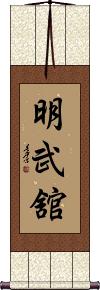
Meibukan (明武舘) is a branch of Gōjū-ryū karate. It was created by Meitoku Yagi, a student of Goju-ryu's founder, Chojun Miyagi. Meibukan means "House of the pure-minded warrior."
New Life
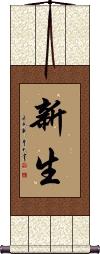
新生 literally means “new life” or “new birth” in Chinese, Japanese Kanji, and old Korean Hanja.
Depending on the context, this word can also mean newborn, new student, rebirth, new birth, or nascent.
In Japanese, this can be the given name Wakaki.
Note: This is not the most common word selection for a calligraphy wall scroll. But if you’re a westerner, you can bend the rules a bit.
Daito-Ryu Aiki-jujutsu
School of Japanese Martial Arts
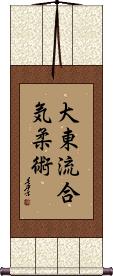
大東流合気柔術 is Daitō-Ryū Aiki-jūjutsu, a Japanese martial art established by Takeda Sōkaku.
The most famous student of Daitō-Ryū Aiki-jūjutsu is Morihei Ueshiba who later founded the school or branch of martial arts known as Aikido.
Note: 大東流合気柔術 can also be romanized as Daito-ryu Aiki-Jujutsu, Daitou-Ryuu Aiki-Juujutsu or Daito-Ryu Aiki-Jujitsu.
It is better to be a warrior in a garden than a gardener in a war
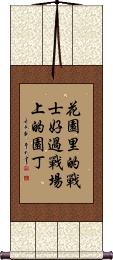
花園里的戰士好過戰場上的園丁 is the Chinese for the phrase, “It is better to be a warrior in a garden than a gardener in a war.”
This proverb is purported to come from the following exchange:
A student approaches his samurai master and says,
“Teacher, you instruct me how to fight, yet you preach to me about peace. How do I reconcile the two?”
The samurai responds,
“Because it is better to be a warrior in a garden than a gardener in a war.”
Ronin / Masterless Samurai
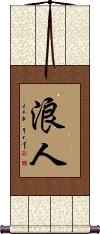
The 浪人 or Ronin have no master - The most famous are the 47 ronin created after their Lord committed suicide. This term was not a positive title for the Samurai of ancient Japan. However, in recent years, movies and video games have glorified the term Ronin.
In Chinese, this term has the original meaning of a hobo, vagabond, or ruffian.
In Korean Hanja, these characters would be read as adventurer, wanderer, someone without a steady job, or someone who is wasting away time.
In modern Japan, this term is used as a nickname for a high school student who has failed a college entry exam (and is trying again).
In Chinese and Korean, the Japanese definition of “Masterless Samurai” is known because of the historical context. Even in Japanese, the literal translation is closer to the Chinese and Korean definitions shown above.
This will make a fine wall scroll if you are a fan of the Ronin or see yourself as a Ronin of sorts. However, please think twice before getting a Ronin tattoo!
Shorinji Kempo / Kenpo
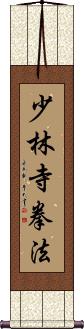
少林寺拳法 is a specific type of martial art in Japan that claims origins in the Kung Fu practiced in the original Shaolin Monastery of China.
The first three characters mean “Shaolin Monastery,” and you might notice the Japanese is pronounced in a very similar way. The reason is, many words were “borrowed” from the original Chinese when Japan did not have a written language and simply absorbed Chinese characters into their language around the 5th century. When a Japanese word did not exist, the Chinese pronunciation was often absorbed as well as the written form.
The last two characters mean “fist law” or “method of the fist.” It has long been argued as to whether the Japanese for these characters should be Romanized as “kempo” or “kenpo.” The official method should be “kenpou” but it's common to drop the “u” that comes after the “o.”
I imagine if you are looking for this title, you already know what it means, so the above is simply extra information that a student of Shorinji Kempo might want to know.
Fatal error: Cannot redeclare foreignPrice() (previously declared in /home/gwest/web/chinesescrollpainting.com/public_html/includes/currencyconverter.php:22) in /home/gwest/web/orientaloutpost.com/public_html/includes/currencyconverter.php on line 22