Many custom options...


And formats...



Taekwondo in Chinese / Japanese...
Buy a Taekwondo calligraphy wall scroll here!
Personalize your custom “Taekwondo” project by clicking the button next to your favorite “Taekwondo” title below...
1. Taekwondo
4. Taekwondo Tenets / Spirit of Taekwon-do
7. Self-Restraint / Self-Control
8. Sense of Shame / Sense of Honor / Integrity / Modesty
Taekwondo
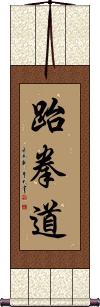
跆拳道 is one of the most widespread types of martial arts in the world as well as being an Olympic sport. Taekwondo was born in Korea with influences of Chinese and Japanese styles combined with traditional Korean combat skills. Some will define it as the “Korean art of empty-handed self-defense.”
In the simplest translation, the first character means “kick,” the second character can mean either “fist” or “punching,” and the third means “way” or “method.” Altogether, you could say this is the “Kick Punch Method.” When heard or read in various Asian languages, all will automatically think of this famous Korean martial art. It is written the same in Japanese Kanji, Chinese, and Korean Hanja characters - so the appearance of the characters is universal. However, you should note that there is another way to write this in modern Korean Hangul characters, which looks like the image to the right. 
We suggest the original Korean Hanja (Chinese characters) for a wall scroll, but if you need the Hangul version, you must use master calligrapher Cao Bin: Order Taekwondo in Korean Hangul
Note: Taekwondo is sometimes Romanized as Tae-Kwondo, Tae Kwon Do, Taekwon-do, Taegwondo, Tae Gweon Do, Tai Kwon Do, Taikwondo, Taekwando, Tae Kwan Do and in Chinese Taiquandao, Tai Quan Dao, Taichuando, or Tai Chuan Tao.
Spirit of Taekwondo
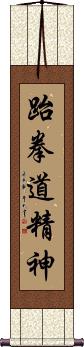
跆拳道精神 means “Taekwondo Spirit” or “The Spirit of Taekwondo.”
跆拳道精神 is the title of General Choi's calligraphy often referred to as “The Tenets of Taekwon-do.”
Songahm Taekwondo
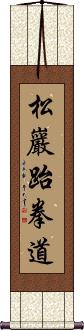
松巖跆拳道 is the title Songahm Taekwondo.
If you want this written in Korean Hangul instead of Hanja, click on the Hangul characters below the Korean flag above.
Note, Songahm is usually written in Hanja as 松巖. However, in Traditional Chinese, it would be 鬆巖, and in modern Japanese, it can be 松岩 (but not known in this context - I think it's a small train station and place in Japan).
Technically, all of these can also be Korean Hanja so that you might see these variations in use. If you need a version other than 松巖, just let me know when you order.
Taekwondo Tenets / Spirit of Taekwon-do
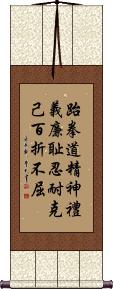
跆拳道精神禮義廉耻忍耐克己百折不屈 is General Choi's writing that is often called “The Tenets of Taekwon-do.”

The actual title would be translated as “Taekwondo Spirit” or “The Spirit of Taekwondo.” It was originally written in Korean Hanja (Chinese characters used in Korea for about 1600 years).
General Choi's original calligraphy is shown to the right. Your custom calligraphy will be unique, and not an exact match, as each calligrapher has their own style.In modern times, the common form of written Korean is Hangul (a phonetic character set). The table below shows the text in Hangul and Hanja along with a pronunciation guide and a brief English translation:
| Traditional Korean Hanja | Modern Korean Hangul | Pronunciation | English |
| 跆拳道精神 | 태권도정신 | tae gweon do jeong sin | Taekwondo Spirit |
| 禮儀 | 예의 | ye yi | Courtesy / Etiquette / Propriety / Decorum / Formality |
| 廉耻 | 염치 | yeom ci | Integrity / Sense of Honor |
| 忍耐 | 인내 | in nae | Patience / Perseverance / Endurance |
| 克己 | 극기 | geug gi | Self-Control / Self-Denial / Self-Abnegation |
| 百折不屈 | 백절불굴 | baeg jeor bur gur | Indomitable Spirit (Undaunted even after repeated attacks from the opponent) |
| Note that the pronunciation is the official version now used in South Korea. However, it is different than what you may be used to. For instance, “Taekwon-do” is “tae gweon do.” This new romanization is supposed to be closer to actual Korean pronunciation. | |||
Ch'ang Hon Taekwondo
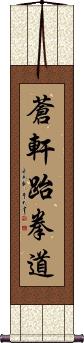
蒼軒跆拳道 is the title “Chang Hon Taekwon-Do” written in old Korean Hanja.
This literally means “Pale Blue Kick Fist/Punch Way.”
The rather awkward official romanization is “cang heon tae gweon do.”
Occasionally, you will see the first Hanja character written as 苍 instead of 蒼. it’s just a different way to write the same character. If you want 苍 instead of 蒼, just let me know.
Korean CKD Virtues
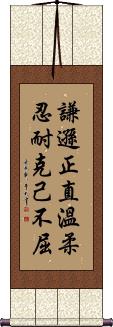
谦逊正直温柔忍耐克己不屈 are the virtues used by Choi Kwang Do Martial Arts.
| English | Hanja | Hangul | Pronunciation |
| 1. Humility (Humble / Modesty) | 謙遜 | 겸손 | gyeom son |
| 2. Honesty (Integrity) | 正直 | 정직 | jeong jig |
| 3. Gentleness | 溫柔 | 온유 | on yu |
| 4. Perseverance (To Endure) | 忍耐 | 인내 | in nae |
| 5. Self-Control (Self-Restraint) | 克己 | 극기 | geug gi |
| 6. Unbreakable Spirit (Unyielding / Unbending) | 不屈 | 불굴 | bur gur |
The characters shown here are in the ancient Korean Hanja form of writing. If you wish for a Korean Hangul form of these tenets, we can arrange that with our Master Calligrapher Xing An-Ping (click on the Hangul next to the South Korean flag above to order this in Hangul).
Self-Restraint / Self-Control
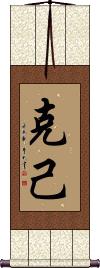
克己 can be translated as “self-denial,” “self-abnegation,” “self-restraint,” “self-discipline,” “self-mastery,” or selflessness.
As a tenet of Korean taekwondo, and other martial arts, this is often used with the title “self-control.”
Sense of Shame / Sense of Honor / Integrity / Modesty (Korean)
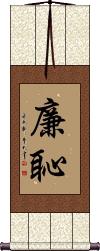
廉恥 simultaneously means “sense of honor” and “sense of shame” in Korean.
This term is often used as a tenet of Taekwondo, where the English terms “integrity” and “modesty” are applied.
廉恥 is also a Chinese word, though it is usually read with the “sense of shame” meaning, and is a poor choice for a wall scroll if your audience is Chinese.
Patience / Perseverance / To Endure / Tolerant
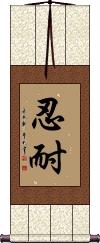
忍耐 is patience, the quiet hope, and trust that things will turn out right.
You wait without complaining. You are tolerant and accepting of difficulties and mistakes. You picture the end in the beginning and persevere to meet your goals.
忍耐 can also mean “to endure,” “restrain oneself,” or “forbearance,” and in some contexts, it can mean “perseverance” or “endurance.”
忍耐 is also used as a tenet of Taekwondo, Tang Soo Do, and other Korean martial arts where it's titled “Endurance” and romanized as “In Neh.”
 Note that when writing this as Kanji, Japanese will tend to write the first character in the form shown to the right. If you select our Japanese master calligrapher, please expect this Kanji form (yes,
it’s
just one stroke that is slightly different in location, crossing another stroke in the Japanese Kanji form).
Note that when writing this as Kanji, Japanese will tend to write the first character in the form shown to the right. If you select our Japanese master calligrapher, please expect this Kanji form (yes,
it’s
just one stroke that is slightly different in location, crossing another stroke in the Japanese Kanji form).
See Also: Peace | Harmony | Perseverance
Indomitable Spirit
Korean Only
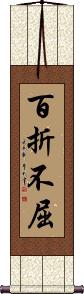
百折不屈 is a Korean proverb that means “indomitable spirit,” at least, that is the way it is commonly translated in martial arts circles (Taekwondo, Hapkido, etc.).
The literal translation is “[one] hundred [times] broken [still] don't succumb.”
Or more naturally translated, “Even if attacked/beaten one hundred times, still be undaunted/indomitable.”
Notes:
Some will say this is one long word rather than a proverb.
This is also a proverb/word in Chinese though rarely used in modern times.
Martial Arts / Wushu
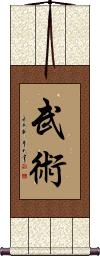
武術 is Wushu or Wu Shu, the very Chinese way to express “Martial Arts.”
Some even use this word to describe Kung Fu directly. But this is a label that fits all disciplines from Karate to Kung Fu to Taekwondo.
Note: This also means Martial Arts with the same appearance as old Korean Hanja characters and is pronounced “musul” or “musur” in Korean.
While this is best if your audience is Chinese or Korean, this also means “martial arts” in Japanese, where the popularity of this term is growing (romanized as Bujutsu or Bujitsu) in Japanese martial arts circles.
Tang Soo Do Tenets
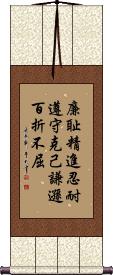
廉耻精進忍耐遵守克己謙遜百折不屈 are the tenets of Tang Soo Do.
| English | Old Hanja | Modern Hangul | Pronunciation |
| 1. Integrity | 廉耻 | 렴치 or 염치 | yeom ci |
| 2. Concentration | 精進 | 정진 | jeong jin |
| 3. Perseverance | 忍耐 | 인내 | in nae |
| 4. Respect & Obedience | 遵守 | 준수 | jun su |
| 5. Self-Control | 克己 | 극기 | geug gi |
| 6. Humility | 謙遜 | 겸손 | gyeom son |
| 7. Indomitable Spirit | 百折不屈 | 백절불굴 | baeg jeor bur gur |
After some research, it appears this list was compiled in English based on Taekwondo tenets. We filled in a few of the words that did not have a corresponding Hanja or Hangul. If someone else has a better list with characters included, please contact me.
Justice / Rectitude / Right Decision
Also means: honor loyalty morality righteousness
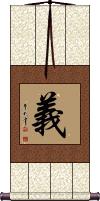
義 is about doing the right thing or making the right decision, not because it's easy but because it's ethically and morally correct.
No matter the outcome or result, one does not lose face if tempering proper justice.
義 can also be defined as righteousness, justice, morality, honor, or “right conduct.” In a more expanded definition, it can mean loyalty to friends, loyalty to the public good, or patriotism. This idea of loyalty and friendship comes from the fact that you will treat those you are loyal to with morality and justice.
義 is also one of the five tenets of Confucius's doctrine.
 There's also an alternate version of this character sometimes seen in Bushido or Korean Taekwondo tenets. It's just the addition of a radical on the left side of the character. If you want this version, click on the image to the right instead of the button above.
This is also a virtue of the Samurai Warrior
See our page with just Code of the Samurai / Bushido here
See Also: Judgment | Impartial | Confucius Tenets
Fatal error: Cannot redeclare foreignPrice() (previously declared in /home/gwest/web/chinesescrollpainting.com/public_html/includes/currencyconverter.php:22) in /home/gwest/web/orientaloutpost.com/public_html/includes/currencyconverter.php on line 22